


Vitamin A Supportive
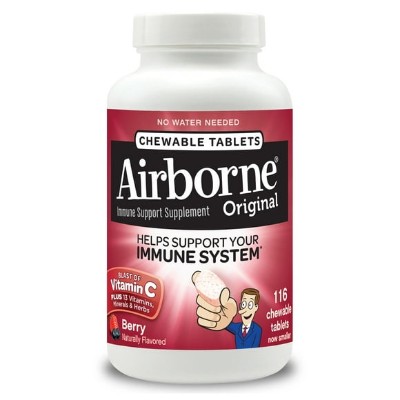
$23.45 $0.80 per serving
Product analysis
Airborne Original Very Berry is a chewable immune-support supplement providing 1,000 mg of vitamin C, 8 mg of zinc and 600 mcg of vitamin A per four tablets. These nutrients contribute to normal immune function, but the individual amounts in the small 35.5 mg herbal blend are undisclosed, so its added benefit is unclear.
AI assessment of the formula, label and price. How scoring works
Nutrient Quality31
The vitamin C sources are clearly named, but their proportions are unknown. Synthetic vitamin E and the oxide and sulfate forms of magnesium make the ingredient forms more mixed.
Ingredient Transparency69
All 11 listed ingredient amounts are given and seven forms are identified. The herbal blend and other unspecified source compositions prevent a full breakdown of individual ingredient amounts.
Value For Money31
Vitamin C supplies a substantial amount, although the formula is comparatively pricey as a vitamin C source. Manganese and sodium compare more favorably, but they are less relevant to the immune purpose.
Customer Satisfaction75
Customer feedback averages 4.8 out of 5. Hundreds of ratings give the feedback a reasonable base.
Product Focus35
The formula is primarily focused on immune nutrition with vitamin C and zinc. The undivided herbal blend prevents a complete count of individual actives and makes its additional role unclear.
- Format
Tablet - Container
- 116 Tablet(s)
- Per serving
- $0.80
- Also available
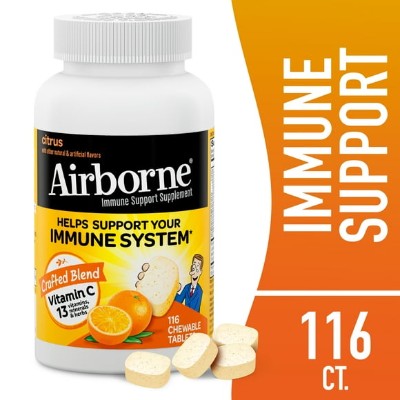 Airborne Original Citrus$21.99
- Customer rating
- 4.8 · 190 ratings
Goals

Impact
Highest effect
Magnesium · 40 mgVitamin C · 1000 mgZinc · 8 mgVitamin A · 600 mcgSelenium · 15 mcg
Airborne Original Very Berry is led by 1,000 mg of vitamin C, with smaller amounts of zinc and vitamin A supporting normal immune function. Vitamin C helps immune cells function and provides antioxidant protection, with modest regular-use support for shorter colds. The 8 mg of zinc supports immune-cell regulation, while 600 mcg RAE of vitamin A contributes to the barriers that help defend the body.
Zinc Supportive
Vitamin C Supportive
Selenium Mixed
Vitamin E Supportive
Magnesium Supportive

Impact
High effect
Magnesium · 40 mgSelenium · 15 mcgZinc · 8 mgVitamin C · 1000 mg
Airborne Original Very Berry offers focused antioxidant and immune nutrition when dietary intake is inadequate. Vitamin C at 1,000 mg supplies the leading contribution, with 8 mg of zinc supporting the same normal functions.
Magnesium Supportive
Selenium Supportive
Zinc Supportive
Vitamin C Supportive
Impact
High effect
Zinc · 8 mgVitamin C · 1000 mgSelenium · 15 mcgVitamin E · 13.5 mg
Airborne Original Very Berry offers nutritional support for skin when vitamin C or zinc intake is inadequate. Vitamin C at 1000 mg supports collagen formation and wound healing impaired by deficiency. Zinc at 8 mg provides additional nutritional support for skin repair.
Vitamin A Supportive
Zinc Supportive
Vitamin C Supportive
Vitamin E Supportive
Selenium Supportive

Impact
High effect
Vitamin E · 13.5 mgVitamin C · 1000 mg
Airborne Original Very Berry offers antioxidant support with a limited fit for broad inflammation relief. Vitamin C at 1,000 mg drives that connection, with the supplied inflammatory-marker signal limited to people starting with elevated markers. Zinc at 8 mg supports nutrient sufficiency when intake is inadequate; the other assessed nutrient amounts add little to this goal.
Zinc Supportive
Vitamin C Supportive
Magnesium Supportive
Selenium Supportive
Vitamin E Supportive

Impact
High effect
Zinc · 8 mgVitamin E · 13.5 mgVitamin C · 1000 mgVitamin A · 600 mcg
Airborne Original Very Berry has a limited eye-health fit, mainly through its 1000 mg of vitamin C for retinal and lens antioxidant support. Vitamin A at 600 mcg supports the visual cycle when intake is inadequate, so its value depends on a dietary gap.
Vitamin A Supportive
Zinc Supportive
Vitamin E Disputed
Vitamin C Disputed
Selenium Supportive
Ingredients
| Ingredient | Amount per serving | Score |
|---|---|---|
Calories | 15 Calorie(s) | |
Total Carbohydrate | 3 Gram(s) | |
Vitamin A (Retinyl Acetate) | 600 mcg | |
Vitamin C (Ascorbic Acid, Sodium Ascorbate) | 1000 mg | |
Vitamin E (DL-Alpha-Tocopheryl Acetate) | 13.5 mg | |
Magnesium (Magnesium Oxide, Magnesium Sulfate) | 40 mg | |
Zinc (Zinc Sulfate) | 8 mg | |
Selenium (Selenium Amino Acid Chelate) | 15 mcg | |
Manganese (Manganese Gluconate) | 3 mg | |
Sodium | 40 mg | |
Proprietary Herbal Blend | 35.5 mg |
Manganese (Manganese Gluconate) · 3 mg OverallScore80
Airborne Airborne Original Very Berry is a reasonable manganese choice: each serving supplies 3 mg, an amount suited to nutritional maintenance. Manganese gluconate is a readily soluble organic salt. At $0.51 per 2 mg of manganese, it offers moderate value; the full formula costs $0.77 per serving.
Vitamin C (Ascorbic Acid, Sodium Ascorbate) · 1000 mg OverallScore58
Airborne Airborne Original Very Berry is poor value for vitamin C at $0.77 per 1,000 mg of vitamin C, which is also the price per serving. 1000 mg per serving provides a substantial amount. The vitamin C comes from Ascorbic Acid, Sodium Ascorbate, with proportions undisclosed. The mineral ascorbate form is buffered, but the effect of the full mixture is uncertain. Sweeteners are included.
Alternative products
Report alternatives
Sources
Published studies used for the product analysis and the top-ranked studies for each ingredient and goal.
- Perioperative systemic magnesium to minimize postoperative pain: a meta-analysis of randomized controlled trials.
- Long-term outcome after intravenous magnesium sulphate in suspected acute myocardial infarction: the second Leicester Intravenous Magnesium Intervention Trial (LIMIT-2).
- Association of magnesium sulfate use with mortality in critically ill patients with sepsis: a retrospective propensity score-matched cohort study.
- Hypomagnesemia and Mortality in Incident Hemodialysis Patients.
- The effects of magnesium supplementation on abnormal uterine bleeding, alopecia, quality of life, and acne in women with polycystic ovary syndrome: a randomized clinical trial.
- Associations of selenium status with all-cause and cause-specific mortality: a systematic review and meta-analysis of cohort studies.
- Dietary Antioxidants, Circulating Antioxidant Concentrations, Total Antioxidant Capacity, and Risk of All-Cause Mortality: A Systematic Review and Dose-Response Meta-Analysis of Prospective Observational Studies.
- The efficacy and safety of selenium supplementation versus placebo in the treatment of Graves' orbitopathy: A systematic review and meta-analysis of randomised controlled trials.
- Associations of plasma metal concentrations with the risks of all-cause and cardiovascular disease mortality in Chinese adults.
- Updates on clinical studies of selenium supplementation in radiotherapy.
- Dietary intake and blood concentrations of antioxidants and the risk of cardiovascular disease, total cancer, and all-cause mortality: a systematic review and dose-response meta-analysis of prospective studies.
- Scientific Opinion on the substantiation of a health claim related to vitamin C and increasing non haem iron absorption pursuant to Article 14 of Regulation (EC) No 1924/2006.
- Vitamin C Depletion and All-Cause Mortality in Renal Transplant Recipients.
- Associations of Serum Biomarkers of Fruit and Vegetable Intake With the Risk of Cause-Specific Mortality and All-Cause Mortality: A National Prospective Cohort Study.
- Relation between plasma ascorbic acid and mortality in men and women in EPIC-Norfolk prospective study: a prospective population study. European Prospective Investigation into Cancer and Nutrition.
- Effectiveness of sodium bicarbonate and zinc chloride mouthwashes in the treatment of oral mucositis and quality of life in patients with cancer under chemotherapy.
- Zinc supplementation in young children with acute diarrhea in India.
- Associations of mortality with ocular disorders and an intervention of high-dose antioxidants and zinc in the Age-Related Eye Disease Study: AREDS Report No. 13.
- Effects of zinc and probiotic co-supplementation on inflammation, gastrointestinal symptoms, quality of life, and mood in irritable bowel syndrome patients.
- Effect of zinc sulfate supplementation on premenstrual syndrome and health-related quality of life: Clinical randomized controlled trial.