
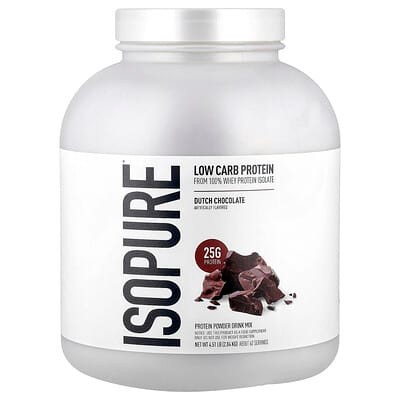
Isopure Low Carb Dutch Chocolate

Goals
$111.39 $1.79 per serving


Product analysis
Isopure Low Carb Dutch Chocolate offers a chocolate-flavored protein option with magnesium and potassium that contribute to normal heart function and mineral balance. Unspecified nutrient forms make detailed quality comparisons harder.
AI assessment of the formula, label and price. How scoring works
Nutrient Quality20
The nutrient forms are unspecified, leaving quality and absorption characteristics uncertain. The long nutrient list does not establish a quality advantage.
Ingredient Transparency63
Amounts are disclosed throughout the nutrition listing, making quantities easier to compare. Nutrient forms are unspecified, so more detailed comparisons remain difficult.
Value For Money46
Value is mixed, with a favorable potassium comparison and less attractive comparisons for several other minerals. Most vitamin and protein value comparisons remain unresolved.
Customer Satisfaction87
Customer ratings are very positive across tens of thousands of reviews. The large review pool gives a broad picture of satisfaction, without confirming nutritional benefits.
Product Focus34
The clearest additional nutritional contribution comes from magnesium and potassium supporting normal heart function and mineral balance. The wide ingredient list does not show equally broad practical benefits.
- Format
Powder - Container
- 4 lb(s)
- Per serving
- $1.79
- Also available
 Isopure Low Carb Dutch Chocolate$87.14
- Customer rating
- 4.5 · 22,058 ratings
Goals

Impact
Moderate effect
Vitamin K · 20 mcgMagnesium · 100 mgVitamin B12 · 2.8 mcgVitamin B6 · 0.5 mgFolate · 160 mcg DFE
Ingredients
| Ingredient | Amount per serving | Score |
|---|---|---|
Calories | 110 Calorie(s) | |
Total Fat | 0.5 Gram(s) | |
Cholesterol | 10 mg | |
Sodium | 200 mg | |
Total Carbohydrates | 1 Gram(s) | |
Protein | 25 Gram(s) | |
Calcium | 350 mg | |
Iron | 0.7 mg | |
Potassium | 470 mg | |
Vitamin A | 380 mcg | |
Vitamin C | 15 mg | |
Vitamin E | 5 mg | |
Vitamin K | 20 mcg | |
Thiamine | 0.3 mg | |
Riboflavin | 0.4 mg | |
Niacin | 5 mg | |
Vitamin B6 | 0.5 mg | |
Folate | 160 mcg DFE | |
Vitamin B12 | 2.8 mcg | |
Biotin | 75 mcg | |
Pantothenic Acid | 2.5 mg | |
Phosphorus | 280 mg | |
Iodine | 38 mcg | |
Magnesium | 100 mg | |
Zinc | 4.2 mg | |
Selenium | 17 mcg | |
Copper | 0.6 mg | |
Manganese | 0.5 mg | |
Chromium | 33 mcg | |
Molybdenum | 20 mcg | |
Chloride | 350 mg |
Sodium · 200 mg OverallScore51
A serving provides 200 mg sodium, a small amount for replacing sweat loss during intense activity. The cost per serving is moderately high. Sodium chloride is listed in Other Ingredients, but the source of the stated sodium amount is unknown. An artificial sweetener is listed.
How this ingredient is rated
Active Ingredient Quality & Bioavailability45
Sodium chloride is listed in Other Ingredients, but the source of the stated sodium amount is unknown. A serving also provides 470 mg potassium and 100 mg magnesium; their forms are unclear.
Sodium Source Purity & Quality
Sodium chloride is listed in Other Ingredients, but the source of the stated sodium amount is unknown.
Bioavailability of Supporting Electrolytes
A serving also provides 470 mg potassium and 100 mg magnesium; their forms are unclear.
Trace Mineral Complex & Buffering Forms
No additional trace mineral complex or sodium bicarbonate is identified.
Dose, Safety & Label Transparency57
A serving provides 200 mg sodium, a small amount for replacing sweat loss during intense activity. An artificial sweetener is listed.
Sodium Dosage for Athletic Replenishment
A serving provides 200 mg sodium, a small amount for replacing sweat loss during intense activity.
Ingredient Label Transparency
The sodium amount and the listed supporting electrolyte amounts are stated per serving.
Artificial Color and Sweetener Disclosure
An artificial sweetener is listed.
Value50
The cost per serving is moderately high.
Price Per Serving vs. Collection Median
The cost per serving is moderately high.
Chloride · 350 mg OverallScore49
Each serving provides 350 mg of chloride, a meaningful amount, at a high cost per serving. Other Ingredients lists chromium chloride, potassium chloride and sodium chloride, but the chloride entry does not assign its source.
How this ingredient is rated
Active Ingredient Quality & Bioavailability32
Other Ingredients lists chromium chloride, potassium chloride and sodium chloride; their contributions to the chloride total are not specified.
Chloride source quality
Other Ingredients lists chromium chloride, potassium chloride and sodium chloride; their contributions to the chloride total are not specified.
Dose, Safety & Label Transparency81
The label states a meaningful chloride amount. The chloride entry does not fully name the source.
Chloride amount per serving
Each serving supplies 350 mg of chloride, a meaningful amount.
Amount and source disclosure
The chloride amount is stated, but the chloride entry does not fully identify its salt source.
Value20
The cost per serving is high.
Price per serving
The cost per serving is high.
Calcium · 350 mg OverallScore36
Each serving provides 350 mg of calcium, a moderate amount, at a high cost per serving. Calcium D-Pantothenate and Dicalcium Phosphate appear in Other Ingredients, but the calcium entry does not assign the source or proportions. An artificial additive is listed, though its identity is not specified in the available information.
How this ingredient is rated
Active Ingredient Quality & Bioavailability37
Calcium D-Pantothenate and Dicalcium Phosphate appear in Other Ingredients, but the calcium entry does not assign the source or proportions. The elemental calcium amount is stated.
Calcium Form & Absorption Potential
Calcium D-Pantothenate and Dicalcium Phosphate appear in Other Ingredients, but the calcium entry does not assign the source or proportions.
Elemental Calcium Transparency
The label states the elemental calcium amount.
Dose, Safety & Label Transparency42
Each serving provides 350 mg of calcium. An artificial additive is listed, though its identity is not specified in the available information.
Absorption-Optimized Serving Dose
The serving provides 350 mg of calcium, a moderate amount.
Formulation Purity & Additives
An artificial additive is listed, though its identity is not specified in the available information.
Value20
The cost per serving is high.
Price Per Serving Efficiency
The cost per serving is high.
Alternative products
Report alternatives
Sources
Published studies used for the product analysis and the top-ranked studies for each ingredient and goal.
- Folic Acid Therapy Reduces the First Stroke Risk Associated With Hypercholesterolemia Among Hypertensive Patients.
- Periconception Red Blood Cell Folate and Offspring Congenital Heart Disease : Nested Case-Control and Mendelian Randomization Studies.
- Intake of vitamin B6, folate, and vitamin B12 and risk of coronary heart disease: a systematic review and dose-response meta-analysis of prospective cohort studies.
- Folate Biomarkers, Folate Intake, and Risk of Death From All Causes, Cardiovascular Disease, and Cancer: A Systematic Review and Dose-Response Meta-Analysis of Prospective Cohort Studies.
- The association between folic acid supplementation and congenital heart defects: Systematic review and meta-analysis.
- Quantitative Association Between Serum/Dietary Magnesium and Cardiovascular Disease/Coronary Heart Disease Risk: A Dose-Response Meta-analysis of Prospective Cohort Studies.
- Effects of magnesium supplementation on improving hyperglycemia, hypercholesterolemia, and hypertension in type 2 diabetes: A pooled analysis of 24 randomized controlled trials.
- The effect of lowering blood pressure by magnesium supplementation in diabetic hypertensive adults with low serum magnesium levels: a randomized, double-blind, placebo-controlled clinical trial.
- Positive effects of magnesium supplementation in metabolic syndrome.
- Comparative Efficacy of Nutraceuticals on Endothelial Function: A Systematic Review and Network Meta-Analysis.
- Differential effect of two nicotinic acid preparations on low-density lipoprotein subclass distribution in patients classified as low-density lipoprotein pattern A, B, or I.
- The ARBITER 6-HALTS Trial (Arterial Biology for the Investigation of the Treatment Effects of Reducing Cholesterol 6-HDL and LDL Treatment Strategies in Atherosclerosis): final results and the impact of medication adherence, dose, and treatment duration.
- The effects of extended-release niacin on carotid intimal media thickness, endothelial function and inflammatory markers in patients with the metabolic syndrome.
- Effect of niacin therapy on cardiovascular outcomes in patients with coronary artery disease.
- Effect of niacin on endothelial function: a systematic review and meta-analysis of randomized controlled trials.
- Potassium intake, stroke, and cardiovascular disease a meta-analysis of prospective studies.
- Oral potassium supplementation for management of essential hypertension: A meta-analysis of randomized controlled trials.
- Joint association of urinary sodium and potassium excretion with cardiovascular events and mortality: prospective cohort study.
- Effect of Potassium Supplementation on Endothelial Function: A Systematic Review and Meta-Analysis of Intervention Studies.
- Effects of potassium supplementation on office, home, and 24-h blood pressure in patients with essential hypertension.