
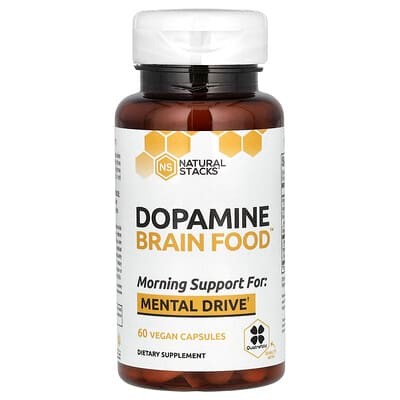

$39.95 $1.99 per serving


Product analysis
Dopamine Brain Food supplies B vitamins that support normal nerve function and tyrosine that may help mental performance under demanding conditions. It offers weak value for its vitamin C and amino acids, which matters when choosing it for everyday focus.
AI assessment of the formula, label and price. How scoring works
Nutrient Quality35
Several vitamin preparations are named, but their presence does not establish sharper thinking or superior benefits. The amino-acid forms are not clearly disclosed, limiting direct quality comparisons.
Ingredient Transparency84
All ingredient amounts are stated, making the serving easy to check. Three forms remain unspecified, so not every ingredient can be compared precisely.
Value For Money28
Vitamin C, tyrosine and phenylalanine are expensive for the amounts supplied. The remaining vitamins do not have a clear separate value comparison.
Customer Satisfaction73
Customer ratings are strongly positive. The size of the review pool affects how settled that picture is, and ratings do not establish effectiveness.
Product Focus65
The formula has a coherent link to normal nerve nutrition and mental performance under stress. Its ingredients do not establish dependable focus or extra energy in well-nourished, rested adults.
- Format
Capsule - Container
- 60 Capsule(s)
- Per serving
- $1.99
- Customer rating
- 4.5 · 473 ratings
Goals

Impact
High effect
Folate · 1000 mcg DFEVitamin B12 · 4000 mcgVitamin B6 · 5 mg
B vitamins support normal nerve function and the processes used to make brain chemicals. Thiamin, niacin, folate and B12 are especially relevant when low intake causes cognitive problems; additional amounts do not establish sharper thinking with adequate intake. Tyrosine has performance findings under acute stress or sleep loss, without establishing benefit in rested users. Phenylalanine's precursor role does not establish cognition gains, and methylated B-vitamin forms do not establish superiority.
How this product is rated for Brain Health
Ingredient fit71
B vitamins and amino acids contribute, with broad goal links limiting focus.
Goal fit
B vitamins and amino acids contribute, with broad goal links limiting focus.
Dose adequacy
The declared amounts receive partial recognition overall; large B12 amounts do not establish extra cognitive benefit.
Pathways41
Making monoamine brain chemicals is the strongest represented area. Other areas have limited coverage.
Depth
Making monoamine brain chemicals is the strongest area in the saved findings; pathway mapping does not establish an improvement in cognition.
Breadth
Only making monoamine brain chemicals reaches the saved coverage threshold.
Evidence92
Vitamin B6 leads the saved evidence finding. The credited preparations are recognized by the saved findings.
Evidence strength
Vitamin B6 leads the saved evidence finding; its recognized role does not establish broad cognitive enhancement.
Studied preparation
The saved findings recognize the preparations of the credited ingredients; this does not establish universal clinical benefit.
Formulation logic100
No unmet partner requirement or configured conflict was found. All credited ingredients clear the amount threshold used for inclusion.
Partner coverage
Each credited ingredient works independently or has its required partner.
Conflicts
No configured conflict was matched among the evaluated combinations.
Effective doses
All credited ingredients clear the inclusion threshold; that threshold does not prove an effective clinical dose.

Impact
High effect
Folate · 1000 mcg DFEVitamin B12 · 4000 mcgVitamin C · 500 mg
Folate, B12 and B6 supply nutrients involved in blood formation and one-carbon metabolism. Vitamin C adds nutritional availability relevant to normal immune and antioxidant functions. These roles can matter when intake is low, but large amounts do not establish improved energy or extra health benefit when intake is adequate. The branded vitamin C preparation has no supplied advantage.
How this product is rated for Everyday Health
Ingredient fit74
The B vitamins and vitamin C supply contributions within a broader amino-acid formula.
Goal fit
The B vitamins and vitamin C supply contributions within a broader amino-acid formula.
Dose adequacy
B vitamins reach or approach their comparison ranges; vitamin C provides a partial contribution.
Pathways60
Blood formation and one-carbon metabolism receives the strongest saved coverage. Blood formation, with smaller energy-metabolism and immune contributions describe the breadth of the supplied findings.
Depth
Blood formation and one-carbon metabolism receives the strongest saved coverage.
Breadth
Blood formation, with smaller energy-metabolism and immune contributions describe the breadth of the supplied findings.
Evidence82
Folate anchors the nutritional evidence; this does not establish added benefit above adequate intake.
Evidence strength
Folate anchors the nutritional evidence; this does not establish added benefit above adequate intake.
Studied preparation
The counted preparations with substantial known amounts are accepted in the saved findings; no form superiority is established.
Formulation logic100
The counted ingredients can contribute independently or have their required partner.
Partner coverage
The counted ingredients can contribute independently or have their required partner.
Conflicts
No configured ingredient conflict was found.
Effective doses
All 4 counted ingredients provide meaningful amount under the saved criteria.

Impact
High effect
Vitamin C · 500 mg
Vitamin C offers modest support for shorter colds with regular use, rather than infection prevention or treatment after symptoms begin. Folate, B6 and B12 can help address low intake that impairs immune-cell function. Their high amounts and activated forms do not establish extra immune benefit when nutrition is adequate. C receives partial amount coverage in the saved comparison, while the three B vitamins reach their full anchors.
How this product is rated for Immunity
Ingredient fit67
C and three B vitamins contribute, with partial amount coverage for C.
Goal fit
Other actives and links to other goals reduce focus on the counted immune contributions.
Dose adequacy
Folate, B6 and B12 reach full amount coverage; C receives partial coverage without implying that more would improve outcomes.
Pathways40
C supplies the evaluated innate-cell coverage; nutritional B-vitamin contributions are tracked separately.
Depth
Innate immune-cell activity receives partial coverage through C.
Breadth
Only innate immune-cell activity meets the coverage threshold.
Evidence100
C leads the evidence finding, with limited regular-use cold-duration support.
Evidence strength
C supplies the leading evidence contribution without establishing infection prevention.
Studied preparation
All counted declarations receive full preparation recognition; activated and branded forms receive no automatic advantage.
Formulation logic100
Partner checks are satisfied and no configured conflict was found.
Partner coverage
No counted vitamin lacks a required partner.
Conflicts
No configured ingredient conflict was matched.
Effective doses
All four counted vitamins pass the minimum amount threshold.

Impact
Moderate effect
Vitamin C · 500 mg
Vitamin C at 500 mg provides antioxidant support relevant to oxidative stress and inflammation. Evidence for changes in inflammatory markers depends on the person’s starting status, so a broad inflammation benefit should not be assumed.
How this product is rated for Inflammation
Ingredient fit40
1 assessed ingredient relate to inflammation, alongside 6 other active ingredients aimed at broader needs. The assessed amounts provide a partial match to the reviewed exposure ranges.
Goal fit
1 assessed ingredient relate to inflammation, alongside 6 other active ingredients aimed at broader needs.
Dose adequacy
The assessed amounts provide a partial match to the reviewed exposure ranges.
Pathways17
Oxidative and mitochondrial stress is the main area of support identified in the saved assessment. Support remains narrow, with no assessed mechanism reaching the saved coverage threshold.
Depth
Oxidative and mitochondrial stress is the main area of support identified in the saved assessment.
Breadth
Support remains narrow, with no assessed mechanism reaching the saved coverage threshold.
Evidence87
Vitamin C provides the strongest evidence contribution at an assessed meaningful amount; the clinical context still matters. The ingredients assessed at meaningful amounts match preparations recognized in the saved evidence review.
Evidence strength
Vitamin C provides the strongest evidence contribution at an assessed meaningful amount; the clinical context still matters.
Studied preparation
The ingredients assessed at meaningful amounts match preparations recognized in the saved evidence review.
Formulation logic100
The assessed ingredients can contribute alone or have their required partner present. No ingredient conflicts were identified in the saved assessment. 1 of 1 assessed ingredients meet the saved amount threshold.
Partner coverage
The assessed ingredients can contribute alone or have their required partner present.
Conflicts
No ingredient conflicts were identified in the saved assessment.
Effective doses
1 of 1 assessed ingredients meet the saved amount threshold.

Impact
High effect
Vitamin C · 500 mg
Vitamin C supports collagen formation and wound healing when intake is low; added vitamin C has no established skin benefit when intake is adequate. The B vitamins help prevent deficiency-related dermatitis; larger amounts do not establish further skin improvement.
How this product is rated for Skin Health
Ingredient fit68
Ingredients relevant to skin health sit within a broader formula with other active ingredients. The relevant declared amounts fully meet or nearly meet the saved exposure comparison; this does not establish an optimal regimen.
Goal fit
Ingredients relevant to skin health sit within a broader formula with other active ingredients.
Dose adequacy
The relevant declared amounts fully meet or nearly meet the saved exposure comparison; this does not establish an optimal regimen.
Pathways0
No mapped pathway receives a contribution in the saved findings, although the ingredient findings remain separate.
Depth
No mapped pathway received a contribution in the saved findings, despite the separate ingredient findings.
Breadth
None of the mapped pathways meets the saved coverage threshold.
Evidence100
Vitamin C leads the saved evidence finding. Accepted preparation matches do not remove the ingredient-specific limitations described above.
Evidence strength
Vitamin C provides the leading evidence contribution in the saved comparison; its clinical limitations still apply.
Studied preparation
The saved finding accepts the preparations used for its included ingredients; it does not establish that every labelled preparation matches a clinical trial.
Formulation logic100
The saved checks find no missing required partner or configured conflict. The included amounts pass the minimum comparison screen.
Partner coverage
The included ingredients do not lack a required partner under the saved finding; this does not establish added benefit from combining them.
Conflicts
No configured ingredient conflict was triggered by the supplied facts.
Effective doses
All ingredients included in this amount screen meet its minimum comparison level; that level is not a proven effective dose.
Ingredients
| Ingredient | Amount per serving | Score |
|---|---|---|
Vitamin C (Quali-C) | 500 mg | |
Vitamin B6 (Pyridoxal 5-Phosphate) | 5 mg | |
Folate ((6S)-5-Methyltetrahydrofolate Calcium Salt) | 1000 mcg DFE | |
Vitamin B12 (Methylcobalamin) | 4000 mcg | |
L-Tyrosine | 650 mg | |
Trimethylglycine | 600 mg | |
L-Phenylalanine | 500 mg |
Vitamin B12 (Methylcobalamin) · 4000 mcg OverallScore90
Each serving lists 4,000 mcg of vitamin B12 as methylcobalamin. At the whole-product price, that works out to about $0.50 per 1,000 mcg of B12.
How this ingredient is rated
Active Ingredient Quality & Bioavailability100
The B12 is identified as methylcobalamin, a coenzyme form.
Bioactive B12 Form Selection
The B12 is identified as methylcobalamin, a coenzyme form.
Dose, Safety & Label Transparency100
The saved details identify both the B12 form and its amount: 4,000 mcg per serving.
Therapeutic Dosage Level
Each serving provides 4,000 mcg of vitamin B12.
Label and Form Transparency
The saved details identify 4,000 mcg of B12 per serving as methylcobalamin.
Value50
At the whole-product price, that works out to about $0.50 per 1,000 mcg of B12.
Price per 1,000 mcg B12
At the whole-product price, that works out to about $0.50 per 1,000 mcg of B12.
Phenylalanine · 500 mg OverallScore82
A serving supplies 500 mg of L-Phenylalanine, and a PKU warning is recorded. The whole-product price works out to about $2.00 per 500 mg of phenylalanine.
How this ingredient is rated
Active Ingredient Quality & Bioavailability100
The form is identified as L-Phenylalanine. No competing protein or amino acids were identified in the saved ingredient panel.
Isomeric Form Specificity
The form is identified as L-Phenylalanine.
Absorption Environment Optimization
No competing protein or amino acids were identified in the saved ingredient panel.
Dose, Safety & Label Transparency100
A serving provides 500 mg of L-Phenylalanine. The amount is disclosed and a phenylketonuria (PKU) warning is recorded.
Phenylalanine Dosage Efficacy
A serving provides 500 mg of L-Phenylalanine.
Transparency and Safety Warnings
The amount is disclosed and a phenylketonuria (PKU) warning is recorded.
Value10
The whole-product price works out to about $2.00 per 500 mg of phenylalanine.
Price per 500mg Active Phenylalanine
The whole-product price works out to about $2.00 per 500 mg of phenylalanine.
Tyrosine · 650 mg OverallScore80
Each serving provides 650 mg of L-tyrosine in a clearly listed amount. The whole-product price corresponds to about $3.07 per gram of tyrosine, which is high for that ingredient.
How this ingredient is rated
Active Ingredient Quality & Bioavailability94
L-tyrosine is the standard form, and third-party purity testing is reported.
Tyrosine Chemical Form
L-tyrosine is the standard form for raising tyrosine levels.
Purity and Sourcing Signals
A third-party purity-testing claim is recorded.
Dose, Safety & Label Transparency100
The serving lists 650 mg of tyrosine separately, a substantial amount for acute cognitive support.
Tyrosine Dosage Adequacy
The 650 mg per serving is a substantial amount for acute cognitive support.
Label Transparency and Blends
The 650 mg of tyrosine per serving is listed individually.
Value10
The whole-product price corresponds to about $3.07 per gram of tyrosine, which is high for that ingredient.
Price per Gram of Tyrosine
The whole-product price corresponds to about $3.07 per gram of tyrosine, which is high for that ingredient.
Alternative products
Report alternatives
Sources
Published studies used for the product analysis and the top-ranked studies for each ingredient and goal.
- B vitamins and prevention of cognitive decline and incident dementia: a systematic review and meta-analysis.
- Folate and long-chain polyunsaturated fatty acid supplementation during pregnancy has long-term effects on the attention system of 8.5-y-old offspring: a randomized controlled trial.
- Folic acid supplementation improves cognitive function in participants with cerebral small vascular disease-related cognitive impairment: a randomized controlled trial.
- Circulating folate concentrations and the risk of mild cognitive impairment: A prospective study on the older Chinese population without folic acid fortification.
- Normal-But-Low Serum Folate Levels and the Risks for Cognitive Impairment.
- The Association between Dietary Amino Acid Intake and Cognitive Decline 8 Years Later in Japanese Community-Dwelling Older Adults.
- Magnetic resonance imaging in phenylketonuria: reversal of cerebral white matter change.
- [Cross-sectional association between the amino acid intake and episodic memory in middle- and old-aged community dwellers].
- Improved dietary control results in improvements in indices of white matter structure in adults with phenylketonuria: the ReDAPT study.
- [Brain white matter lesions of children with phenylketonuria before and after treatment].
- Combined L-carnosine and L-tyrosine supplementation as an ergogenic strategy for physical and cognitive performance under fatigue in professional football players.
- Effect of tyrosine supplementation on clinical and healthy populations under stress or cognitive demands--A review.
- Influence of nutritional tyrosine on cognition and functional connectivity in healthy old humans.
- Dietary Tyrosine Intake (FFQ) Is Associated with Locus Coeruleus, Attention and Grey Matter Maintenance: An MRI Structural Study on 398 Healthy Individuals of the Berlin Aging Study-II.
- Baseline-dependent effect of dopamine's precursor L-tyrosine on working memory gating but not updating.
- Relationship between vitamin B12 levels and motor development: A systematic review.
- Vitamin B12 supplementation improves cognitive function in middle aged and elderly patients with cognitive impairment.
- Structural and Functional Brain Changes Associated with Vitamin B12 Deficiency using Magnetic Resonance Imaging: A Systematic Review and Meta-analysis.
- Maternal vitamin B12, vitamin D, and folic acid status during pregnancy and child neurodevelopment: a systematic review.
- Higher vitamin B12 from mid- to late life is related to slower rates of cognitive decline.