
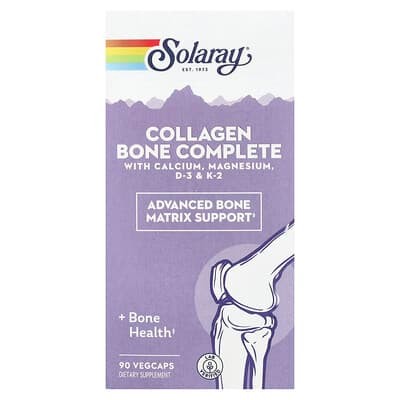

$27.64 $0.92 per serving


Product analysis
Collagen Bone Complete combines calcium and vitamin D to support normal bone nutrition when intake is low. The small collagen contribution is expensive for the amount provided, which limits its appeal as a collagen supplement.
AI assessment of the formula, label and price. How scoring works
Nutrient Quality38
Vitamin D3 is a favorable form, while the seaweed minerals and collagen descriptions do not establish how well the body can use them. The vitamin K description also leaves its specific type unclear.
Ingredient Transparency80
The ingredient amounts and named forms are disclosed. Missing mixture proportions still leave important details unclear.
Value For Money26
The collagen contribution is expensive for the amount provided, and the calcium and vitamin K offer weak value. Uncertain comparisons for the other ingredients do not resolve those disadvantages.
Customer Satisfaction81
Customer feedback is positive, with a substantial number of ratings. Ratings reflect satisfaction and cannot establish effectiveness or safety.
Product Focus58
Bone nutrition is the clearest purpose, led by calcium and vitamin D. The smaller collagen contribution and wider suggested uses have less direct support.
- Format
Capsule - Container
- 90 VegCap(s)
- Per serving
- $0.92
- Customer rating
- 4.7 · 1,117 ratings
Goals

Impact
High effect
Vitamin K · 80 mcgMagnesium · 35 mgCalcium · 500 mgVitamin D · 1000 IUVitamin C · 25 mgCollagen · 300 mg
Calcium supplies mineral for normal bone mineralization and can fill a dietary intake gap. Its serving amount is not a target for supplemental intake, and fracture results are mixed. Vitamin D supports calcium absorption and deficiency-related mineralization, without established routine fracture prevention in adequately nourished adults.
How this product is rated for Bone Health
Ingredient fit72
The ingredients keep the formula focused, though it may be linked to other health uses.
Goal fit
The ingredients keep the formula focused, though it may be linked to other health uses.
Dose adequacy
The disclosed amounts only partly meet the saved comparison ranges; small or unresolved amounts limit this finding.
Pathways63
The strongest recorded connection concerns calcium absorption and regulation, without proving improved bone density or fewer fractures.
Depth
The strongest recorded connection concerns calcium absorption and regulation, without proving improved bone density or fewer fractures.
Breadth
Only part of the selected bone mechanisms reaches the saved coverage threshold.
Evidence94
Calcium leads the saved evidence finding; its nutritional or preparation-specific limits still apply.
Evidence strength
Calcium leads the saved evidence finding; its nutritional or preparation-specific limits still apply.
Studied preparation
Vitamin K lacks a matching studied preparation in the saved findings.
Formulation logic100
No required partner is missing in the saved findings; this does not demonstrate extra combination benefit.
Partner coverage
No required partner is missing in the saved findings; this does not demonstrate extra combination benefit.
Conflicts
No matched ingredient conflict was recorded in the supplied findings.
Effective doses
All counted ingredients meet the saved minimum amount threshold; this is not a proven fracture-prevention dose.

Impact
High effect
Vitamin D · 1000 IUMagnesium · 35 mgVitamin K · 80 mcgCollagen · 300 mgVitamin C · 25 mg
The B vitamins provide nutritional building blocks for normal metabolism, with folate contributing to blood formation. Magnesium adds a contribution toward mineral needs. These contributions concern nutrient availability when intake is low; larger amounts and special forms do not establish added health benefits when intake is adequate.
How this product is rated for Everyday Health
Ingredient fit70
Magnesium, Vitamin D, Vitamin K provide the recorded nutritional connection. The amounts match those references unevenly.
Goal fit
The identified nutritional ingredients provide a focused connection to general health, while the product is also linked to other goals.
Dose adequacy
Amounts vary in how fully they match the nutritional comparison references; unresolved quantities cannot establish a contribution.
Pathways45
The strongest connection is to bone and mineral metabolism. Recorded coverage also depends on the amounts available for each function.
Depth
The strongest recorded coverage concerns bone and mineral metabolism, reflecting ingredient availability rather than a measured health improvement.
Breadth
The recorded coverage includes bone and mineral metabolism.
Evidence82
Vitamin D anchors the recorded evidence finding. Benefits remain conditional on nutritional need rather than proving improved general health in adequately nourished adults.
Evidence strength
Vitamin D provides the strongest recorded evidence finding; the supplied context supports conditional nutritional usefulness rather than broad disease prevention.
Studied preparation
The counted preparations match those recognized in the saved findings, without establishing that any chemical form or delivery method is superior.
Formulation logic100
No missing partners or configured conflicts were identified. The counted amounts meet the minimum comparison threshold.
Partner coverage
No required ingredient partner is missing from the counted contributions; this does not imply extra benefit from combining nutrients.
Conflicts
No configured ingredient conflict was identified in the supplied findings.
Effective doses
All counted ingredients meet the comparison’s amount threshold; that threshold is not a proven clinical dose.

Impact
Moderate effect
Magnesium · 35 mgVitamin C · 25 mgVitamin D · 1000 IU
Vitamin D3 at 25 mcg provides the main immune relevance by supporting normal immune regulation. Vitamin C at 25 mg and magnesium at 35 mg make smaller nutritional contributions; the formula does not imply extra resistance to infection.
How this product is rated for Immunity
Ingredient fit46
Vitamin D provides the main immune relevance within a formula serving other nutritional purposes. Vitamin D provides a partial exposure comparison; vitamin C and magnesium are below the levels counted.
Goal fit
Vitamin D provides the main immune relevance within a formula serving other nutritional purposes.
Dose adequacy
Vitamin D provides a partial exposure comparison; vitamin C and magnesium are below the levels counted.
Pathways40
Immune-cell regulation is the strongest assessed route, with smaller barrier or innate-cell contributions. Only immune-cell regulation reaches the saved coverage level.
Depth
Immune-cell regulation is the strongest assessed route, with smaller barrier or innate-cell contributions.
Breadth
Only immune-cell regulation reaches the saved coverage level.
Evidence100
Vitamin D provides the strongest saved evidence contribution at a counted amount; its evidence scope does not imply broad infection prevention. The counted ingredient matches the preparation category accepted in the saved findings.
Evidence strength
Vitamin D provides the strongest saved evidence contribution at a counted amount; its evidence scope does not imply broad infection prevention.
Studied preparation
The counted ingredient matches the preparation category accepted in the saved findings.
Formulation logic100
The counted ingredients can contribute independently or have their required partner. The counted ingredient meets the saved minimum exposure comparison.
Partner coverage
The counted ingredients can contribute independently or have their required partner.
Conflicts
No configured ingredient conflict was identified in the saved assessment.
Effective doses
The counted ingredient meets the saved minimum exposure comparison.

Impact
Moderate effect
Magnesium · 35 mgVitamin K · 80 mcgVitamin D · 1000 IUCollagen · 300 mg
Vitamin D supports normal muscle and bone function, particularly when a dietary gap contributes to deficiency. Vitamin K relates to vascular and bone proteins, while vitamin C supports collagen formation. The 300 mg collagen declaration is not matched here to the specific peptide preparation used for visible skin outcomes.
How this product is rated for Longevity
Ingredient fit62
The relevant ingredients provide a reasonable connection within a broader formula. The counted amounts provide partial support relative to the supplied dose ranges.
Goal fit
The relevant ingredients provide a reasonable connection within a broader formula.
Dose adequacy
The counted amounts provide partial support relative to the supplied dose ranges.
Pathways9
The strongest assessed connection is arterial calcification control, with limited coverage. No mechanism reaches the saved broader-coverage threshold.
Depth
The strongest assessed connection is arterial calcification control, with limited coverage.
Breadth
No mechanism reaches the saved broader-coverage threshold.
Evidence74
Vitamin D provides the strongest relevant evidence among ingredients counted at meaningful amounts. That comparison does not establish lifespan extension. Most, but not all, of the assessed contribution matches preparations accepted in the saved evidence assessment.
Evidence strength
Vitamin D provides the strongest relevant evidence among ingredients counted at meaningful amounts. That comparison does not establish lifespan extension.
Studied preparation
Most, but not all, of the assessed contribution matches preparations accepted in the saved evidence assessment.
Formulation logic100
The counted ingredients can contribute independently or have their required partner. No ingredient conflict was identified in the saved assessment. 2 of 2 counted ingredients reach the saved meaningful-amount threshold.
Partner coverage
The counted ingredients can contribute independently or have their required partner.
Conflicts
No ingredient conflict was identified in the saved assessment.
Effective doses
2 of 2 counted ingredients reach the saved meaningful-amount threshold.

Impact
Moderate effect
Magnesium · 35 mgVitamin D · 1000 IU
Vitamin D supports normal muscle and bone function, with exercise benefits most relevant when deficiency is present. Calcium contributes to bone nutrition, while the 0.3 g collagen serving has only a limited connection to the supplied joint-related evidence and should not be treated as a complete muscle-building protein.
How this product is rated for Fitness
Ingredient fit50
The relevant ingredients provide a partial connection to fitness.
Goal fit
Vitamin D provides the main assessed connection within a broader bone-focused formula.
Dose adequacy
Vitamin D partly meets the saved amount comparison.
Pathways0
The saved coverage is concentrated in no specific fitness area.
Depth
No specific fitness area receives coverage.
Breadth
No area reaches substantial coverage.
Evidence69
The evidence contribution depends on the ingredient and exercise context.
Evidence strength
Vitamin D provides the strongest saved evidence contribution.
Studied preparation
The saved preparation check is satisfied for vitamin D.
Formulation logic100
The saved partner and conflict checks are satisfied, with the amount findings noted below.
Partner coverage
No required partner is missing.
Conflicts
No configured ingredient conflict was found.
Effective doses
All relevant ingredients meet the saved minimum amount comparison.

Impact
Moderate effect
Collagen · 300 mg
Vitamin C supports collagen formation, while calcium and vitamin D contribute to normal mineral physiology. The 300 mg collagen amount provides little structural-protein contribution in the saved assessment, and direct nail evidence is limited to a specific branded peptide preparation. The broader nutrient roles do not clearly establish better nail quality.
How this product is rated for Nail Health
Ingredient fit67
The nail-relevant ingredients sit within a broader formula containing ingredients directed at other health uses. The declared amounts provide partial coverage of the amounts used in the saved assessment.
Goal fit
The nail-relevant ingredients sit within a broader formula containing ingredients directed at other health uses.
Dose adequacy
The declared amounts provide partial coverage of the amounts used in the saved assessment.
Pathways10
The strongest saved contribution concerns nutrients involved in nail formation, with partial coverage. No pathway reaches the saved threshold for substantial coverage.
Depth
The strongest saved contribution concerns nutrients involved in nail formation, with partial coverage.
Breadth
No pathway reaches the saved threshold for substantial coverage.
Evidence58
Vitamin D provides the strongest saved evidence among the ingredients at an assessed effective amount; nail-specific evidence remains limited. The saved findings recognize the assessed effective ingredients as studied preparations.
Evidence strength
Vitamin D provides the strongest saved evidence among the ingredients at an assessed effective amount; nail-specific evidence remains limited.
Studied preparation
The saved findings recognize the assessed effective ingredients as studied preparations.
Formulation logic100
The credited ingredients can contribute independently or have their required partners. No configured ingredient conflicts were recorded in the saved findings. All credited ingredients meet the saved minimum amount.
Partner coverage
The credited ingredients can contribute independently or have their required partners.
Conflicts
No configured ingredient conflicts were recorded in the saved findings.
Effective doses
All credited ingredients meet the saved minimum amount.
Magnesium Not classified
No linked studies yet.
Ingredients
| Ingredient | Amount per serving | Score |
|---|---|---|
Vitamin C (Amla fruit extract) | 25 mg | |
Vitamin D3 (Cholecalciferol) | 1000 IU | |
Calcium (Lithothamnion Seaweed) | 500 mg | |
Magnesium (Lithothamnion Seaweed) | 35 mg | |
Marine Collagen (Type I & III Collagen, wild-caught deep sea Fish) | 300 mg | |
Vitamin K (Chickpea, Vitamin K-2) | 80 mcg |
Calcium (Lithothamnion Seaweed) · 500 mg OverallScore56
A serving supplies 500 mg of calcium, though its chemical form is unknown. The whole-product serving costs about $0.92.
How this ingredient is rated
Active Ingredient Quality & Bioavailability30
The label lists 500 mg of calcium per serving, but its form is unknown.
Calcium Form & Absorption Potential
The saved facts do not identify the calcium form.
Elemental Calcium Transparency
The calcium amount is explicitly listed as 500 mg per serving.
Dose, Safety & Label Transparency100
The serving provides 500 mg of calcium; no evaluated artificial additives or flow agents were identified.
Absorption-Optimized Serving Dose
The serving supplies 500 mg of calcium.
Formulation Purity & Additives
No evaluated artificial additives or flow agents were identified; sugar information is unavailable.
Value20
The whole-product serving costs about $0.92.
Price Per Serving Efficiency
The whole-product serving costs about $0.92.
Vitamin D (Cholecalciferol) · 1000 IU OverallScore66
A three-capsule serving provides 1,000 IU of vitamin D3, a form that generally raises and maintains vitamin D levels more effectively than D2. The whole-product serving costs about $0.92, making its vitamin D relatively costly.
How this ingredient is rated
Active Ingredient Quality & Bioavailability87
The vitamin D is D3, which generally raises and maintains vitamin D levels more effectively than D2. No raw source is identified in the saved information.
Vitamin D3 vs. D2 Superiority
Vitamin D3 (cholecalciferol) is recorded; it generally raises and maintains vitamin D levels more effectively than D2.
Sourcing and Active Marker Disclosure
The saved information does not identify a raw source for the vitamin D.
Dose, Safety & Label Transparency62
The serving provides 1000 IU of vitamin D. No qualifying verification or GMP claim is recorded.
Daily Dosage Appropriateness
The serving provides 1000 IU of vitamin D.
Excipient and Additive Purity
None of the three evaluated additive categories is identified in the available ingredient information; the sugar amount is unknown.
Purity and Quality Certification
No qualifying independent seal, batch-specific certificate of analysis, or GMP claim is recorded in the saved facts.
Value30
The whole-product serving costs about $0.92; the cost relative to its vitamin D amount is high.
Price per 1,000 IU Efficiency
The whole-product serving costs about $0.92; the cost relative to its vitamin D amount is high.
Vitamin K (Chickpea, Vitamin K-2) · 80 mcg OverallScore15
A serving provides 80 mcg of vitamin K, with a K2 claim but no resolved subtype in the saved facts. The MK-7 amount cannot be assessed, and a whole-product serving costs about $0.92.
How this ingredient is rated
Active Ingredient Quality & Bioavailability0
The recorded K2 claim does not resolve the vitamin K subtype or establish an MK-7 isomer.
Vitamin K Form (MK-7 vs. MK-4 vs. K1)
The saved facts do not resolve the vitamin K subtype, so MK-7 cannot be confirmed.
MK-7 Isomer Disclosure
No MK-7 source is resolved, so its isomer cannot be assessed.
Dose, Safety & Label Transparency27
The serving provides 80 mcg of vitamin K, but its subtype and any MK-7 amount remain unresolved.
Vitamin K2 (MK-7) Dosage Efficacy
The serving has 80 mcg of vitamin K, but an MK-7 amount is not established.
Form and Subtype Transparency
The evaluation recognizes a K2 claim, but the saved facts do not resolve its subtype.
Value20
A whole-product serving costs about $0.92; the MK-7 amount is unresolved.
Price per Effective MK-7 Serving
A whole-product serving costs about $0.92; the MK-7 amount is unresolved.
Alternative products
Report alternatives
Sources
Published studies used for the product analysis and the top-ranked studies for each ingredient and goal.
- What is the impact of daily oral supplementation of vitamin D3 (cholecalciferol) plus calcium on the incidence of hip fracture in older people? A systematic review and meta-analysis.
- Calcium supplementation prevents seasonal bone loss and changes in biochemical markers of bone turnover in elderly New England women: a randomized placebo-controlled trial.
- The effects of calcium supplementation (milk powder or tablets) and exercise on bone density in postmenopausal women.
- The efficacy of calcium supplementation alone in elderly Thai women over a 2-year period: a randomized controlled trial.
- Calcium-enriched foods and bone mass growth in prepubertal girls: a randomized, double-blind, placebo-controlled trial.
- Effect of Calcium and Vitamin D Supplementation With and Without Collagen Peptides on Volumetric and Areal Bone Mineral Density, Bone Geometry and Bone Turnover in Postmenopausal Women With Osteopenia.
- Bone turnover and bone collagen maturation in osteoporosis: effects of antiresorptive therapies.
- A calcium-collagen chelate dietary supplement attenuates bone loss in postmenopausal women with osteopenia: a randomized controlled trial.
- Assessment of Osteoporosis in Lumbar Spine: In Vivo Quantitative MR Imaging of Collagen Bound Water in Trabecular Bone.
- Effect of calcium and vitamin D supplementation with and without collagen peptides on bone turnover in postmenopausal women with osteopenia.
- Association between Serum Magnesium and Fractures: A Systematic Review and Meta-Analysis of Observational Studies.
- Bioabsorbable Magnesium-Based Materials Potential and Safety in Bone Surgery: A Systematic Review.
- Vascularized bone grafting fixed by biodegradable magnesium screw for treating osteonecrosis of the femoral head.
- An update on magnesium and bone health.
- Sex-specific differences in the association of magnesium intake with femoral neck bone mineral density among older adults.
- Can Dietary Intake of Vitamin C-Oriented Foods Reduce the Risk of Osteoporosis, Fracture, and BMD Loss? Systematic Review With Meta-Analyses of Recent Studies.
- Dietary vitamin C intake and the risk of hip fracture: a dose-response meta-analysis.
- Smoking, antioxidant vitamins, and the risk of hip fracture.
- Micronutrients and the risk of hip fracture: Case-control study.
- Favorable effect of dietary vitamin C on bone mineral density in postmenopausal women (KNHANES IV, 2009): discrepancies regarding skeletal sites, age, and vitamin D status.