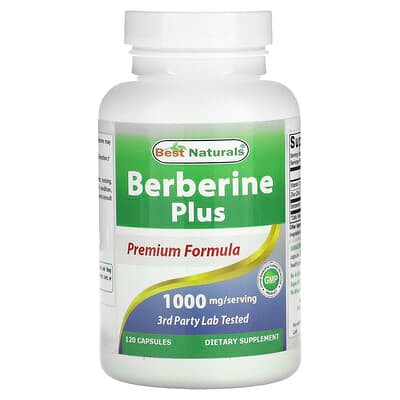

Berberine Plus 1000 mg

Berberine Plus 1000 mg

Best Naturals4.7 (1,410 ratings)
Format:Capsule Quantity: 120 Capsule(s) · 60 servings
Goals
$20.67 $0.34 per serving

About this product

The supported conclusions are clearer for zinc nutrition than for the headline berberine ingredient. Zinc gluconate at 30 mg supports normal immune function and may help skin or hormone functions when zinc intake is low. Those roles do not establish extra benefit for people already meeting their needs.

Berberine hydrochloride is named at 1,000 mg, but the supporting findings do not establish its preparation quality or its contribution to the listed goals. Vitamin C adds normal collagen and antioxidant nutrition, although its 120 mg amount falls below the supplied immune-contribution threshold. The combination therefore should not be read as equally well supported across all ingredients.

The zinc amount and source are clear, with moderate value for that contribution. Zinc is in the higher daily-dose range, while the copper amount is unknown. Missing berberine assessment detail limits a broader conclusion about the formula's usefulness or value.

Who is it for
  • Adults comparing this combination for a zinc-related dietary gap who understand that the berberine contribution remains uncertain
Best for
  • Supporting zinc intake when dietary supply is low

Pros

  • Zinc gluconate is an identified, reasonably absorbed source
  • Amounts are disclosed for each active ingredient
  • Vitamin C contributes normal collagen-related nutrition

Cons

  • Headline berberine contribution is not established in the supplied findings
  • Vitamin C is below the supplied immune-contribution threshold
  • Copper content is not established
  • Added benefit from combining the ingredients is not demonstrated

Product analysis

75 out of 100

Best Naturals Berberine Plus is marketed for glucose metabolism and digestive health, with 1,000 mg of berberine hydrochloride per two capsules. Its clearer nutritional contribution comes from the 30 mg of zinc and 120 mg of vitamin C in the same serving, which support normal immune function; the benefits of the berberine combination for its advertised uses remain uncertain.

AI assessment of the formula, label and price. How scoring works

Nutrient Quality62

Zinc gluconate offers useful absorption potential, while vitamin C comes in its ordinary unbuffered form. The label identifies berberine hydrochloride, but its form-specific quality is uncertain.

Ingredient Transparency88

The amounts of all three active ingredients are clear. The label names berberine hydrochloride as well as the vitamin and mineral sources.

Value For Money79

The added zinc is good value and the vitamin C is fairly priced. These comparisons cover the full formula's cost rather than establishing the value of berberine itself.

Customer Satisfaction83

Customers give it a high average rating of 4.7 out of 5. Feedback from over 1,400 ratings indicates broad satisfaction.

Product Focus72

The three-ingredient formula has a clear nutritional role, especially for immunity through zinc and vitamin C. Several other supported uses depend chiefly on correcting low zinc intake, rather than a demonstrated benefit of berberine for those purposes.

Format
Capsule
Container
120 Capsule(s)
Per serving
$0.34
Customer rating
4.7 · 1,410 ratings
Report analysis

Goals

Immunity
Impact
Highest effect
B Ingredient FitB+ PathwaysA+ EvidenceA+ Formulation Logic
Vitamin C · 120 mgZinc · 30 mg

Berberine Plus 1000 mg offers normal immune-function support mainly through its 30 mg of zinc as zinc gluconate. Zinc supports immune-cell function and regulation. Vitamin C at 120 mg provides a smaller supporting amount for regular-use cold-duration support.

Study evidence
Zinc Supportive
Everyday Health
Impact
High effect
B Ingredient FitD+ PathwaysB- EvidenceA+ Formulation Logic
Zinc · 30 mgVitamin C · 120 mg

Berberine Plus 1000 mg has a supported everyday-health role mainly through its zinc content. The 30 mg zinc serving contributes to normal immune function when it helps fill a dietary gap.

Study evidence
Zinc Supportive
Impact
High effect
B- Ingredient FitF PathwaysA EvidenceA+ Formulation Logic
Zinc · 30 mg

Berberine Plus 1000 mg offers a narrow testosterone-support role through its 30 mg of zinc as gluconate. Zinc can help restore normal testosterone when zinc deficiency is present.

Study evidence
Zinc Disputed
Skin Health
Impact
High effect
B Ingredient FitF PathwaysB+ EvidenceA+ Formulation Logic
Zinc · 30 mgVitamin C · 120 mg

Berberine Plus 1000 mg has a narrow nutritional fit for skin health through its added zinc. The 30 mg zinc gluconate serving supports normal skin repair, particularly when zinc intake is inadequate. Vitamin C at 120 mg contributes to normal collagen formation, but the supplied facts give berberine no established skin role.

Study evidence
Zinc Supportive
Eye Health
Impact
High effect
C+ Ingredient FitD PathwaysB+ EvidenceA+ Formulation Logic
Zinc · 30 mgVitamin C · 120 mg

Berberine Plus 1000 mg has a limited eye-health fit led by its 30 mg of zinc as zinc gluconate. Zinc is relevant to photoreceptor structure and the visual cycle, although its eye-related support mainly concerns defined combinations for selected populations. Vitamin C at 120 mg adds a small antioxidant role.

Study evidence
Zinc Supportive
Impact
High effect
B Ingredient FitF PathwaysA+ EvidenceA+ Formulation Logic
Zinc · 30 mgVitamin C · 120 mg

Berberine Plus 1000 mg has a limited hair-health fit through its 30 mg of zinc, which can fill a zinc gap associated with shedding. The supplied facts give berberine no supported hair-health role, making zinc the ingredient that explains this comparison.

Study evidence
Zinc Supportive

Ingredients

IngredientAmount per servingScore
Vitamin C (Ascorbic Acid)
120 mg
Zinc (Zinc Gluconate)
30 mg 77
Berberine Hydrochloride
1000 mg
Gluten Free Adults 18–50 Sugar Free
Report overview
B+ Active Ingredient Quality & BioavailabilityC+ Dose, Safety & Label TransparencyA Value
Best Naturals Berberine Plus 1000 mg offers a useful zinc amount: 30 mg per serving as Zinc Gluconate. The copper amount is unknown. At $0.11 per 10 mg zinc for comparison and $0.34 per serving, the zinc is good value. The serving price covers the full formula.
Report alternatives

Sources

Published studies used for the product analysis and the top-ranked studies for each ingredient and goal.

  1. Dietary intake and blood concentrations of antioxidants and the risk of cardiovascular disease, total cancer, and all-cause mortality: a systematic review and dose-response meta-analysis of prospective studies.
    Aune D; Keum N; Giovannucci E; Fadnes LT; Boffetta P; Greenwood DC; Tonstad S; Vatten LJ; Riboli E; Norat T · The American journal of clinical nutrition · 2019
    Meta-analysis69 studies pooledEveryday Health forVitamin C
  2. Scientific Opinion on the substantiation of a health claim related to vitamin C and increasing non haem iron absorption pursuant to Article 14 of Regulation (EC) No 1924/2006.
    EFSA Panel on Dietetic Products, Nutrition and Allergies (NDA) · EFSA journal. European Food Safety Authority · 2026
    Guideline / consensusEveryday Health forVitamin C
  3. Vitamin C Depletion and All-Cause Mortality in Renal Transplant Recipients.
    Sotomayor CG; Eisenga MF; Gomes Neto AW; Ozyilmaz A; Gans ROB; Jong WHA; Zelle DM; Berger SP; Gaillard CAJM; Navis GJ; Bakker SJ · Nutrients · 2018
    Cohort study598 participantsEveryday Health forVitamin C
  4. Associations of Serum Biomarkers of Fruit and Vegetable Intake With the Risk of Cause-Specific Mortality and All-Cause Mortality: A National Prospective Cohort Study.
    Pu L; Zhang R; Wang X; Zhao T; Sun H; Han L · Frontiers in nutrition · 2022
    Cohort study12,530 participantsEveryday Health forVitamin C
  5. Relation between plasma ascorbic acid and mortality in men and women in EPIC-Norfolk prospective study: a prospective population study. European Prospective Investigation into Cancer and Nutrition.
    Khaw KT; Bingham S; Welch A; Luben R; Wareham N; Oakes S; Day N · Lancet (London, England) · 2001
    Cohort study19,496 participantsEveryday Health forVitamin C
  6. Effectiveness of sodium bicarbonate and zinc chloride mouthwashes in the treatment of oral mucositis and quality of life in patients with cancer under chemotherapy.
    Mohammadi F; Oshvandi K; Kamallan SR; Khazaei S; Ranjbar H; Ahmadi-Motamayel F; Gillespie M; Jenabi E; Vafaei SY · Nursing open · 2022
    Randomized trial144 participantsEveryday Health forZinc
  7. Zinc supplementation in young children with acute diarrhea in India.
    Sazawal S; Black RE; Bhan MK; Bhandari N; Sinha A; Jalla S · The New England journal of medicine · 1995
    Randomized trial937 participantsEveryday Health forZinc
  8. Associations of mortality with ocular disorders and an intervention of high-dose antioxidants and zinc in the Age-Related Eye Disease Study: AREDS Report No. 13.
    Clemons TE; Kurinij N; Sperduto RD; AREDS Research Group · Archives of ophthalmology (Chicago, Ill. : 1960) · 2004
    Randomized trial4,753 participantsEveryday Health forZinc
  9. Effects of zinc and probiotic co-supplementation on inflammation, gastrointestinal symptoms, quality of life, and mood in irritable bowel syndrome patients.
    Rezazadegan M; Soheilipour M; Amani R · Scientific reports · 2026
    Randomized trial84 participantsEveryday Health forZinc
  10. Effect of zinc sulfate supplementation on premenstrual syndrome and health-related quality of life: Clinical randomized controlled trial.
    Siahbazi S; Behboudi-Gandevani S; Moghaddam-Banaem L; Montazeri A · The journal of obstetrics and gynaecology research · 2018
    Randomized trial142 participantsEveryday Health forZinc
  11. Role of Oral Vitamin 'C' on Astigmatic Errors in Phacoemulsification.
    Mohan S; Sah K; Khattri M; Ahmad L; Sachan SK · Current eye research · 2021
    Randomized trial400 participantsEye Health forVitamin C
  12. Ascorbic acid metabolites are involved in intraocular pressure control in the general population.
    Hysi PG; Khawaja AP; Menni C; Tamraz B; Wareham N; Khaw KT; Foster PJ; Benet LZ; Spector TD; Hammond CJ · Redox biology · 2019
    Observational studyEye Health forVitamin C
  13. Nutritional modulation of cataract.
    Weikel KA; Garber C; Baburins A; Taylor A · Nutrition reviews · 2014
    Narrative reviewEye Health forVitamin C
  14. Dietary n-3 Fatty Acid, α-Tocopherol, Zinc, vitamin D, vitamin C, and β-carotene are Associated with Age-Related Macular Degeneration in Japan.
    Aoki A; Inoue M; Nguyen E; Obata R; Kadonosono K; Shinkai S; Hashimoto H; Sasaki S; Yanagi Y · Scientific reports · 2017
    Case-control study530 participantsEye Health forVitamin C
  15. Adherence to a Mediterranean diet, lifestyle and age-related macular degeneration: the Coimbra Eye Study - report 3.
    Raimundo M; Mira F; Cachulo MDL; Barreto P; Ribeiro L; Farinha C; Laíns I; Nunes S; Alves D; Figueira J; Merle BM; Delcourt C; Santos L; Silva R · Acta ophthalmologica · 2019
    Case-control study883 participantsEye Health forVitamin C
  16. Antioxidant vitamin and mineral supplements for age-related macular degeneration.
    Evans JR · The Cochrane database of systematic reviews · 2002
    Systematic review170 participants7 studies pooledEye Health forZinc
  17. Antioxidant vitamin and mineral supplements for slowing the progression of age-related macular degeneration.
    Evans JR; Lawrenson JG · The Cochrane database of systematic reviews · 2023
    Meta-analysis3,790 participants5 studies pooledEye Health forZinc
  18. Oral zinc in macular degeneration.
    Newsome DA; Swartz M; Leone NC; Elston RC; Miller E · Archives of ophthalmology (Chicago, Ill. : 1960) · 1988
    Randomized trial151 participantsEye Health forZinc
  19. A randomized, placebo-controlled, clinical trial of high-dose supplementation with vitamins C and E, beta carotene, and zinc for age-related macular degeneration and vision loss: AREDS report no. 8.
    Age-Related Eye Disease Study Research Group · Archives of ophthalmology (Chicago, Ill. : 1960) · 2001
    Randomized trial3,640 participantsEye Health forZinc
  20. Effect of vitamin A and zinc supplementation on the nutriture of children in Northeast Thailand.
    Udomkesmalee E; Dhanamitta S; Sirisinha S; Charoenkiatkul S; Tuntipopipat S; Banjong O; Rojroongwasinkul N; Kramer TR; Smith JC · The American journal of clinical nutrition · 1992
    Randomized trial133 participantsEye Health forZinc