
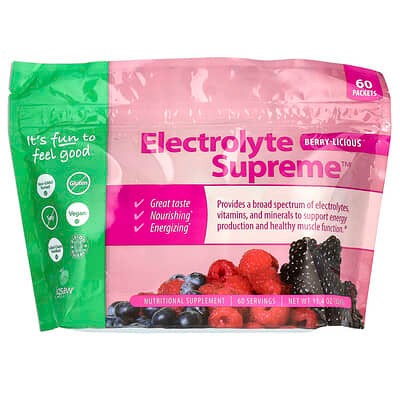
Electrolyte Supreme Berry-Licious

Goals
$59.97 $0.99 per serving


Product analysis
Electrolyte Supreme Berry-Licious contributes minerals for normal electrolyte balance, with potassium providing the clearest nutritional role. Undisclosed proportions of the sodium and potassium sources make the mineral mixture harder to compare.
AI assessment of the formula, label and price. How scoring works
Nutrient Quality39
Potassium chloride is a favorable, clearly identified chloride source. The potassium mixture combines sources of differing quality in unknown proportions, while comparative quality for many additions remains uncertain.
Ingredient Transparency75
All listed amounts and most forms are disclosed. Some forms and the proportions of mixed sodium and potassium sources are missing, limiting a complete comparison.
Value For Money56
The serving cost compares favorably for sodium and potassium, while chloride offers middling value. Most added nutrients lack a confident value comparison, leaving the complete mixture with mixed demonstrated value.
Customer Satisfaction67
Customer feedback is generally positive, though the review pool is small. That gives limited confidence about how widely shared the reported satisfaction is.
Product Focus44
Potassium provides the clearest connection to electrolyte balance and blood-vessel tone. The many added nutrients make the mixture broader, while the small magnesium contribution does not establish a substantial separate benefit.
- Format
Powder - Container
- 60 Packet(s)
- Per serving
- $0.99
- Customer rating
- 4.5 · 93 ratings
Goals

Impact
Moderate effect
Magnesium · 20 mgVitamin B12 · 6 mcgVitamin B6 · 1 mg
Potassium at 210 mg is the main contribution to electrolyte balance and blood-vessel tone. Magnesium at 20 mg adds a small nutrient amount; the supplied blood-pressure evidence is limited and used larger daily exposures. B6 and B12 support normal nutrient metabolism, without established independent prevention of major heart outcomes.
How this product is rated for Heart Health
Ingredient fit65
Relevant nutrients sit within a broader formula with ingredients outside the reviewed heart functions. The counted nutrient reaches the full saved amount comparison; that comparison is not a demonstrated blood-pressure regimen.
Goal fit
Relevant nutrients sit within a broader formula with ingredients outside the reviewed heart functions.
Dose adequacy
The counted nutrient reaches the full saved amount comparison; that comparison is not a demonstrated blood-pressure regimen.
Pathways19
The main mechanism in the saved assessment is electrolyte balance and blood-vessel tone. None of the three target mechanisms reaches the saved coverage threshold.
Depth
The main mechanism in the saved assessment is electrolyte balance and blood-vessel tone.
Breadth
None of the three target mechanisms reaches the saved coverage threshold.
Evidence60
Potassium leads the saved evidence comparison; this does not establish prevention of major heart outcomes. The nutrients counted at sufficient amounts match recognized preparations.
Evidence strength
Potassium leads the saved evidence comparison; this does not establish prevention of major heart outcomes.
Studied preparation
The nutrients counted at sufficient amounts match recognized preparations.
Formulation logic100
The counted nutrients can contribute independently or have their required partner. No configured ingredient conflict was found in the supplied assessment. 1 of 1 counted nutrients reach the saved minimum amount criterion.
Partner coverage
The counted nutrients can contribute independently or have their required partner.
Conflicts
No configured ingredient conflict was found in the supplied assessment.
Effective doses
1 of 1 counted nutrients reach the saved minimum amount criterion.
Ingredients
| Ingredient | Amount per serving | Score |
|---|---|---|
Calories | 10 Calorie(s) | |
Total Carbohydrates | 4 Gram(s) | |
Vitamin C (Calcium Ascorbate) | 260 mg | |
Vitamin B6 (Pyridoxal 5-Phosphate) | 1 mg | |
Vitamin B12 (Methylcobalamin) | 6 mcg | |
Biotin | 75 mcg | |
Calcium (Calcium Ascorbate) | 30 mg | |
Iodine (Potassium Iodide) | 50 mcg | |
Magnesium (DiMagnesium Malate) | 20 mg | |
Zinc (Zinc Bisglycinate Chelate) | 3.75 mg | |
Selenium (L-Selenomethionine) | 18 mcg | |
Copper (Copper Bisglycinate Chelate) | 200 mcg | |
Manganese (Manganese Bisglycinate Chelate) | 0.5 mg | |
Chromium (Chromium Nicotinate Glycinate Chelate) | 40 mcg | |
Sodium (Sea Salt, Sodium Bicarbonate) | 270 mg | |
Potassium (Potassium Bicarbonate, Potassium Chloride, Potassium Iodide) | 210 mg | |
Chloride (Potassium Chloride) | 200 mg |
Sodium (Sea Salt, Sodium Bicarbonate) · 270 mg OverallScore94
A serving contains 270 mg of sodium, along with 210 mg of potassium and 20 mg of magnesium. Sodium bicarbonate is among the sources, but their individual contributions are unknown.
How this ingredient is rated
Active Ingredient Quality & Bioavailability100
Sodium bicarbonate is among the sources; the remaining source and proportions are unknown. It is a buffering form.
Sodium Source Purity & Quality
Sodium bicarbonate is among the sources, but the other source and the amounts from each are unknown.
Bioavailability of Supporting Electrolytes
At least one supporting electrolyte uses a form considered favorable in the evaluation, though its exact form is not identified in the available facts.
Trace Mineral Complex & Buffering Forms
Sodium bicarbonate is present and is a buffering form.
Dose, Safety & Label Transparency85
The serving lists 270 mg of sodium. No artificial color or sweetener is identified in the available ingredient evidence.
Sodium Dosage for Athletic Replenishment
The serving provides 270 mg of sodium for exercise-related replenishment.
Ingredient Label Transparency
The serving amounts are individually specified: 270 mg sodium, 210 mg potassium and 20 mg magnesium.
Artificial Color and Sweetener Disclosure
No artificial color or sweetener is identified in the available ingredient evidence.
Value100
A whole-product serving costs about $1.00; the price is for the entire product, not sodium alone.
Price Per Serving vs. Collection Median
A whole-product serving costs about $1.00; the price is for the entire product, not sodium alone.
Chloride (Potassium Chloride) · 200 mg OverallScore78
A serving provides 200 mg chloride from potassium chloride, a meaningful amount. The whole-product serving costs about $1.00.
How this ingredient is rated
Active Ingredient Quality & Bioavailability80
The named chloride source is potassium chloride.
Chloride source quality
The named chloride source is potassium chloride.
Dose, Safety & Label Transparency90
A serving provides 200 mg chloride, a meaningful amount. The label lists both the chloride amount and its potassium chloride source.
Chloride amount per serving
A serving provides 200 mg chloride, a meaningful amount.
Amount and source disclosure
The label lists both the chloride amount and its potassium chloride source.
Value50
The whole-product serving costs about $1.00.
Price per serving
The whole-product serving costs about $1.00.
Each serving provides 210 mg of potassium, a moderate amount in this comparison. The listed forms are potassium bicarbonate, chloride, iodide and glycinate; their proportions are unknown.
How this ingredient is rated
Active Ingredient Quality & Bioavailability36
The listed forms are potassium bicarbonate, chloride, iodide and glycinate; their proportions are unknown.
Potassium Form Quality
The listed forms are potassium bicarbonate, chloride, iodide and glycinate; their proportions are unknown.
Dose, Safety & Label Transparency64
Each serving provides 210 mg of potassium, a moderate amount in this comparison. The potassium amount is stated, though the saved evidence does not explicitly use the wording “elemental potassium.”
Potassium Dosage Potency
Each serving provides 210 mg of potassium, a moderate amount in this comparison.
Elemental Yield Transparency
The potassium amount is stated, though the saved evidence does not explicitly use the wording “elemental potassium.”
Value100
A whole-product serving costs about $1.00.
Potassium Value Efficiency
A whole-product serving costs about $1.00.
Alternative products
Report alternatives
Sources
Published studies used for the product analysis and the top-ranked studies for each ingredient and goal.
- Quantitative Association Between Serum/Dietary Magnesium and Cardiovascular Disease/Coronary Heart Disease Risk: A Dose-Response Meta-analysis of Prospective Cohort Studies.
- Effects of magnesium supplementation on improving hyperglycemia, hypercholesterolemia, and hypertension in type 2 diabetes: A pooled analysis of 24 randomized controlled trials.
- The effect of lowering blood pressure by magnesium supplementation in diabetic hypertensive adults with low serum magnesium levels: a randomized, double-blind, placebo-controlled clinical trial.
- Positive effects of magnesium supplementation in metabolic syndrome.
- Comparative Efficacy of Nutraceuticals on Endothelial Function: A Systematic Review and Network Meta-Analysis.
- Potassium intake, stroke, and cardiovascular disease a meta-analysis of prospective studies.
- Oral potassium supplementation for management of essential hypertension: A meta-analysis of randomized controlled trials.
- Joint association of urinary sodium and potassium excretion with cardiovascular events and mortality: prospective cohort study.
- Effect of Potassium Supplementation on Endothelial Function: A Systematic Review and Meta-Analysis of Intervention Studies.
- Effects of potassium supplementation on office, home, and 24-h blood pressure in patients with essential hypertension.
- Selenium concentration is associated with occurrence and diagnosis of three cardiovascular diseases: A systematic review and meta-analysis.
- Effect of supplementation with high-selenium yeast on plasma lipids: a randomized trial.
- Exploring the Impact of Selenium Supplementation on Nutritional, Inflammatory, and Cardiac Function in Chronic Heart Failure Patients: A Novel Approach to Managing Deficiency.
- Higher serum selenium concentration is associated with lower risk of all-cause and cardiovascular mortality among individuals with chronic kidney disease: A population-based cohort study of NHANES.
- Correlation between dietary selenium intake and stroke in the National Health and Nutrition Examination Survey 2003-2018.
- Vitamin B12 deficiency is associated with cardiovascular autonomic neuropathy in patients with type 2 diabetes.
- Vitamin B12 Status and Cardiovascular Risk: Novel Insights from NMR-Based Lipoprotein Profiling in 20,665 Adults.
- Vitamin B12 and folate status in early pregnancy and cardiometabolic risk factors in the offspring at age 5-6 years: findings from the ABCD multi-ethnic birth cohort.
- Orthostatic tolerance in older patients with vitamin B12 deficiency before and after vitamin B12 replacement.
- The impact of folic acid/VB12 deficiency on essential hypertension in children and adolescents: from a nested case-control and a cohort study.