
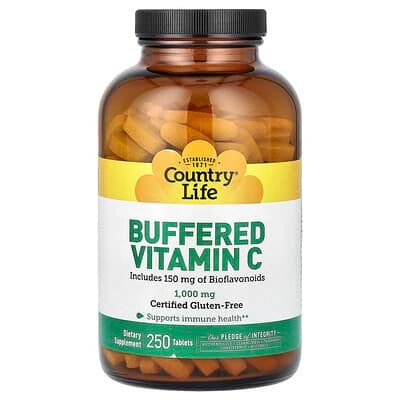

$29.99 $0.11 per serving


Product analysis
Buffered Vitamin C 1000 mg supports normal immune function and collagen formation, with the clearest everyday benefit when dietary intake is low. Its vitamin C price comparison is favourable.
AI assessment of the formula, label and price. How scoring works
Nutrient Quality40
The ingredient sources are clearly named, which helps with comparison. The buffered description does not establish a special absorption or quality advantage.
Ingredient Transparency100
The amounts and forms are clearly disclosed throughout the formula. That makes it straightforward to compare servings and preparations.
Value For Money66
The vitamin C looks good value for the amount supplied. The accompanying minerals and flavonoids do not have reliable separate value comparisons.
Customer Satisfaction85
Customers are strongly positive about the supplement. A substantial review base makes the satisfaction pattern more established, without proving a health benefit.
Product Focus73
The formula centres on vitamin C for normal immune nutrition, antioxidant functions and collagen formation. Benefits depend mainly on nutritional needs, and the buffered preparation does not establish extra benefits.
- Format
Tablet - Container
- 250 Tablet(s)
- Per serving
- $0.11
- Also available
 Buffered Vitamin C 1000 mg$19.19
- Customer rating
- 4.8 · 1,449 ratings
Goals


Impact
High effect
Magnesium · 12 mgVitamin C · 1000 mg

Impact
High effect
Vitamin C · 1000 mg

Impact
High effect
Vitamin C · 1000 mg

Impact
High effect
Vitamin C · 1000 mg
Ingredients
| Ingredient | Amount per serving | Score |
|---|---|---|
Vitamin C (Ascorbic Acid) | 1000 mg | |
Calcium (Calcium Carbonate) | 200 mg | |
Magnesium (Magnesium Oxide) | 12 mg | |
Lemon Bioflavonoids (Citrus limonum) | 150 mg |
Vitamin C (Ascorbic Acid) · 1000 mg OverallScore72
A serving provides 1,000 mg of vitamin C at a very low cost for the amount supplied. It uses ascorbic acid. Minerals partially buffer the acid.
How this ingredient is rated
Active Ingredient Quality & Bioavailability39
It uses ascorbic acid. The ascorbic acid is partially buffered by minerals.
Vitamin C Chemical Form & Delivery System
It uses ascorbic acid.
Gastric Comfort & pH Balance
The ascorbic acid is partially buffered by minerals.
Dose, Safety & Label Transparency91
A serving provides 1,000 mg of vitamin C. Standard excipients are listed.
Optimal Dosage Targeting
A serving provides 1,000 mg of vitamin C.
Purity & Excipient Quality
The Other Ingredients include standard excipients.
Mineral & Source Transparency
The vitamin C amount and its ascorbic acid form are stated; no associated mineral amount is needed for that form.
Value100
The cost per gram of vitamin C is very low.
Price per Gram of Vitamin C
The cost per gram of vitamin C is very low.
Alternative products
Report alternatives
Sources
Published studies used for the product analysis and the top-ranked studies for each ingredient and goal.
- Perioperative systemic magnesium to minimize postoperative pain: a meta-analysis of randomized controlled trials.
- Long-term outcome after intravenous magnesium sulphate in suspected acute myocardial infarction: the second Leicester Intravenous Magnesium Intervention Trial (LIMIT-2).
- Association of magnesium sulfate use with mortality in critically ill patients with sepsis: a retrospective propensity score-matched cohort study.
- Hypomagnesemia and Mortality in Incident Hemodialysis Patients.
- The effects of magnesium supplementation on abnormal uterine bleeding, alopecia, quality of life, and acne in women with polycystic ovary syndrome: a randomized clinical trial.
- Dietary intake and blood concentrations of antioxidants and the risk of cardiovascular disease, total cancer, and all-cause mortality: a systematic review and dose-response meta-analysis of prospective studies.
- Scientific Opinion on the substantiation of a health claim related to vitamin C and increasing non haem iron absorption pursuant to Article 14 of Regulation (EC) No 1924/2006.
- Vitamin C Depletion and All-Cause Mortality in Renal Transplant Recipients.
- Associations of Serum Biomarkers of Fruit and Vegetable Intake With the Risk of Cause-Specific Mortality and All-Cause Mortality: A National Prospective Cohort Study.
- Relation between plasma ascorbic acid and mortality in men and women in EPIC-Norfolk prospective study: a prospective population study. European Prospective Investigation into Cancer and Nutrition.
- Role of Oral Vitamin 'C' on Astigmatic Errors in Phacoemulsification.
- Ascorbic acid metabolites are involved in intraocular pressure control in the general population.
- Nutritional modulation of cataract.
- Dietary n-3 Fatty Acid, α-Tocopherol, Zinc, vitamin D, vitamin C, and β-carotene are Associated with Age-Related Macular Degeneration in Japan.
- Adherence to a Mediterranean diet, lifestyle and age-related macular degeneration: the Coimbra Eye Study - report 3.
- Hypomagnesemia Is a Risk Factor for Infections after Kidney Transplantation: A Retrospective Cohort Analysis.
- Higher Intake of Dietary Magnesium Is Inversely Associated With COVID-19 Severity and Symptoms in Hospitalized Patients: A Cross-Sectional Study.
- Mg2+ regulates cytotoxic functions of NK and CD8 T cells in chronic EBV infection through NKG2D.
- Effect of magnesium on granulocyte function and on the exercise induced inflammatory response.
- Maternal and neonatal outcomes following magnesium sulfate in the setting of chorioamnionitis: a meta-analysis.