



Biotin Supportive
$16.59 $0.55 per serving
Product analysis
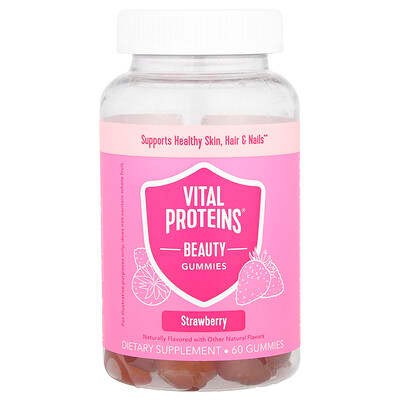
Vital Proteins Strawberry Beauty Gummies are a convenient option for hair and nail support, with 2,500 mcg of biotin and 8 mg of zinc per two gummies. The biotin amount aligns with the limited evidence for brittle nails and offers good value, although the gummies also contain 2 g of added sugar.
AI assessment of the formula, label and price. How scoring works
Nutrient Quality54
The gummies include well-identified forms of niacin, zinc and selenium. The biotin form is less specific, and the vitamin A and C sources lack a detailed comparative form assessment.
Ingredient Transparency86
The amounts of the vitamins, minerals and other nutrition entries are declared. Form identification is fairly useful for the vitamins and minerals, although biotin's isomer is not specified.
Value For Money47
Biotin offers good value for a nail-oriented gummy, with zinc also reasonably priced for the amount. The lower amounts of some other nutrients, particularly vitamin C and selenium, compare less favorably on cost.
Customer Satisfaction73
Customer feedback is positive, averaging 4.7 out of 5. The 215 ratings provide some useful perspective, though the sample is not particularly large.
Product Focus73
The gummies focus on related hair, skin and nail uses, with the strongest rationale for biotin and nail support. Zinc and the other vitamins chiefly offer complementary nutrition rather than a broad range of demonstrated outcomes.
- Format
Gummy - Container
- 60 Gummy(ies)
- Per serving
- $0.55
- Customer rating
- 4.7 · 215 ratings
Goals

Impact
Highest effect
Biotin · 2500 mcg
Beauty Gummies Strawberry is a biotin-led option for nail support. Its 2500 mcg biotin per two gummies matches the exposure described in the supplied brittle-nail evidence. Zinc at 8 mg supports nail-matrix cell function and is mainly relevant when a zinc gap contributes to nail changes. Vitamin C at 50 mg supplies a smaller complementary role in normal collagen formation.
Selenium Adverse
Vitamin C Supportive
Zinc No effect
Impact
High effect
Zinc · 8 mgVitamin C · 50 mgSelenium · 5.5 mcg
Beauty Gummies Strawberry has a narrow skin-health role through nutritional support. Its 8 mg of zinc supports normal repair when intake is inadequate. Biotin at 2,500 mcg supplies a nutrient whose deficiency can affect the skin, while vitamin A at 900 mcg supports normal skin-cell differentiation.
Vitamin A Supportive
Zinc Supportive
Niacin Supportive
Vitamin C Supportive
Selenium Supportive
Biotin Supportive

Impact
High effect
Biotin · 2500 mcgZinc · 8 mgVitamin C · 50 mg
Beauty Gummies Strawberry offers nutritional support for deficiency-related hair concerns. Biotin at 2,500 mcg and zinc at 8 mg are relevant when a shortage of either nutrient contributes to shedding.
Zinc Supportive
Vitamin A Disputed
Selenium Disputed
Vitamin C Mixed
Biotin Supportive
Niacin Disputed
Ingredients
| Ingredient | Amount per serving | Score |
|---|---|---|
Calories | 15 Calorie(s) | |
Total Carbohydrates | 4 Gram(s) | |
Vitamin A (Retinyl Palmitate) | 900 mcg RAE | |
Vitamin C (Ascorbic Acid) | 50 mg | |
Niacin (Niacinamide) | 8 mg NE | |
Biotin | 2500 mcg | |
Zinc (Zinc Citrate) | 8 mg | |
Selenium (L-Selenomethionine) | 5.5 mcg |
Biotin · 2500 mcg OverallScore84
Vital Proteins Beauty Gummies Strawberry offers good value for biotin at $1.11 per 5,000 mcg of biotin; a serving costs $0.55 for the full formula. Each serving supplies 2,500 mcg, a substantial amount for hair and nail support. The label lists Biotin without specifying the isomer. The serving contains 2 g of added sugar.
Alternative products
Report alternatives
Sources
Published studies used for the product analysis and the top-ranked studies for each ingredient and goal.
- The Role of Sesbania grandiflora-Derived Biotin and Bambusa arundinacea-Derived Silica Extracts in Promoting Hair, Skin, and Nail Health: A Randomized, Double-Blind, Placebo-Controlled Clinical Study.
- Low serum biotinidase activity in children with valproic acid monotherapy.
- Vitamins A, B, C, and D: A Short Review for the Dermatologist.
- The Infatuation With Biotin Supplementation: Is There Truth Behind Its Rising Popularity? A Comparative Analysis of Clinical Efficacy versus Social Popularity.
- A pilot study evaluating the efficacy of topically applied niacin derivatives for treatment of female pattern alopecia.
- Topical adenosine increases thick hair ratio in Japanese men with androgenetic alopecia.
- Beyond Efficacy: 0.6% Selenium Disulfide Shampoo Matches 2% Ketoconazole for Seborrheic Dermatitis with Superior Cosmesis.
- Selenium Disulfide-based shampoo applied for 4 weeks significantly improves dandruff and seborrheic dermatitis.
- A Comparative Randomized Clinical Study Assessing the Efficacy of a 1% Selenium Disulfide-Based Shampoo versus 2% Ketoconazole Shampoo in Subjects with Moderate to Severe Scalp Seborrheic Dermatitis.
- Changes of serum trace elements level in patients with alopecia areata: A meta-analysis.
- Scientific opinion on the tolerable upper intake level for selenium.
- Topical tretinoin for hair growth promotion.
- A review of isotretinoin in the treatment of frontal fibrosing alopecia.
- Efficacy of Isotretinoin and Acitretin in Treatment of Frontal Fibrosing Alopecia: Retrospective Analysis of 54 Cases.
- Systemic Treatments for Lichen Planopilaris and Frontal Fibrosing Alopecia: A Retrospective Study of 315 Patients.
- Tretinoin enhances minoxidil response in androgenetic alopecia patients by upregulating follicular sulfotransferase enzymes.
- Management of hair loss associated with endocrine therapy in patients with breast cancer: an overview.
- Elucidating causal relationships of diet-derived circulating antioxidants and the risk of non-scarring alopecia: A Mendelian randomization study.
- Alterations of plasma antioxidants and mitochondrial DNA mutation in hair follicles of smokers.
- Removal of synthetic hair dye using formamidine sulfinic acid and other sulfinate precursors.