


Vitamin D Supportive
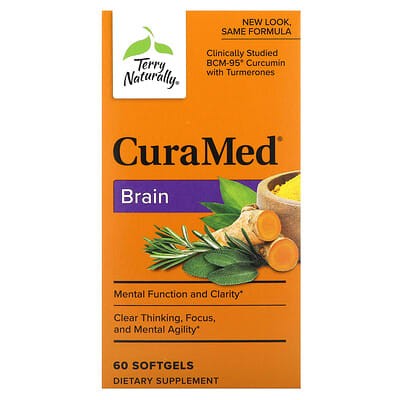
$41.56 $1.38 per serving
Product analysis
Terry Naturally CuraMed Brain is intended to support mental clarity and focus, combining 2,000 IU of vitamin D3 with a 600 mg botanical complex in two softgels. The blend lists curcumin, rosemary and sage but does not identify their individual amounts, so the vitamin D contribution to normal nutritional health is clearer than the proposed cognitive benefits.
AI assessment of the formula, label and price. How scoring works
Nutrient Quality91
Vitamin D3 is a favorable and clearly identified form of vitamin D. The quality of the combination blend is harder to establish without more information about its individual ingredients.
Ingredient Transparency65
The vitamin D and the total complex amount are declared. Individual blend amounts remain undisclosed, limiting comparisons with other cognitive-support formulas.
Value For Money47
The vitamin D is fairly priced for the amount supplied. The price covers the entire formula, so this comparison does not establish the value of the botanical complex.
Customer Satisfaction68
Customer feedback is favorable, with an average of 4.56 out of 5. The 57 ratings give a relatively small pool of experiences.
Product Focus40
The formula is marketed for mental focus, but its confirmed vitamin D contribution relates more clearly to general nutritional health. The undisclosed blend details make the cognitive benefits and complete ingredient count uncertain.
- Format
Softgel - Container
- 60 Softgel(s)
- Per serving
- $1.38
- Customer rating
- 4.5 · 32 ratings
Goals

Impact
High effect
Vitamin D · 2000 IU
CureMed Brain has a conditional nutritional role for energy when vitamin D deficiency is present. Its selected serving supplies 50 mcg vitamin D3 as cholecalciferol, addressing a nutrient whose inadequacy can matter to fatigue.

Impact
Highest effect
Vitamin D · 2000 IU
CureMed Brain offers a focused everyday-health contribution from 50 mcg of vitamin D3, mainly for bone and mineral function. Vitamin D helps the body use calcium, making the product most useful when dietary intake is inadequate. The supplied label facts do not confirm curcumin, so it adds no reliable basis for choosing this product.
Vitamin D Supportive

Impact
Highest effect
Vitamin D · 2000 IU
CureMed Brain supports normal immune function through its confirmed vitamin D content. Vitamin D3 at 50 mcg contributes to immune regulation. The supplied curcumin inventory is unresolved, so an additional immune contribution from curcumin cannot be confirmed.
Vitamin D Supportive

Impact
High effect
Vitamin D · 2000 IU
CureMed Brain has a narrow nutritional role in healthy aging through vitamin D. The serving supplies 50 mcg vitamin D3, which supports muscle function when inadequate status is corrected. Its curcumin amount is unresolved, and the supplied curcumin findings do not provide a clear additional healthy-aging benefit.
Vitamin D Supportive

Impact
High effect
Vitamin D · 2000 IU
CureMed Brain has a narrow nutritional fit for testosterone support when vitamin D deficiency is relevant. The serving supplies 50 mcg of vitamin D3, a nutrient whose hormone-related relevance depends on nutritional status.
Vitamin D Supportive

Impact
Highest effect
Vitamin D · 2000 IU
CureMed Brain has a limited direct fit for inflammation through its confirmed 50 mcg vitamin D serving. Vitamin D relates to inflammatory signaling, with mixed findings that include a temporary change in one inflammatory marker.
Vitamin D Supportive
Ingredients
| Ingredient | Amount per serving | Score |
|---|---|---|
Vitamin D3 (Cholecalciferol) | 2000 IU | |
Proprietary Complex | 600 mg |
Vitamin D (Cholecalciferol) · 2000 IU OverallScore71
Terry Naturally CureMed Brain provides a useful amount of vitamin D: 2,000 IU per serving. The form is D3, though its raw source is not specified. $0.67 per 1,000 IU of vitamin D makes it midrange value; $1.33 per serving covers the full formula. No certification or batch-specific testing is listed.
Alternative products
Report alternatives
Sources
Published studies used for the product analysis and the top-ranked studies for each ingredient and goal.
- Effect of Vitamin D Supplementation on Fatigue in Multiple Sclerosis: A Systematic Review and Meta-Analysis.
- Vitamin D Supplementation in Adolescents and Young Adults With Juvenile Systemic Lupus Erythematosus for Improvement in Disease Activity and Fatigue Scores: A Randomized, Double-Blind, Placebo-Controlled Trial.
- Vitamin D in Myalgic Encephalomyelitis/Chronic Fatigue Syndrome After COVID-19 or Vaccination: A Randomized Controlled Trial.
- The effects of vitamin D supplementation on disease activity and fatigue in Libyan rheumatoid arthritis patients.
- The effect of home-based aerobic training and vitamin D supplementation on fatigue and quality of life in patients with multiple sclerosis during COVID-19 outbreak.
- Vitamin D supplementation for prevention of mortality in adults.
- Effect of vitamin D on gastrointestinal symptoms and health-related quality of life in irritable bowel syndrome patients: a randomized double-blind clinical trial.
- The impact of vitamin D administration on mortality in COVID-19 patients: a systematic review and meta-analysis of randomized controlled trials.
- Vitamin D Status and Mortality: A Systematic Review of Observational Studies.
- Meta-analysis of long-term vitamin D supplementation on overall mortality.
- Vitamin D supplementation to prevent acute respiratory infections: individual participant data meta-analysis.
- Association Between Vitamin D and Influenza: Meta-Analysis and Systematic Review of Randomized Controlled Trials.
- Vitamin D3 and deconvoluting a rash.
- Effect of vitamin D3 supplementation on cellular immunity and inflammatory markers in COVID-19 patients admitted to the ICU.
- Current opinion on the role of vitamin D supplementation in respiratory infections and asthma/COPD exacerbations: A need to establish publication guidelines for overcoming the unpublished data.
- Vitamin D deficiency and C-reactive protein: a bidirectional Mendelian randomization study.
- Vitamin D in Children With Inflammatory Bowel Disease: A Randomized Controlled Clinical Trial.
- Vitamin D supplementation reduces infection rate and promotes wound healing in patients with diabetic foot ulcers.
- Associations of C-reactive Protein with 25-hydroxyvitamin D in 24 Specific Diseases: A Cross-sectional Study from NHANES.
- Combined effects of vitamin D deficiency and systemic inflammation on all-cause mortality and cause-specific mortality in older adults.