
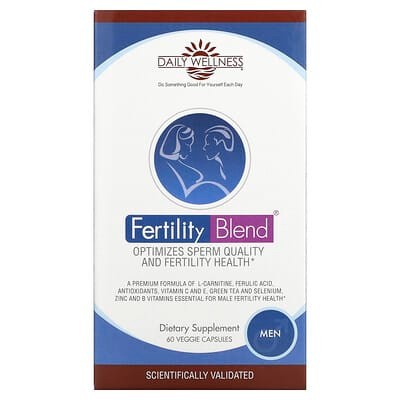
FertilityBlend Men

Goals
$32.99 $1.09 per serving


Product analysis
FertilityBlend Men supplies vitamins and minerals that may help fill dietary gaps supporting normal immune function and general nutrition. Its unidentified herbal blend makes it harder to judge the full formula.
AI assessment of the formula, label and price. How scoring works
Nutrient Quality35
Nutrient forms are mixed, with natural vitamin E a favorable feature and folic acid and sodium selenite less favorable choices. Several other ingredients lack enough information for a firm judgment about form quality.
Ingredient Transparency76
Nutrient amounts and most forms are clear, making much of the formula easy to check. The herbal blend does not identify its components, so its total amount cannot tell you what it contains.
Value For Money30
The known vitamin and mineral contributions offer limited value for the cost of the full serving. Missing information for several nutrients prevents a complete comparison.
Customer Satisfaction82
Customer ratings are positive. Thousands of reviews provide a broad view of customer opinion, without proving effectiveness or safety.
Product Focus38
The formula mainly provides nutritional support across general health, immunity and hair concerns. The unidentified blend prevents a clear picture of how concentrated the formula is.
- Format
Capsule - Container
- 60 Capsule(s)
- Per serving
- $1.09
- Customer rating
- 4.5 · 2,798 ratings
Goals

Impact
Moderate effect
Vitamin E · 150 IUVitamin C · 120 mg
Selenium at 70 mcg supports antioxidant enzymes, and 15 mg zinc supports normal immune function. These nutrients mainly help maintain adequacy rather than promise an added anti-inflammatory effect in well-nourished adults. Vitamin C adds antioxidant support at 120 mg.
How this product is rated for Inflammation
Ingredient fit50
Relevant ingredients sit alongside actives aimed at other needs, so the formula has a broader focus. The relevant amounts make a modest match to the saved dose comparisons; unresolved amounts limit that match.
Goal fit
Relevant ingredients sit alongside actives aimed at other needs, so the formula has a broader focus.
Dose adequacy
The relevant amounts make a modest match to the saved dose comparisons; unresolved amounts limit that match.
Pathways13
The strongest saved connection is oxidative and mitochondrial stress, with limited coverage. None of the reviewed routes reaches the saved level for broad coverage.
Depth
The strongest saved connection is oxidative and mitochondrial stress, with limited coverage.
Breadth
None of the reviewed routes reaches the saved level for broad coverage.
Evidence59
Selenium provides the strongest saved evidence at the assessed amount; its relevance remains dependent on the studied context. The preparations at the assessed amounts match those recognized in the saved review.
Evidence strength
Selenium provides the strongest saved evidence at the assessed amount; its relevance remains dependent on the studied context.
Studied preparation
The preparations at the assessed amounts match those recognized in the saved review.
Formulation logic92
The assessed ingredients can work independently or have their relevant partner. No ingredient conflicts were recorded in the supplied assessment. 2 of 3 assessed ingredients reach the saved amount threshold; Vitamin E fall below it.
Partner coverage
The assessed ingredients can work independently or have their relevant partner.
Conflicts
No ingredient conflicts were recorded in the supplied assessment.
Effective doses
2 of 3 assessed ingredients reach the saved amount threshold; Vitamin E fall below it.

Impact
Highest effect
Vitamin C · 120 mgZinc · 15 mgSelenium · 70 mcg
Zinc, selenium, folate, B6 and B12 supply nutrients involved in normal immune-cell function. They may help fill low dietary intake, without establishing added protection from infection when intake is adequate. Vitamin E's usable amount is unresolved and its respiratory evidence remains mixed. Green-tea source facts also remain unresolved; preparation-specific tea trials do not establish a generic extract benefit, and the smaller vitamin C amount is not independently counted.
How this product is rated for Immunity
Ingredient fit74
Zinc is a relevant contributor alongside the other counted ingredients. Their nutritional roles or limited regular-use evidence do not establish general infection prevention.
Goal fit
Zinc provides the main relevant contribution; the formula has no additional actives diluting this finding.
Dose adequacy
Vitamin E has an unresolved individual amount and cannot meet the amount comparison; the other counted ingredients do.
Pathways64
Lymphocyte function is the strongest association. The broader findings span lymphocyte function, oxidative and inflammatory balance.
Depth
lymphocyte function is the strongest association in the saved findings; this is not a prediction of protection against infection.
Breadth
lymphocyte function, oxidative and inflammatory balance meet the breadth comparison; coverage describes ingredient roles rather than clinical protection.
Evidence100
Zinc supplies an established normal-function nutrient; additional infection prevention with adequate intake is not established.
Evidence strength
Zinc supplies an established normal-function nutrient; additional infection prevention with adequate intake is not established.
Studied preparation
The counted preparations meet the saved preparation finding; no added clinical benefit from buffered, liposomal or named salt forms is established.
Formulation logic96
The partner and conflict checks are satisfied, while Vitamin E has an unresolved individual amount.
Partner coverage
Every counted ingredient works independently or has its required partner; this does not establish extra benefit from combining them.
Conflicts
None of the evaluated combinations triggered a conflict finding; this does not establish overall suitability.
Effective doses
Vitamin E does not meet the amount check because individual quantities are unresolved; the other counted ingredients meet it.

Impact
High effect
Zinc · 15 mgVitamin C · 120 mg
Zinc can help address a dietary gap that contributes to diffuse shedding. Folate supports cell division and selenium contributes antioxidant biology, but neither establishes routine hair growth; excessive selenium can worsen hair loss. The saved findings give the main emphasis to these nutrients, while the vitamin C and B12 amounts fall below the comparison threshold. Ordinary vitamin E cannot inherit the hair-count findings of a tocotrienol preparation.
How this product is rated for Hair Health
Ingredient fit70
Zinc supplies a relevant connection to nutrient-related shedding. The formula has uneven amount support across its relevant nutrients.
Goal fit
The relevant ingredients provide a concentrated connection to hair health, although broader product uses also affect the saved finding.
Dose adequacy
The relevant amounts provide partial support in the saved comparison, rather than matching all reference amounts.
Pathways44
The strongest connection is antioxidant biology, chiefly through selenium and other relevant nutrients. Coverage across the other assessed hair pathways is limited.
Depth
Selenium and other relevant nutrients give the strongest connection to antioxidant biology, without establishing routine hair regrowth.
Breadth
Antioxidant support is the only substantially covered area; androgen signalling and stress regulation receive no contribution.
Evidence98
Zinc supplies the strongest relevant basis for deficiency-related shedding. Other normal nutrient functions and matching preparations do not establish routine regrowth.
Evidence strength
Zinc provides the strongest relevant basis, principally for deficiency-related shedding rather than routine growth when intake is adequate.
Studied preparation
The contributing forms align with the saved preparation comparison, without proving that this product reproduces a studied hair outcome.
Formulation logic100
No missing required partners or configured conflicts were identified. The retained ingredients meet the saved minimum amount comparison, without implying synergy or a proven growth dose.
Partner coverage
No missing required partner was identified for the contributing ingredients; this does not imply an added benefit from combining them.
Conflicts
No configured ingredient conflict was identified among the assessed ingredients.
Effective doses
All ingredients retained in this finding reach its minimum amount comparison; that threshold is not a proven effective hair-growth dose.

Impact
Highest effect
Folate · 400 mcgVitamin B12 · 6 mcgSelenium · 70 mcgZinc · 15 mgVitamin C · 120 mg
Folate, vitamin B6 and B12 offer nutritional support when intake is low, with their saved findings centered on blood-formation-related metabolism. Zinc, selenium and vitamin C add further nutrient availability. The amounts receive mixed recognition, without establishing enhanced immunity, improved energy or broader benefits above adequate intake.
How this product is rated for Everyday Health
Ingredient fit84
The evaluated nutrients have mixed amount recognition, with folate more strongly recognized.
Goal fit
The credited ingredients provide a clear connection to the reviewed general-health functions.
Dose adequacy
The evaluated nutrients have mixed amount recognition, with folate more strongly recognized.
Pathways80
Folate and B vitamins drive blood-formation coverage, alongside antioxidant-related nutrient contributions.
Depth
Folate and B vitamins drive blood-formation coverage, alongside antioxidant-related nutrient contributions.
Breadth
Two functional areas reach the saved coverage threshold.
Evidence82
Folate supplies the strongest recognized evidence within a nutritional scope.
Evidence strength
Folate supplies the strongest recognized evidence within a nutritional scope.
Studied preparation
The evaluated nutrient declarations are recognized without a bonus for chemical form or delivery method.
Formulation logic100
The recognized ingredients have their required partners or work independently, with no matched formulation conflict.
Partner coverage
Recognized ingredients have any required partner or work independently; this does not establish added combination benefit.
Conflicts
No matched formulation conflict appears in the supplied findings.
Effective doses
All included ingredients meet the saved amount threshold; it is not a guarantee of clinical benefit or safety.
Ingredients
| Ingredient | Amount per serving | Score |
|---|---|---|
Vitamin C (Ascorbic Acid) | 120 mg | |
Vitamin E (D-Alpha-Tocopherol) | 150 IU | |
Vitamin B6 (Pyridoxine Hydrochloride) | 2 mg | |
Vitamin B12 (Cyanocobalamin) | 6 mcg | |
Folate (Folic Acid) | 400 mcg | |
Zinc (Zinc Gluconate) | 15 mg | |
Selenium (Sodium Selenite) | 70 mcg | |
Proprietary Blend | 900 mg |
Vitamin E (D-Alpha-Tocopherol) · 150 IU OverallScore60
A serving supplies 150 IU of vitamin E as natural d-alpha-tocopherol. The whole-product serving costs about $1.10.
How this ingredient is rated
Active Ingredient Quality & Bioavailability46
The named form is natural d-alpha-tocopherol.
Natural (d-alpha) vs. Synthetic (dl-alpha)
D-alpha-tocopherol is a natural vitamin E form.
Mixed Tocopherol Isomer Diversity
No mixed-tocopherol complex is identified in the saved facts.
Tocotrienol Complex Inclusion
No tocotrienols are identified in the saved facts.
Dose, Safety & Label Transparency85
A serving lists 150 IU of vitamin E. The saved facts identify the vitamin E form and the total amount in IU.
Therapeutic Dosage Range
A serving lists 150 IU of vitamin E.
Label Transparency and Isomer Specificity
The saved facts identify the vitamin E form and the total amount in IU.
Value40
The whole-product serving costs about $1.10.
Cost per Natural-Form Therapeutic Serving
The whole-product serving costs about $1.10.
Selenium (Sodium Selenite) · 70 mcg OverallScore43
Each serving provides 70 mcg of selenium, below the amount favored by the evaluation. The source is sodium selenite, an inorganic form rated less favorably than specific organic forms.
How this ingredient is rated
Active Ingredient Quality & Bioavailability32
Sodium selenite is an identified inorganic form, rated less favorably in the evaluation than specific organic forms.
Selenium Chemical Form
Sodium selenite is an inorganic form, which the evaluation rates less favorably than specific organic forms.
Form Transparency & Isomer Specificity
The selenium compound is identified as sodium selenite.
Dose, Safety & Label Transparency70
The 70 mcg of selenium per serving is below the evaluation's favored amount and does not exceed its upper limit.
Dosage Efficacy Sweet Spot
At 70 mcg per serving, selenium falls below the evaluation's favored amount.
Safety Margin & UL Adherence
The serving does not exceed the upper limit used in the evaluation; selenium from food also contributes to total intake.
Value10
The full-product price works out to about $3.14 per 200 mcg of selenium; it is a comparison figure, not a separate selenium price.
Price per 200 mcg Serving
The full-product price works out to about $3.14 per 200 mcg of selenium; it is a comparison figure, not a separate selenium price.
Folate (Folic Acid) · 400 mcg OverallScore10
Each serving lists 400 mcg folate from folic acid, which needs conversion to active folate. Its DFE basis is not established in the saved evaluation, so the amount cannot be compared on that basis.
How this ingredient is rated
Active Ingredient Quality & Bioavailability14
Folate comes from folic acid, which must be converted to active folate.
Folate Form Hierarchy
Folic acid is a synthetic form that requires conversion to become active folate.
Patented Sources & Isomeric Purity
The saved evaluation identifies no branded source or separate active-isomer marker.
Dose, Safety & Label Transparency0
Each serving lists 400 mcg folate, but an unambiguous DFE basis is not established.
Folate Dosage by Declared Basis
The stored amount does not establish a DFE basis or a separate folic acid source amount for evaluation.
Value20
The whole-product serving costs about $1.10.
Price per Bioavailable Serving
The whole-product serving costs about $1.10.
Alternative products
Report alternatives
Sources
Published studies used for the product analysis and the top-ranked studies for each ingredient and goal.
- Intakes of Folate, Vitamin B6, and Vitamin B12 in Relation to All-Cause and Cause-Specific Mortality: A National Population-Based Cohort.
- The responsiveness of plasma homocysteine to small increases in dietary folic acid: a primary care study.
- Associations of Serum Folate and Homocysteine Concentrations with All-Cause, Cardiovascular Disease, and Cancer Mortality in Men and Women in Korea: the Cardiovascular Disease Association Study.
- The concept of folic acid supplementation and its role in prevention of neural tube defect among pregnant women: PRISMA.
- Systematic review of adverse health outcomes associated with high serum or red blood cell folate concentrations.
- Associations of selenium status with all-cause and cause-specific mortality: a systematic review and meta-analysis of cohort studies.
- Dietary Antioxidants, Circulating Antioxidant Concentrations, Total Antioxidant Capacity, and Risk of All-Cause Mortality: A Systematic Review and Dose-Response Meta-Analysis of Prospective Observational Studies.
- The efficacy and safety of selenium supplementation versus placebo in the treatment of Graves' orbitopathy: A systematic review and meta-analysis of randomised controlled trials.
- Associations of plasma metal concentrations with the risks of all-cause and cardiovascular disease mortality in Chinese adults.
- Updates on clinical studies of selenium supplementation in radiotherapy.
- Oral Vitamin B12 versus Placebo for the Prevention of Chemotherapy-Induced Peripheral Neuropathy in Gynecological Cancer Patients: A Randomized, Double-Blind, Placebo-Controlled Trial.
- Vitamin B12 Supplementation in Diabetic Neuropathy: A 1-Year, Randomized, Double-Blind, Placebo-Controlled Trial.
- A single-center randomized controlled trial of local methylcobalamin injection for subacute herpetic neuralgia.
- Local Injection of Methylcobalamin Combined with Lidocaine for Acute Herpetic Neuralgia.
- The Effect of Vitamin B12 and Folic Acid Supplementation on Serum Homocysteine, Anemia Status and Quality of Life of Patients with Multiple Sclerosis.
- Dietary intake and blood concentrations of antioxidants and the risk of cardiovascular disease, total cancer, and all-cause mortality: a systematic review and dose-response meta-analysis of prospective studies.
- Scientific Opinion on the substantiation of a health claim related to vitamin C and increasing non haem iron absorption pursuant to Article 14 of Regulation (EC) No 1924/2006.
- Vitamin C Depletion and All-Cause Mortality in Renal Transplant Recipients.
- Associations of Serum Biomarkers of Fruit and Vegetable Intake With the Risk of Cause-Specific Mortality and All-Cause Mortality: A National Prospective Cohort Study.
- Relation between plasma ascorbic acid and mortality in men and women in EPIC-Norfolk prospective study: a prospective population study. European Prospective Investigation into Cancer and Nutrition.