
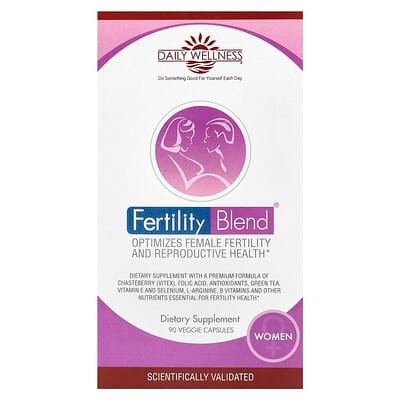
Fertility Blend Women

Goals
$36.99 $1.23 per serving


Product analysis
Fertility Blend Women provides nutrients that may help fill dietary gaps affecting normal energy use and blood formation. An incompletely described herbal blend and high cost relative to several nutrient amounts make it harder to judge the value.
AI assessment of the formula, label and price. How scoring works
Nutrient Quality34
Natural vitamin E is a favorable choice, while magnesium oxide, folic acid and sodium selenite are less favorable forms. The unidentified herbal preparation leaves an additional part of the formula unclear.
Ingredient Transparency77
The listed nutrient and total blend amounts are stated, and individual nutrient forms are named. The herbal blend does not identify its components or their proportions, making the contents hard to judge.
Value For Money25
Several nutrients are costly in relation to the amounts provided, particularly magnesium and selenium. Natural vitamin E is somewhat more competitive, but the formula still offers limited value.
Customer Satisfaction81
Customer feedback is generally positive across a large number of ratings. That broad feedback base describes customer reception without establishing fertility or other health benefits.
Product Focus31
The clearest supported role is filling nutritional gaps, with more limited links to energy, bones and immune function. The unidentified herbal blend prevents a complete picture of the active ingredients.
- Format
Capsule - Container
- 90 Capsule(s)
- Per serving
- $1.23
- Customer rating
- 4.4 · 3,921 ratings
Goals

Impact
Moderate effect
Magnesium · 400 mgZinc · 15 mg

Impact
Lower effect
Magnesium · 400 mgZinc · 15 mg
Vitamin B6 Not classified
No linked studies yet.


Impact
High effect
Folate · 400 mcgVitamin B12 · 12 mcgMagnesium · 400 mgSelenium · 70 mcgZinc · 15 mg

Impact
Moderate effect
Magnesium · 400 mgVitamin B12 · 12 mcgVitamin B6 · 6 mgFolate · 400 mcg

Impact
Limited evidence
Zinc · 15 mgIron · 18 mg
Ingredients
| Ingredient | Amount per serving | Score |
|---|---|---|
Vitamin E (D-Alpha-Tocopherol) | 150 IU | |
Vitamin B6 (Pyridoxine Hydrochloride) | 6 mg | |
Vitamin B12 (Cyanocobalamin) | 12 mcg | |
Folate (Folic Acid) | 400 mcg | |
Iron (Iron Gluconate) | 18 mg | |
Magnesium (Magnesium Oxide) | 400 mg | |
Zinc (Zinc Gluconate) | 15 mg | |
Selenium (Sodium Selenite) | 70 mcg | |
Proprietary Blend | 1080 mg |
Vitamin E (D-Alpha-Tocopherol) · 150 IU OverallScore60
A serving provides 150 IU of vitamin E at a high cost. It uses natural D-Alpha-Tocopherol. The available information does not establish a mixed-tocopherol complex or tocotrienols.
How this ingredient is rated
Active Ingredient Quality & Bioavailability46
D-Alpha-Tocopherol is natural. The available information does not establish mixed tocopherols or tocotrienols.
Natural (d-alpha) vs. Synthetic (dl-alpha)
D-Alpha-Tocopherol is a natural form of vitamin E.
Mixed Tocopherol Isomer Diversity
The available information does not establish a mixed-tocopherol complex with gamma and delta forms.
Tocotrienol Complex Inclusion
The available information does not establish whether tocotrienols are included.
Dose, Safety & Label Transparency85
The 150 IU amount falls in the range used for general antioxidant support. The form and total IU amount are specified, but individual isomer amounts are not given.
Therapeutic Dosage Range
The 150 IU amount falls in the range used for general antioxidant support.
Label Transparency and Isomer Specificity
The form and total IU amount are specified, but individual isomer amounts are not given.
Value40
The serving cost is high for a natural form of vitamin E.
Cost per Natural-Form Therapeutic Serving
The serving cost is high for a natural form of vitamin E.
Iron (Iron Gluconate) · 18 mg OverallScore57
It provides 18 mg of iron per serving at a high cost per serving. The iron source is iron gluconate.
How this ingredient is rated
Active Ingredient Quality & Bioavailability31
The iron source is iron gluconate. Vitamin B12, folate and zinc are listed; zinc may compete with iron absorption.
Iron Chemical Form & Bioavailability
The iron source is iron gluconate.
Absorption Support & Blocker Avoidance
Vitamin B12, folate and zinc are listed; zinc may compete with iron absorption.
Dose, Safety & Label Transparency100
The serving provides 18 mg of iron. The amount is stated separately from compound weight.
Elemental Iron Label Clarity
The iron amount is stated separately from compound weight.
Dosage Effectiveness & Safety Range
The serving provides 18 mg of iron.
Value20
The cost per serving is high.
Price per Effective Serving
The cost per serving is high.
Magnesium (Magnesium Oxide) · 400 mg OverallScore48
A serving provides 400 mg of magnesium at a high whole-product cost per serving. It uses Magnesium Oxide. A positive amount of vitamin B6, vitamin D or boron is stated, though the specific cofactor is unclear.
How this ingredient is rated
Active Ingredient Quality & Bioavailability14
It uses Magnesium Oxide. No branded or fully chelated magnesium claim is specified.
Magnesium Form & Absorption Potential
It uses Magnesium Oxide.
Patented Materials & Chelation Quality
No branded or fully chelated magnesium claim is specified.
Dose, Safety & Label Transparency100
The serving contains 400 mg of elemental magnesium. A positive amount of vitamin B6, vitamin D or boron is stated, though the specific cofactor is unclear.
Elemental Yield Transparency
The elemental magnesium amount is stated.
Therapeutic Dosage Alignment
A serving provides 400 mg of elemental magnesium.
Synergistic Formulation Logic
A positive amount of vitamin B6, vitamin D or boron is stated, though the specific cofactor is unclear.
Value10
The whole-product cost per serving is high.
Price Per Elemental Quality
The whole-product cost per serving is high.
Alternative products
Report alternatives
Sources
Published studies used for the product analysis and the top-ranked studies for each ingredient and goal.
- Association between RBC folate and lumbar bone mineral density in postmenopausal women, a cross-sectional study from NHANES 2009-2018.
- Genetic variants modify the associations of concentrations of methylmalonic acid, vitamin B-12, vitamin B-6, and folate with bone mineral density.
- Adequate Intake and Supplementation of B Vitamins, in Particular Folic Acid, can Play a Protective Role in Bone Health.
- Relation of homocysteine, folate, and vitamin B12 to bone mineral density of postmenopausal women.
- Dietary intake of folate, but not vitamin B2 or B12, is associated with increased bone mineral density 5 years after the menopause: results from a 10-year follow-up study in early postmenopausal women.
- Association between Serum Magnesium and Fractures: A Systematic Review and Meta-Analysis of Observational Studies.
- Bioabsorbable Magnesium-Based Materials Potential and Safety in Bone Surgery: A Systematic Review.
- Vascularized bone grafting fixed by biodegradable magnesium screw for treating osteonecrosis of the femoral head.
- An update on magnesium and bone health.
- Sex-specific differences in the association of magnesium intake with femoral neck bone mineral density among older adults.
- Effect of Vitamin B12 and Folic Acid Supplementation on Bone Mineral Density and Quantitative Ultrasound Parameters in Older People with an Elevated Plasma Homocysteine Level: B-PROOF, a Randomized Controlled Trial.
- Plasma B vitamins, homocysteine, and their relation with bone loss and hip fracture in elderly men and women.
- Relation between homocysteine and B-vitamin status indicators and bone mineral density in older Americans.
- The role of B-vitamin intake, B-vitamin-rich dietary patterns, the B-vitamin deficiency index in bone mineral density among school-aged children.
- Hyperhomocysteinemia is Associated with Inflammation, Bone Resorption, Vitamin B12 and Folate Deficiency and MTHFR C677T Polymorphism in Postmenopausal Women with Decreased Bone Mineral Density.
- The Effects of the AGE Inhibitor Pyridoxamine on Bone in Older Women With Type 2 Diabetes: A Randomized Clinical Trial.
- Dietary B vitamin intake and risk of hip fracture: the Singapore Chinese Health Study.
- Hip fracture patients may be vitamin B6 deficient. Controlled study of serum pyridoxal-5'-phosphate.
- Degree of mineralization-related collagen crosslinking in the femoral neck cancellous bone in cases of hip fracture and controls.
- Increased incidence of fractures in middle-aged and elderly men with low intakes of phosphorus and zinc.