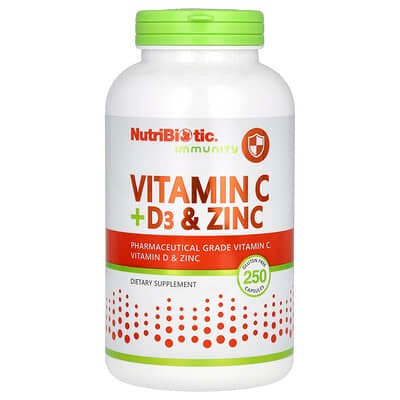
Vitamin C + D3 & Zinc

Vitamin C + D3 & Zinc

NutriBiotic Immunity4.9 (19,779 ratings)
Format:Capsule Quantity: 250 Capsule(s) · 125 servings
Goals
$22.49 $0.17 per serving

About this product

Combining three nutrients at a low serving cost is the main practical benefit. Vitamin C supports collagen formation and antioxidant functions, while zinc and vitamin D contribute to normal immune nutrition. These roles matter most when intake is low, and larger amounts do not establish additional benefit once needs are met.

The fixed doses are the main limitation: 1,500 mg vitamin C, 125 mcg vitamin D3 and 40 mg zinc per serving. Zinc sulfate is less favored for absorption, and the zinc amount reaches the stated adult daily upper limit before other sources are counted. The vitamin C is unbuffered L-ascorbic acid, and copper content is unknown.

The combination is more relevant to identified nutrient gaps than to routine hair, skin, nail or hormone enhancement. It does not establish broader eye benefits or an extra effect from combining all three nutrients. People needing only one of them have limited flexibility to adjust their intake with this formula.

Who is it for
  • Adults who have a reason to supplement all three nutrients at the listed amounts.
Best for
  • Low-cost access to a specific vitamin C, D3 and zinc combination.

Pros

  • States the amount and source of each active nutrient.
  • Provides vitamin C for normal collagen formation alongside immune-related nutrient coverage.
  • Low serving cost for the declared vitamin C and zinc amounts.

Cons

  • Sulfate is a less favorable zinc form among the supplied options.
  • Copper content and mineral balance are unknown.
  • Vitamin D cannot be adjusted separately from the high zinc amount.
  • The vitamin C has no established buffering or stomach-friendly feature.

Warnings

  • A serving contains 40 mg zinc, already at the stated adult daily upper limit before food and other supplements.
  • The 125 mcg vitamin D serving can substantially increase total intake if combined with another vitamin D supplement; review overlapping amounts first.


Product analysis

71 out of 100

Vitamin C + D3 & Zinc supplies nutrients that support normal immune function, particularly when intake is low. Vitamin C and zinc offer favorable value, although the zinc form compares less favorably for quality.

AI assessment of the formula, label and price. How scoring works

Nutrient Quality33

Zinc sulfate compares less favorably in form quality. Vitamin C and D3 have named forms, but their comparative quality remains uncertain.

Ingredient Transparency100

All three nutrient amounts and forms are disclosed. The clear labeling makes intake and preparation comparisons straightforward.

Value For Money73

Vitamin C and zinc are favorably priced in the available comparisons. Vitamin D value remains uncertain, leaving part of the value picture unresolved.

Customer Satisfaction96

Customer feedback is very positive across tens of thousands of ratings. The large response gives an established satisfaction picture.

Product Focus78

The formula mainly supports normal immune function and nutritional adequacy. The substantial zinc amount without copper also raises a nutrient-balance concern.

Format
Capsule
Container
250 Capsule(s)
Per serving
$0.17
Customer rating
4.9 · 19,779 ratings
Report analysis

Goals

Immunity
Impact
Highest effect
A Ingredient FitA+ PathwaysA+ EvidenceA+ Formulation Logic
Vitamin C · 1500 mgZinc · 40 mgVitamin D · 125 mcg

Vitamin C provides modest regular-use cold-duration support, while zinc and vitamin D supply nutrients relevant to normal immune function. Their substantial serving amounts meet the saved comparisons but do not establish extra protection from infection. This serving also does not establish the delivery and repeated regimen used in acute zinc-lozenge trials.

How this product is rated for Immunity

Ingredient fit92

Zinc, Vitamin D, Vitamin C provide the focused contribution to immunity here. The counted amounts meet the saved comparisons, without establishing extra benefit above nutritional or trial-reference amounts.
Goal fit
Zinc, Vitamin D, Vitamin C provide the focused contribution to immunity here.
Dose adequacy
The counted amounts meet the saved comparisons, without establishing extra benefit above nutritional or trial-reference amounts.

Pathways100

The strongest contribution concerns innate immune cell activity, based on the relevant ingredients and their amounts. Three immune-related areas reach the supplied breadth comparison.
Depth
The strongest contribution concerns innate immune cell activity, based on the relevant ingredients and their amounts.
Breadth
Three immune-related areas reach the supplied breadth comparison.

Evidence100

Vitamin C has the strongest supported contribution here, with modest regular-use cold-duration evidence rather than infection prevention.
Evidence strength
Vitamin C has the strongest supported contribution here, with modest regular-use cold-duration evidence rather than infection prevention.
Studied preparation
The counted preparations meet the supplied preparation comparison, without establishing superior effects from their forms or delivery methods.

Formulation logic100

The counted ingredients can contribute independently or have the partners required by the supplied findings. No configured ingredient conflict was identified from the supplied facts.
Partner coverage
The counted ingredients can contribute independently or have the partners required by the supplied findings.
Conflicts
No configured ingredient conflict was identified from the supplied facts.
Effective doses
The counted ingredients all meet the minimum amount comparison; this does not establish infection-prevention or treatment doses.
Study evidence
Vitamin C Supportive 53 studies
Vitamin D Supportive 85 studies
Zinc Supportive 73 studies
Testosterone Support
Impact
High effect
B+ Ingredient FitF PathwaysA EvidenceA+ Formulation Logic
Zinc · 40 mgVitamin D · 125 mcg

Zinc helps maintain testosterone when zinc intake is inadequate; extra zinc has no established testosterone benefit when intake is sufficient. Vitamin D has a possible role in initially deficient men, with inconsistent findings in men whose intake is adequate.

How this product is rated for Testosterone Support

Ingredient fit84

The relevant ingredients are present at declared amounts. Their amounts qualify for the saved findings, without proving a testosterone increase.
Goal fit
Relevant ingredients sit within a broader formula with other intended uses.
Dose adequacy
The counted ingredients reach the full amount range used in the saved comparison; that does not establish added hormone benefit.

Pathways0

No direct hormone pathway coverage was recorded.
Depth
No direct hormone pathway contribution was recorded for these ingredients.
Breadth
No hormone pathway met the coverage requirement.

Evidence93

Human findings remain limited by nutrient status, study conditions or population; accepted preparations do not remove those limits.
Evidence strength
Zinc supplies the strongest counted human evidence, with the population and nutrient-status limits described above.
Studied preparation
The saved findings accept the counted preparations as studied; this does not establish that the finished product raises testosterone.

Formulation logic100

The counted ingredients meet the saved partner and minimum-amount requirements, with no configured conflict identified.
Partner coverage
The counted ingredients have no unmet partner requirement in the supplied findings.
Conflicts
No configured ingredient conflict was identified.
Effective doses
All counted ingredients meet the minimum amount requirement used in the saved comparison; this does not establish an effective testosterone treatment.
Study evidence
Vitamin D Supportive 56 studies
Zinc Disputed 7 studies
Everyday Health
Impact
Highest effect
A Ingredient FitB+ PathwaysB+ EvidenceA+ Formulation Logic
Vitamin D · 125 mcgZinc · 40 mgVitamin C · 1500 mg

Vitamin C and zinc supply nutrients involved in normal antioxidant and immune functions, while vitamin D contributes to bone and mineral nutrition. Their general-health usefulness is mainly filling dietary gaps. The substantial amounts do not establish extra benefit when intake is already adequate, and their combination does not establish an additional effect.

How this product is rated for Everyday Health

Ingredient fit92

Zinc, Vitamin D, Vitamin C provide the relevant nutritional focus. The relevant amounts fully meet the saved intake comparison; that does not establish greater benefit above nutritional adequacy.
Goal fit
Zinc, Vitamin D, Vitamin C provide the relevant nutritional focus.
Dose adequacy
The relevant amounts fully meet the saved intake comparison; that does not establish greater benefit above nutritional adequacy.

Pathways80

The strongest covered area is antioxidant and immune defence, with substantial support from the relevant ingredients.
Depth
The strongest covered area is antioxidant and immune defence, with substantial support from the relevant ingredients.
Breadth
Coverage reaches the comparison threshold for bone and mineral metabolism, antioxidant and immune defence.

Evidence82

Vitamin D is the main evidence contributor at an eligible amount; the supplied context limits what can be expected from routine supplementation.
Evidence strength
Vitamin D is the main evidence contributor at an eligible amount; the supplied context limits what can be expected from routine supplementation.
Studied preparation
The eligible preparations match those accepted in the saved findings; this does not establish superior forms or broad clinical benefits.

Formulation logic100

The relevant ingredients can contribute independently or have their required partner present; no additional combined effect is established.
Partner coverage
The relevant ingredients can contribute independently or have their required partner present; no additional combined effect is established.
Conflicts
None of the evaluated ingredient conflicts was triggered.
Effective doses
All included ingredients meet the saved minimum amount comparison, which is not itself proof of clinical effectiveness.
Study evidence
Vitamin C Supportive 56 studies
Vitamin D Supportive 115 studies
Zinc Supportive 60 studies
Hair Health
Impact
Highest effect
A Ingredient FitC PathwaysA+ EvidenceA+ Formulation Logic
Vitamin D · 125 mcgZinc · 40 mgVitamin C · 1500 mg

Zinc can contribute when low intake is involved in diffuse shedding. Vitamin C supports normal collagen synthesis and iron absorption, but those functions do not establish independent hair regrowth. Vitamin D associations with alopecia also do not prove routine oral regrowth. The supplied amounts receive full consideration in the saved result without establishing greater hair benefit from higher intake.

How this product is rated for Hair Health

Ingredient fit92

The formula’s hair relevance and usable amounts determine this finding. Recognized amounts contribute fully.
Goal fit
The recognized ingredients align with hair-related nutrition, though the product also serves other goals.
Dose adequacy
The recognized amounts receive full consideration; this does not establish an effective hair-growth dose.

Pathways60

Antioxidant-related nutrients provide the strongest recorded mechanism contribution; their normal functions do not establish hair regrowth.
Depth
Antioxidant-related nutrients provide the strongest recorded mechanism contribution; their normal functions do not establish hair regrowth.
Breadth
Only antioxidant protection reached the required coverage level; the other mechanisms remain less represented.

Evidence98

Zinc leads the saved evidence finding, with hair benefits still limited by its specific nutritional or preparation context.
Evidence strength
Zinc leads the saved evidence finding, with hair benefits still limited by its specific nutritional or preparation context.
Studied preparation
The contributing preparations matched those recognized in the saved result; this does not establish a trial of the complete product.

Formulation logic100

No required partner or configured conflict reduced the contributions. All counted amounts reached the minimum comparison threshold.
Partner coverage
No missing required partner reduced the recognized contributions; this does not demonstrate added benefit from combining ingredients.
Conflicts
No configured ingredient conflict was identified in the supplied calculation.
Effective doses
All counted ingredients reached the minimum amount threshold used in the saved result; that threshold is not a proven hair-growth dose.
Study evidence
Vitamin D Disputed 34 studies
Zinc Supportive 22 studies
Impact
Highest effect
A Ingredient FitB PathwaysA EvidenceA+ Formulation Logic
Vitamin D · 125 mcgVitamin C · 1500 mg

Vitamin C supports antioxidant defenses, with a CRP signal limited to elevated baseline CRP. Vitamin D relates to inflammatory signaling, but its human evidence includes a transient CRP finding rather than established broad clinical benefit. Zinc can help correct low intake associated with inflammation. The amounts receive full reference coverage in the saved result, which does not establish greater benefit from higher intake.

How this product is rated for Inflammation

Ingredient fit92

Vitamin C, vitamin D and zinc are the relevant ingredients, with full saved amount coverage. All three amounts reach their saved reference ranges; retained coverage does not demonstrate extra benefit at higher intake.
Goal fit
Vitamin C, vitamin D and zinc are the relevant ingredients, with full saved amount coverage.
Dose adequacy
All three amounts reach their saved reference ranges; retained coverage does not demonstrate extra benefit at higher intake.

Pathways77

Vitamin C and vitamin D provide coverage across oxidative stress and inflammatory gene signaling.
Depth
Vitamin D provides the strongest saved contribution to inflammatory gene signaling.
Breadth
Vitamin C and vitamin D provide coverage across oxidative stress and inflammatory gene signaling.

Evidence93

Vitamin D leads the saved finding, while human results are mixed and include a transient CRP signal.
Evidence strength
Vitamin D leads the saved finding, while human results are mixed and include a transient CRP signal.
Studied preparation
The saved result recognizes the contributing forms as studied preparations; this does not establish that this complete product has demonstrated clinical benefit.

Formulation logic100

The counted ingredients meet the saved amount threshold and have no unmet partner requirement. No configured conflicts were identified.
Partner coverage
The contributing ingredients have no unmet partner requirement in the supplied findings.
Conflicts
No configured ingredient conflict was identified in the supplied findings.
Effective doses
All ingredients counted as contributors meet the saved amount threshold; this threshold does not establish a proven clinical dose.
Study evidence
Vitamin C Supportive 50 studies
Vitamin D Supportive 101 studies
Zinc Supportive 64 studies
Skin Health
Impact
High effect
B+ Ingredient FitF PathwaysA+ EvidenceA+ Formulation Logic
Zinc · 40 mgVitamin C · 1500 mg

Vitamin C supports collagen formation and wound healing when intake is deficient, while zinc supports skin repair when zinc intake is low. Both receive full amount recognition, but larger amounts do not establish additional skin improvement when intake is adequate. Their combination does not establish broader hydration, elasticity or UV-related benefits.

How this product is rated for Skin Health

Ingredient fit84

The formula’s recognized ingredients and disclosed quantities determine its skin focus and amount findings.
Goal fit
The formula includes recognized skin-related ingredients alongside actives aimed at other goals, reducing its skin focus.
Dose adequacy
The disclosed amounts receive full recognition under the saved amount curves; this does not establish extra benefit beyond nutritional adequacy.

Pathways0

No coverage is assigned to the evaluated mechanisms, despite the ingredient’s normal nutritional role.
Depth
No contribution is assigned to the evaluated skin mechanisms.
Breadth
None of the evaluated mechanisms reaches the coverage threshold.

Evidence100

The saved evidence findings recognize the ingredients below, while the supplied scientific context limits expectations for routine skin improvement.
Evidence strength
Vitamin C supplies the leading recognized evidence contribution, although ingredient context limits what skin benefits can be expected.
Studied preparation
The saved calculation recognizes the counted preparations as studied; ingredient-specific context still limits transfer to routine skin improvement.

Formulation logic100

The counted ingredients have no unmet partner requirement or identified configured conflict. Their minimum amount findings are separate from proof of clinical benefit.
Partner coverage
The counted ingredients have no unmet partner requirement in the saved findings; this does not establish added benefit from combining them.
Conflicts
No configured ingredient conflict was identified; this finding does not assess overall safety or personal suitability.
Effective doses
All counted ingredients clear the saved minimum amount threshold; passing it does not make each amount a proven effective skin dose.
Study evidence
Vitamin C Supportive 53 studies
Zinc Supportive 66 studies

Ingredients

IngredientAmount per servingScore
Vitamin C (L-Ascorbic Acid)
1500 mg 64
Vitamin D3 (Cholecalciferol)
125 mcg
Zinc (Zinc Sulfate)
40 mg 51
Gluten Free Adults 18–50 Dairy Free
Report overview
F Active Ingredient Quality & BioavailabilityB+ Dose, Safety & Label TransparencyA+ Value
Each serving provides 1,500 mg of vitamin C as L-ascorbic acid, an unbuffered form. At the whole-product price, it works out to about $0.12 per gram of vitamin C.
How this ingredient is rated

Active Ingredient Quality & Bioavailability30

Vitamin C comes from L-ascorbic acid, which the evaluation treats as an unbuffered form.
Vitamin C Chemical Form & Delivery System
The identified vitamin C source is L-ascorbic acid.
Gastric Comfort & pH Balance
The evaluation treats L-ascorbic acid as unbuffered, which may matter for a sensitive stomach.

Dose, Safety & Label Transparency81

The serving provides 1,500 mg of vitamin C. The amount and source are identified.
Optimal Dosage Targeting
The serving provides 1,500 mg of vitamin C.
Purity & Excipient Quality
Standard excipients were flagged; the evaluation did not flag sweeteners or artificial colors.
Mineral & Source Transparency
The vitamin C amount and L-ascorbic acid source are given; no associated mineral amount is needed for this form.

Value100

At the whole-product price, vitamin C works out to about $0.12 per gram.
Price per Gram of Vitamin C
At the whole-product price, vitamin C works out to about $0.12 per gram.
F Active Ingredient Quality & BioavailabilityC+ Dose, Safety & Label TransparencyB+ Value
A serving provides 40 mg zinc as zinc sulfate, a form rated lower in the evaluation. That amount reaches the adult daily upper limit before zinc from food or other sources is included.
How this ingredient is rated

Active Ingredient Quality & Bioavailability20

Zinc is supplied as zinc sulfate, a form rated lower in the evaluation.
Zinc Form Bioavailability
Zinc Sulfate receives a lower form rating in the evaluation.

Dose, Safety & Label Transparency67

The serving provides 40 mg zinc, reaching the adult daily upper limit before other zinc sources. The copper amount is unknown, so their balance cannot be assessed.
Elemental Dose Transparency
The saved information identifies 40 mg elemental zinc per serving and its source form.
Zinc Dosage Safety & Effectiveness
A serving contains 40 mg zinc, reaching the adult daily upper limit before zinc from food or other sources.
Zinc-to-Copper Mineral Balance
The copper amount is unknown, so the zinc-to-copper ratio cannot be assessed.

Value80

A whole-product serving costs about $0.18, placing it in a lower price category.
Price Per Serving Efficiency
The whole-product serving costs about $0.18; that price covers all its ingredients, not zinc alone.
Report alternatives

Sources

Published studies used for the product analysis and the top-ranked studies for each ingredient and goal.

  1. Dietary intake and blood concentrations of antioxidants and the risk of cardiovascular disease, total cancer, and all-cause mortality: a systematic review and dose-response meta-analysis of prospective studies.
    Aune D; Keum N; Giovannucci E; Fadnes LT; Boffetta P; Greenwood DC; Tonstad S; Vatten LJ; Riboli E; Norat T · The American journal of clinical nutrition · 2019
    Meta-analysis69 studies pooledEveryday Health forVitamin C
  2. Scientific Opinion on the substantiation of a health claim related to vitamin C and increasing non haem iron absorption pursuant to Article 14 of Regulation (EC) No 1924/2006.
    EFSA Panel on Dietetic Products, Nutrition and Allergies (NDA) · EFSA journal. European Food Safety Authority · 2026
    Guideline / consensusEveryday Health forVitamin C
  3. Vitamin C Depletion and All-Cause Mortality in Renal Transplant Recipients.
    Sotomayor CG; Eisenga MF; Gomes Neto AW; Ozyilmaz A; Gans ROB; Jong WHA; Zelle DM; Berger SP; Gaillard CAJM; Navis GJ; Bakker SJ · Nutrients · 2018
    Cohort study598 participantsEveryday Health forVitamin C
  4. Associations of Serum Biomarkers of Fruit and Vegetable Intake With the Risk of Cause-Specific Mortality and All-Cause Mortality: A National Prospective Cohort Study.
    Pu L; Zhang R; Wang X; Zhao T; Sun H; Han L · Frontiers in nutrition · 2022
    Cohort study12,530 participantsEveryday Health forVitamin C
  5. Relation between plasma ascorbic acid and mortality in men and women in EPIC-Norfolk prospective study: a prospective population study. European Prospective Investigation into Cancer and Nutrition.
    Khaw KT; Bingham S; Welch A; Luben R; Wareham N; Oakes S; Day N · Lancet (London, England) · 2001
    Cohort study19,496 participantsEveryday Health forVitamin C
  6. Vitamin D supplementation for prevention of mortality in adults.
    Bjelakovic G; Gluud LL; Nikolova D; Whitfield K; Wetterslev J; Simonetti RG; Bjelakovic M; Gluud C · The Cochrane database of systematic reviews · 2014
    Meta-analysis95,286 participants159 studies pooledEveryday Health forVitamin D
  7. Effect of vitamin D on gastrointestinal symptoms and health-related quality of life in irritable bowel syndrome patients: a randomized double-blind clinical trial.
    Abbasnezhad A; Amani R; Hajiani E; Alavinejad P; Cheraghian B; Ghadiri A · Neurogastroenterology and motility · 2018
    Randomized trial90 participantsEveryday Health forVitamin D
  8. The impact of vitamin D administration on mortality in COVID-19 patients: a systematic review and meta-analysis of randomized controlled trials.
    Kow CS; Ramachandram DS; Hasan SS; Wong Z; Thiruchelvam K · Inflammopharmacology · 2024
    Meta-analysis2,495 participants19 studies pooledEveryday Health forVitamin D
  9. Vitamin D Status and Mortality: A Systematic Review of Observational Studies.
    Heath AK; Kim IY; Hodge AM; English DR; Muller DC · International journal of environmental research and public health · 2019
    Systematic review84 studies pooledEveryday Health forVitamin D
  10. Meta-analysis of long-term vitamin D supplementation on overall mortality.
    Zheng Y; Zhu J; Zhou M; Cui L; Yao W; Liu Y · PloS one · 2014
    Meta-analysis42 studies pooledEveryday Health forVitamin D
  11. Effectiveness of sodium bicarbonate and zinc chloride mouthwashes in the treatment of oral mucositis and quality of life in patients with cancer under chemotherapy.
    Mohammadi F; Oshvandi K; Kamallan SR; Khazaei S; Ranjbar H; Ahmadi-Motamayel F; Gillespie M; Jenabi E; Vafaei SY · Nursing open · 2022
    Randomized trial144 participantsEveryday Health forZinc
  12. Zinc supplementation in young children with acute diarrhea in India.
    Sazawal S; Black RE; Bhan MK; Bhandari N; Sinha A; Jalla S · The New England journal of medicine · 1995
    Randomized trial937 participantsEveryday Health forZinc
  13. Associations of mortality with ocular disorders and an intervention of high-dose antioxidants and zinc in the Age-Related Eye Disease Study: AREDS Report No. 13.
    Clemons TE; Kurinij N; Sperduto RD; AREDS Research Group · Archives of ophthalmology (Chicago, Ill. : 1960) · 2004
    Randomized trial4,753 participantsEveryday Health forZinc
  14. Effects of zinc and probiotic co-supplementation on inflammation, gastrointestinal symptoms, quality of life, and mood in irritable bowel syndrome patients.
    Rezazadegan M; Soheilipour M; Amani R · Scientific reports · 2026
    Randomized trial84 participantsEveryday Health forZinc
  15. Effect of zinc sulfate supplementation on premenstrual syndrome and health-related quality of life: Clinical randomized controlled trial.
    Siahbazi S; Behboudi-Gandevani S; Moghaddam-Banaem L; Montazeri A · The journal of obstetrics and gynaecology research · 2018
    Randomized trial142 participantsEveryday Health forZinc
  16. Role of Oral Vitamin 'C' on Astigmatic Errors in Phacoemulsification.
    Mohan S; Sah K; Khattri M; Ahmad L; Sachan SK · Current eye research · 2021
    Randomized trial400 participantsEye Health forVitamin C
  17. Ascorbic acid metabolites are involved in intraocular pressure control in the general population.
    Hysi PG; Khawaja AP; Menni C; Tamraz B; Wareham N; Khaw KT; Foster PJ; Benet LZ; Spector TD; Hammond CJ · Redox biology · 2019
    Observational studyEye Health forVitamin C
  18. Nutritional modulation of cataract.
    Weikel KA; Garber C; Baburins A; Taylor A · Nutrition reviews · 2014
    Narrative reviewEye Health forVitamin C
  19. Dietary n-3 Fatty Acid, α-Tocopherol, Zinc, vitamin D, vitamin C, and β-carotene are Associated with Age-Related Macular Degeneration in Japan.
    Aoki A; Inoue M; Nguyen E; Obata R; Kadonosono K; Shinkai S; Hashimoto H; Sasaki S; Yanagi Y · Scientific reports · 2017
    Case-control study530 participantsEye Health forVitamin C
  20. Adherence to a Mediterranean diet, lifestyle and age-related macular degeneration: the Coimbra Eye Study - report 3.
    Raimundo M; Mira F; Cachulo MDL; Barreto P; Ribeiro L; Farinha C; Laíns I; Nunes S; Alves D; Figueira J; Merle BM; Delcourt C; Santos L; Silva R · Acta ophthalmologica · 2019
    Case-control study883 participantsEye Health forVitamin C