
Nutrient quality
The formula mixes useful citrate and glycinate forms with less favorable oxide, carbonate, and cyanocobalamin forms. Broad coverage supports its purpose, but several minerals and measured bioflavonoids are modest.
.
 iHerb iHerb | $ 27.16 | |
 Daily Vita Daily Vita | $ 32.76 | |
 Amazon Amazon | $ 18.36 |
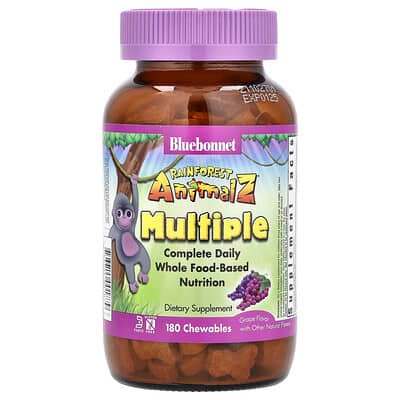
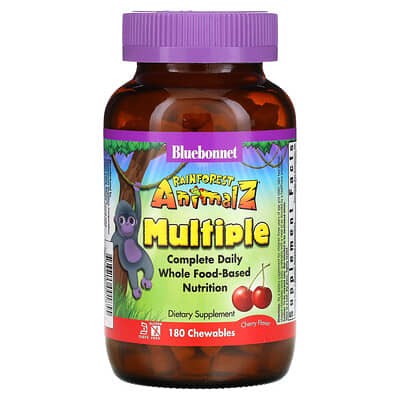
The formula covers most essential vitamins and selected minerals in a child-friendly chewable. Vitamin C, D3, natural vitamin E, iodine, and 5 mg ferrous fumarate provide the most useful nutritional depth.
Magnesium and zinc rely partly or fully on oxide forms, while calcium and magnesium amounts are too small for strong mineral coverage. The 175 mg fruit blend hides its components, and 20 mg citrus bioflavonoids adds only modest targeted value.
The vitamin A listing includes both beta-carotene and preformed palmitate at a substantial amount. The four-tablet serving and iron content make careful age-specific use and safe storage especially important.
The formula mixes useful citrate and glycinate forms with less favorable oxide, carbonate, and cyanocobalamin forms. Broad coverage supports its purpose, but several minerals and measured bioflavonoids are modest.
.The main active amounts are mostly visible, making the core formula possible to assess. Serving directions and non-active ingredients are missing, and any named blend further limits clarity.
.The supplied average is generally strong and the response volume is substantial. No detailed feedback is provided to assess recurring complaints or fit with the intended purpose.
.Broad nutrient coverage supports fair value for a children's multivitamin. The unstandardized fruit blend and mixed ingredient forms limit efficiency.
.| Ingredient | Amount per serving |
|---|---|
Calories | 10 Calorie(s) |
Total Carbohydrates | 2 Gram(s) |
Vitamin A (Beta-Carotene, Vitamin A Palmitate) | 1500 mcg |
Vitamin C (Calcium Ascorbate, L-Ascorbic Acid) | 100 mg |
Vitamin D3 (Cholecalciferol) | 10 mcg |
Vitamin E (D-Alpha-Tocopheryl Succinate) | 20 mg |
Thiamine (Thiamine Mononitrate) | 1.5 mg |
Riboflavin | 1.7 mg |
Niacin (Niacinamide) | 20 mg |
Vitamin B6 (Pyridoxine Hydrochloride) | 2 mg |
Folate | 250 mcg DFE |
Vitamin B12 (Cyanocobalamin, Methylcobalamin) | 8 mcg |
Biotin | 50 mcg |
Pantothenic Acid (Calcium D-Pantothenate) | 10 mg |
Calcium (Calcium Carbonate, Calcium Citrate, Calcium Malate) | 25 mg |
Iron (Ferrous Fumarate) | 5 mg |
Iodine (Potassium Iodide) | 75 mcg |
Magnesium (Magnesium Bisglycinate Chelate, Magnesium Oxide) | 10 mg |
Zinc (Zinc Oxide) | 3 mg |
Manganese (Manganese Gluconate) | 500 mcg |
Potassium (Potassium Glycinate Complex) | 3 mg |
Citrus Bioflavonoids | 20 mg |
Inositol | 10 mcg |
Super Fruit Blend | 175 mg |
Ferrous fumarate is effective but may be less comfortable than a chelated iron form. The elemental amount is below the preferred effective range. The chewable format is less favorable for iron delivery and digestive comfort. The two-unit serving remains reasonably practical. Vitamin C plus folate and vitamin B12 provide a complete absorption and red-blood-cell cofactor profile. Serving cost provides average value.
The chewable provides only 20 mg of explicitly measured citrus bioflavonoids, while a separate fruit blend has no active flavonoid yield. Neither standardization nor meaningful absorption support is disclosed. The low measured dose makes cost efficiency poor despite a moderate serving cost.