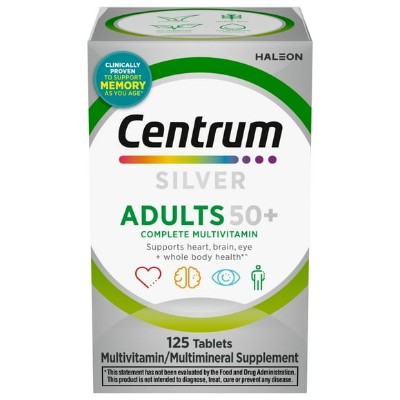
Nutrient quality
Most nutrients lack chemical forms, preventing a confident bioavailability assessment. The maintenance-oriented amounts are generally modest, but the stated vitamin D amount appears anomalous.
 Walmart Walmart | $ 19.12 | |
 Vitacost Vitacost | $ 22.84 |
The tablet otherwise resembles a broad senior multivitamin with B vitamins, minerals, iodine, lutein, and lycopene. Many chemical forms are not specified, and several specialty nutrients are lightly dosed.
The critical issue is the supplied vitamin D3 entry of 25 mg rather than a typical microgram amount. If accurate, that amount would create a severe toxicity risk; if inaccurate, the label data are still not reliable enough for use.
The product should not be taken until the manufacturer or physical package confirms the correct vitamin D unit and amount. No price or broad nutrient convenience justifies accepting that uncertainty.
Most nutrients lack chemical forms, preventing a confident bioavailability assessment. The maintenance-oriented amounts are generally modest, but the stated vitamin D amount appears anomalous.
Specific amounts are shown, but the questionable vitamin D unit undermines confidence. Generic names omit the chemical forms of most nutrients.
The aggregate rating is strong and the available feedback volume gives it useful statistical support. No specific review comments are supplied to assess recurring benefits or complaints.
The low routine cost is attractive, but the label anomaly and missing forms weaken quality. Tiny carotenoid additions do little to improve the core formula.
A broad multivitamin supplies B vitamins, iodine, and other nutrients involved in normal energy metabolism. The once-daily design is more useful for covering nutritional gaps than for an immediate energy effect.
The iodine source and many ingredient forms are not disclosed, limiting confidence in quality. Maintenance-level micronutrients do not provide stimulant, adaptogen, or high-dose mitochondrial support.
| Ingredient | Amount per serving |
|---|---|
Vitamin A (Beta-Carotene) | 750 mcg |
Vitamin C | 60 mg |
Vitamin D3 | 25 mg |
Vitamin E | 22.5 mg |
Vitamin K | 30 mcg |
Thiamine | 1.5 mg |
Riboflavin | 1.7 mg |
Niacin | 20 mg |
Vitamin B6 | 3 mg |
Folate | 667 mcg DFE |
Vitamin B12 | 25 mcg |
Biotin | 30 mcg |
Pantothenic Acid | 10 mg |
Calcium | 220 mg |
Phosphorus | 20 mg |
Iodine | 150 mcg |
Magnesium | 50 mg |
Zinc | 11 mg |
Selenium | 19 mcg |
Copper | 0.5 mg |
Manganese | 2.3 mg |
Chromium | 50 mcg |
Molybdenum | 45 mcg |
Chloride | 72 mg |
Potassium | 80 mg |
Lutein | 250 mcg |
Lycopene | 300 mcg |
Missing source identity leaves both bioavailability and marine-purity risk uncertain. The 150 mcg amount matches standard daily support needs and remains below the adult upper limit. Very low serving cost is attractive despite incomplete source disclosure.
The chloride amount is moderate and clearly disclosed, making it a useful part of a broader multivitamin. The source salt is not identified, which leaves form quality uncertain. A single tablet is convenient and inexpensive per serving.
A modest calcium amount is present without disclosure of its chemical form. Its per-serving dose is efficient, but absorption quality cannot be judged. Excellent basic value comes from the low serving cost and broad multivitamin coverage.
Published studies used for the product analysis and the top-ranked studies for each ingredient and goal.