
Nutrient quality
Glutamine, glucosamine, zinc carnosine, and soothing botanicals support the digestive purpose. Poor copper form and token aloe reduce quality despite a substantial core serving.
 iHerb iHerb | $ 35.99 |
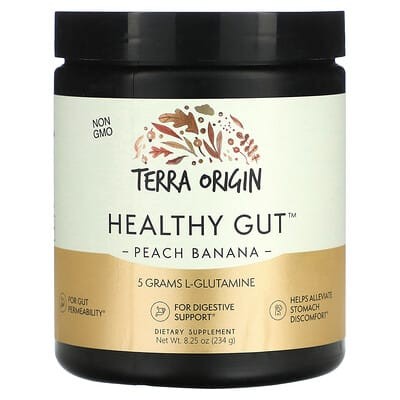
Five grams of L-glutamine provide the dominant active foundation, supported by Sustamine and 500 mg N-acetyl-D-glucosamine. Zinc carnosine, slippery elm, marshmallow, DGL, MSM, quercetin, and aloe broaden the gut-lining approach.
Most ingredient weights are transparent, but several supporting botanicals are modest and the 10 mg aloe extract lacks purification or concentration detail. Copper oxide is poorly absorbed, and the N-acetyl glucosamine source is not identified.
Peach Banana best fits adults who want a mixable, glutamine-centered digestive formula. The skin-health case is secondary, and people avoiding shellfish cannot confirm suitability from the supplied label.
Glutamine, glucosamine, zinc carnosine, and soothing botanicals support the digestive purpose. Poor copper form and token aloe reduce quality despite a substantial core serving.
Every listed active has a stated amount and no proprietary blend hides the formula. Missing flavor-base ingredients, full directions, glucosamine source, and extract ratios leave important gaps.
The supplied average is exceptionally strong and supported by substantial response volume. No comment-level evidence is available to assess repeated complaints or alignment with the intended use.
A substantial glutamine serving and complementary gut ingredients provide moderate value. Weak copper and aloe quality plus incomplete source disclosure limit competitiveness at the high serving cost.

N-acetyl glucosamine may contribute to hyaluronic acid production, while MSM and quercetin add limited structural and antioxidant support. The product is primarily a gut formula rather than a targeted skin intervention.
The glucosamine amount is practical but its source is not disclosed. People avoiding shellfish cannot verify suitability from the available label, and most of the substantial formula weight comes from glutamine.
| Ingredient | Amount per serving |
|---|---|
Calories | 20 Calorie(s) |
Zinc (PepZinGI) | 2.15 mg |
Copper (Copper Oxide) | 1 mg |
L-Glutamine | 5 Gram(s) |
Sustamine L-Alanyl-L-Glutamine | 500 mg |
N-Acetyl-D-Glucosamine | 500 mg |
Slippery Elm bark powder | 200 mg |
Marshmallow root powder | 200 mg |
MSM | 200 mg |
Deglycerrhizinated (DGL) Licorice root powder | 100 mg |
Stevia leaf extract | 100 mg |
Quercetin Dihydrate | 50 mg |
PepZinGI (Zinc Carnosine) | 10 mg |
Aloe vera leaf extract | 10 mg |
The powder provides a standard amount of the explicitly identified D-isomer with clear dose disclosure. Its source is not identified, so people avoiding shellfish cannot verify suitability from the supplied label. A substantial glutamine dose and several supporting ingredients improve the formula's value beyond N-acetyl glucosamine alone.
The mixable powder offers a suitable delivery method for contact with the upper digestive tract. Aloe is clearly quantified but present only in a very small amount, with no concentration or purification details. The serving cost is high for aloe as a minor component, though DGL, slippery elm, and marshmallow add related digestive support.
Copper oxide has very poor human bioavailability. The 1 mg amount supports maintenance and the roughly 2:1 zinc-to-copper ratio sits well below the preferred balance range. Clear amount-and-form disclosure supports assessment, while serving cost is very high for copper-focused use.
Published studies used for the product analysis and the top-ranked studies for each ingredient and goal.