
Nutrient quality
The ginkgo amount is useful and the additional botanicals support a clear menopause use case. Unspecified forms and weak alignment with the listed goals limit nutrient quality.
.
 iHerb iHerb | $ 15.69 | |
 Pure Formulas Pure Formulas | $ 17.69 | |
 Vitacost Vitacost | $ 15.69 | |
| Vitacost | $ 15.69 |
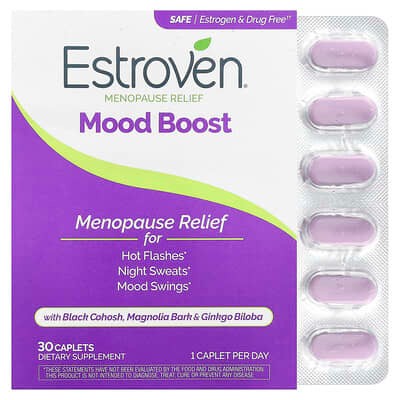
The tablet combines 120 mg ginkgo with black cohosh, soy isoflavones, and magnolia bark. Its design fits menopause and mood support better than brain performance or vision.
Ginkgo provides the main cognitive pathway through circulation, while magnolia may support calm. The remaining actives do not supply macular carotenoids, retinal lipids, or foundational eye nutrients.
Ginkgo lacks active-marker percentages and a ginkgolic-acid limit, while black cohosh standardization is also not shown. Soy and black cohosh make hormone-sensitive and liver-related suitability important.
The ginkgo amount is useful and the additional botanicals support a clear menopause use case. Unspecified forms and weak alignment with the listed goals limit nutrient quality.
.Active amounts are disclosed without a proprietary blend. Most extract specifications, daily-use directions, and non-active ingredients are missing.
.The available rating is favorable and the sample is moderate. Detailed feedback was not supplied, so repeated complaints and alignment with the intended use remain uncertain.
.The short supply provides only modest value for the disclosed quality. Menopause-focused extras add cost without strong alignment to the configured goals.
.
Ginkgo provides the clearest focus-related ingredient at a commonly used amount. Missing standardization for key ginkgo compounds limits confidence in potency and evidence matching.
Magnolia may support stress balance, while black cohosh and soy mainly address menopausal symptoms rather than attention. The formula may suit mood-related concentration concerns but is not a clean, acute focus blend.

The 120 mg ginkgo extract provides a direct circulation-based link to memory and attention. Magnolia may support calmness, but the broader formula is designed more for menopausal mood support than cognition.
Missing ginkgo standardization prevents confirmation of the active flavone and terpene yields. Ginkgo may increase bleeding risk when combined with anticoagulant or antiplatelet medicines.

Ginkgo provides a relevant circulation-based cognitive pathway, while magnolia may support calm during menopause. The broader black cohosh and soy formula is primarily aimed at menopausal symptoms rather than brain health.
The ginkgo amount is clear, but active-marker standardization and a ginkgolic-acid limit are not supplied. Ginkgo may increase bleeding risk with anticoagulants or antiplatelet medicines, and black cohosh warrants caution with liver disease.
| Ingredient | Amount per serving |
|---|---|
Total Carbohydrates | 1 Gram(s) |
Calcium (Dicalcium Phosphate) | 95 mg |
Black Cohosh root extract | 40 mg |
Soy Isoflavones | 56 mg |
Ginkgo biloba leaf extract | 120 mg |
Magnolia bark extract | 15 mg |
The listed 120 mg Ginkgo extract matches a commonly used daily amount, but the label does not confirm key active-marker standardization. The dose is clearly disclosed, while the lack of ginkgolic acid limits or a recognized branded extract leaves purity uncertain. Cost efficiency is difficult to support because the effective standardized amount cannot be verified.
Published studies used for the product analysis and the top-ranked studies for each ingredient and goal.