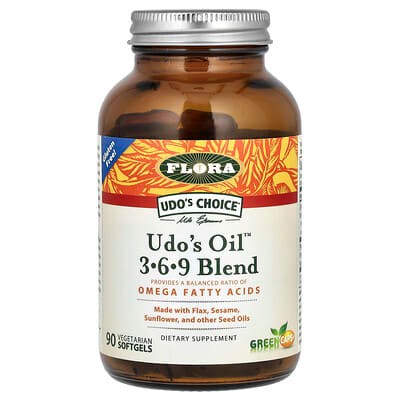
Product Image

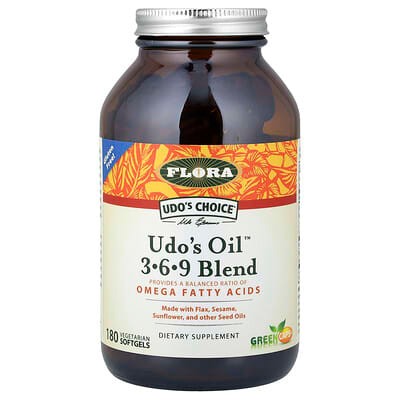
Udo's Oil 3-6-9 Blend

Flora
4.6
★ ★ ★ ★ ★
(561 ratings)
Omega-9 350 mg
Omega-6 420 mg
Omega-3 840 mg
Product Image
Score66
840 mg of omega-3 fatty acids anchors a limited multi-ingredient option with limited value. Its main trade-off is the high dose within a broader formula, which may be either convenient or restrictive depending on the intended routine.
How scoring works
Quantity:180 Softgel(s) • (90 servings)
Goals:
Skin Health

Score 66

840 mg of omega-3 fatty acids anchors a limited multi-ingredient option with limited value. Its main trade-off is the high dose within a broader formula, which may be either convenient or restrictive depending on the intended routine.
How scoring works
$52.18($0.57 per serving)
iHerb
$ 52.18
Vitacost
$ 53.39
Report prices

Analysis

The 840 mg serving provides omega-3 fatty acids alongside Total Fat and Omega-6 Fatty Acids in softgel(s). The high-dose amount sits within a broader formula, so each included ingredient should fit the intended use.

The amount is stated, but the supplied information leaves some formulation detail unspecified. Value is a notable trade-off compared with more economical options, and the broader ingredient list needs more careful comparison with simpler alternatives.

The strongest practical fit is skin health, with related assessments also supporting omega-3-focused use. The main decision is whether 840 mg and the softgel(s) format match the user's preferred routine and budget.

Who is it for
  • Adults seeking a high-dose Omega-3 supplement
  • People who prefer softgel(s) for omega-3 fatty acids
  • Users focused on skin health
Best for
  • Skin Health support

Pros

  • Clearly stated 840 mg amount
  • Includes omega-3 fatty acids with additional active ingredients
  • Serving amount is easy to identify
  • Simple format makes alternatives easy to compare

Cons

  • 840 mg offers little flexibility for lower-dose use
  • Softgel(s) may not suit every user's format preference
  • Value is less competitive than stronger alternatives

Nutrient quality

78 High impact

Softgel delivery offers basic protection for the oils. Total omega fats are supplied in substantial amounts, but EPA and DHA are not separated.
Ingredient transparency

67 High impact

Total omega classes are quantified, but EPA and DHA are not separated. Daily directions, oil sources, and the complete inactive-ingredient list are not supplied.

Customer satisfaction

66 High impact

The supplied average is favorable and the aggregate pool is moderate. No specific feedback is provided to assess taste, tolerance, recurring complaints, or fit for the intended use.

Value for money

52 Moderate impact

Serving cost is high for the total oil amount. Missing EPA, oil-source, and form details prevent a confident judgment of effective value.

Report analysis

Goals

Skin Health
Impact
Moderate effect
C- Goal FitD+ Strength of SupportC- CoverageC+ Formula Quality
Omega-3 · 840 mg

The mixed fatty acids may support skin barrier lipids and inflammatory balance, but their skin relevance is difficult to judge without identifying the individual oils. The omega-3 portion does not state EPA or DHA.

The blend supplies meaningful total fat, yet source, molecular form, processing, and purity details are missing. Omega-6 and omega-9 are common in food, so adding them does not automatically create broader skin benefit.

Study evidence
Omega-3 Supportive 35 studies
Omega-6 Adverse 9 studies
Omega-9 Not classified

No linked studies yet.

Ingredients

IngredientAmount per serving
Calories
20 Calorie(s)
Total Fat
2 Gram(s)
Omega-3 Fatty Acids
840 mg
Omega-6 Fatty Acids
420 mg
Omega-9 Fatty Acids
350 mg
Gluten Free Adults 18–50 Vegetarian
Report overview
Omega-9 · 350 mg OverallScore60
F Active Ingredient Quality & BioavailabilityA- Dose, Safety & Label TransparencyB- Value

The disclosed dose provides a meaningful amount of omega-9, and the label states that amount clearly. Softgels offer some protection, but the oil source and processing method are not identified, leaving important quality details uncertain. Value appears reasonable for the amount supplied.

Omega-6 · 420 mg OverallScore40
F Active Ingredient Quality & BioavailabilityC- Dose, Safety & Label TransparencyB+ Value

The disclosed omega-6 amount offers a meaningful supplemental dose, but the label does not identify its individual fatty acids. The source and extraction method are also not stated, leaving ingredient quality and processing uncertain. Serving cost is favorable compared with similar options, although limited oil detail weakens the formula.

Omega-3 · 840 mg OverallScore20
F Active Ingredient Quality & BioavailabilityF Dose, Safety & Label TransparencyF Value

The blend does not identify EPA or DHA, so its fit for an EPA-and-DHA-focused omega-3 collection is uncertain. The molecular form, oil source, antioxidants, and independent purity testing are not disclosed. Its mixed fatty-acid profile may suit a broader dietary-fat goal, but it cannot be valued against active EPA and DHA.

Loading alternative details
Report alternatives

Sources

Published studies used for the product analysis and the top-ranked studies for each ingredient and goal.

  1. The Effects of α-Linolenic Acid Intake on Skin and Blood Vessel Health and Subjective Fatigue in Middle-Aged Japanese Females: A Randomized, Double-Blind, Placebo-Controlled, Parallel-Group Comparative Trial.
    Ando N; Nosaka N; Arai C; Kato K · The Journal of nutrition · 2025
    Randomized trial120 participantsSkin Health forOmega-3
  2. Dietary supplementation with very long-chain n-3 fatty acids in patients with atopic dermatitis. A double-blind, multicentre study.
    Søyland E; Funk J; Rajka G; Sandberg M; Thune P; Rustad L; Helland S; Middelfart K; Odu S; Falk ES · The British journal of dermatology · 1994
    Randomized trial145 participantsSkin Health forOmega-3
  3. Prenatal Omega-3 Supplementation and Eczema Risk among Offspring at Age 36 Months.
    Berman D; Clinton C; Limb R; Somers EC; Romero V; Mozurkewich E · Insights in allergy, asthma & bronchitis · 2020
    Randomized trial84 participantsSkin Health forOmega-3
  4. Omega-3 fatty acid supplement skin cancer prophylaxis in lung transplant recipients: A randomized, controlled pilot trial.
    Miura K; Vail A; Chambers D; Hopkins PM; Ferguson L; Grant M; Rhodes LE; Green AC · The Journal of heart and lung transplantation : the official publication of the International Society for Heart Transplantation · 2019
    Randomized trial49 participantsSkin Health forOmega-3
  5. Randomized controlled trial of oral omega-3 PUFA in solar-simulated radiation-induced suppression of human cutaneous immune responses.
    Pilkington SM; Massey KA; Bennett SP; Al-Aasswad NM; Roshdy K; Gibbs NK; Friedmann PS; Nicolaou A; Rhodes LE · The American journal of clinical nutrition · 2013
    Randomized trial79 participantsSkin Health forOmega-3
  6. Clinical and metabolic response to flaxseed oil omega-3 fatty acids supplementation in patients with diabetic foot ulcer: A randomized, double-blind, placebo-controlled trial.
    Soleimani Z; Hashemdokht F; Bahmani F; Taghizadeh M; Memarzadeh MR; Asemi Z · Journal of diabetes and its complications · 2018
    Randomized trial60 participantsSkin Health forOmega-3
  7. Dietetic intervention in psoriatic arthritis: the DIETA trial.
    Leite BF; Morimoto MA; Gomes CMF; Klemz BNC; Genaro PS; Shivappa N; Hébert JR; Damasceno NRT; Pinheiro MM · Advances in rheumatology (London, England) · 2022
    Randomized trial97 participantsSkin Health forOmega-3
  8. Treatment of hard-to-heal wounds in ischaemic lower extremities with a novel fish skin-derived matrix.
    Lee YJ; Han HJ; Shim HS · Journal of wound care · 2024
    Randomized trial50 participantsSkin Health forOmega-3
  9. Effect of eicosapentaenoic acid, an omega-3 polyunsaturated fatty acid, on UVR-related cancer risk in humans. An assessment of early genotoxic markers.
    Rhodes LE; Shahbakhti H; Azurdia RM; Moison RM; Steenwinkel MJ; Homburg MI; Dean MP; McArdle F; Beijersbergen van Henegouwen GM; Epe B; Vink AA · Carcinogenesis · 2003
    Randomized trial42 participantsSkin Health forOmega-3
  10. Allergic disease in infants up to 2 years of age in relation to plasma omega-3 fatty acids and maternal fish oil supplementation in pregnancy and lactation.
    Furuhjelm C; Warstedt K; Fagerås M; Fälth-Magnusson K; Larsson J; Fredriksson M; Duchén K · Pediatric allergy and immunology : official publication of the European Society of Pediatric Allergy and Immunology · 2011
    Randomized trial145 participantsSkin Health forOmega-3
  11. Psychosocial Burden in People with Atopic Dermatitis: Effects of a Substance-Free Basic Skincare in a Randomized Health Care Study.
    Braren-von Stülpnagel C; Augustin M; Sommer R; Westphal L · Skin pharmacology and physiology · 2024
    Randomized trial79 participantsSkin Health forOmega-6
  12. Abnormalities in epidermal lipid metabolism in patients with atopic dermatitis.
    Schäfer L; Kragballe K · The Journal of investigative dermatology · 1991
    Cross-sectional study15 participantsSkin Health forOmega-6
  13. Maternal plasma phosphatidylcholine fatty acids and atopy and wheeze in the offspring at age of 6 years.
    Pike KC; Calder PC; Inskip HM; Robinson SM; Roberts GC; Cooper C; Godfrey KM; Lucas JS · Clinical & developmental immunology · 2013
    Cohort study865 participantsSkin Health forOmega-6
  14. Plasma omega-3 and omega-6 concentrations and risk of cutaneous basal and squamous cell carcinomas in Australian adults.
    Wallingford SC; Hughes MC; Green AC; van der Pols JC · Cancer epidemiology, biomarkers & prevention : a publication of the American Association for Cancer Research, cosponsored by the American Society of Preventive Oncology · 2014
    Cohort study1,191 participantsSkin Health forOmega-6
  15. Maternal PUFA status and offspring allergic diseases up to the age of 18 months.
    Yu YM; Chan YH; Calder PC; Hardjojo A; Soh SE; Lim AL; Fisk HL; Teoh OH; Goh A; Saw SM; Kwek K; Gluckman PD; Godfrey KM; Chong YS; Shek LP; Pan A; Chong MF; van Bever HP; GUSTO study group · The British journal of nutrition · 2015
    Cohort study960 participantsSkin Health forOmega-6