Product Image

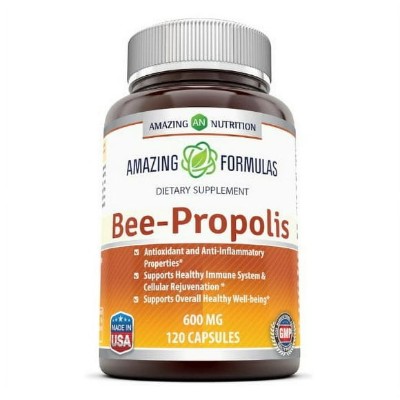
Bee-Propolis 600 mg

AN Amazing Nutrition Amazing Formulas
4.9
★ ★ ★ ★ ★
(53 ratings)
Propolis 600 mg
Product Image
Score72
A large material weight and long supply come with very limited quality detail. Active potency is too uncertain to confirm the apparent value.
How scoring works
Quantity:120 Capsule(s) • (120 servings)
Goals:
Immunity
Anti-Inflammatory Support

Score 72

A large material weight and long supply come with very limited quality detail. Active potency is too uncertain to confirm the apparent value.
How scoring works
$9.99($0.08 per serving)
Walmart
$ 9.99
Pure Formulas
$ 10.98
Report prices

Analysis

One capsule supplies 600 mg bee propolis and the bottle provides 120 servings. The simple formula is easy to use.

The label does not identify whether the material is concentrated extract or raw propolis. No geographic source, flavonoid level, phenolic marker, or extraction ratio is given.

The low serving cost is attractive, but it cannot be normalized to actual extract potency. It suits basic use better than buyers seeking consistent standardized actives.

Who is it for
  • Adults seeking a basic propolis capsule
  • People prioritizing a long supply
  • Users comfortable with raw-material uncertainty
Best for
  • Simple one-capsule use
  • Long bottle life
  • Low serving cost

Pros

  • 600 mg amount is disclosed
  • One hundred twenty servings
  • One capsule per serving
  • Single-active formula

Cons

  • Extract status is unknown
  • No active markers
  • No origin
  • No concentration ratio
  • Value per active amount is unknowable

Warnings

  • Avoid use with an allergy to propolis or other bee products.
  • Stop immediately if rash, swelling, wheezing, or throat tightness develops.

Nutrient quality

81 Highest impact

Generic bee propolis lacks an extract ratio, geographic source, and standardized active markers. The 600 mg serving is useful, though stronger focused doses are available.

.

Ingredient transparency

73 High impact

Active ingredients have stated amounts and no proprietary blend hides a dose. Serving count is supplied, while full directions and the other-ingredients list are missing.

.

Customer satisfaction

61 Moderate impact

The supplied aggregate rating is the only evidence of general satisfaction and its reliability depends on the rating volume. No comment-level evidence is available to assess recurring complaints or confirm how experience matches the intended purpose.

.

Value for money

70 High impact

Low serving cost cannot fully offset uncertainty about actual active strength. Clearly standardized alternatives may deliver more predictable category value.

.

Report analysis

Goals

Immunity
Impact
Moderate effect
C Goal FitC- Strength of SupportD+ CoverageB Formula Quality
Propolis · 600 mg

Bee propolis is directly associated with immune and upper-respiratory support, but evidence is less consistent than for vitamin C, zinc, or vitamin D. The substantial material amount may be useful, yet active exposure cannot be confirmed.

No origin, extract ratio, or flavonoid marker is provided, which sharply limits quality assessment. People with bee-product allergy should avoid propolis because it can trigger allergic reactions.

Study evidence
Propolis Supportive 6 studies
Anti-Inflammatory Support
Impact
Moderate effect
C Goal FitD+ Strength of SupportF CoverageA Formula Quality
Propolis · 600 mg

Bee propolis offers a plausible route to moderating inflammatory signaling. A substantial material amount does not reveal the active flavonoid or CAPE exposure.

The formula is focused but lacks origin, extraction, standardization, and purity details. People with bee-product allergy should avoid propolis because it can trigger allergic reactions.

Study evidence
Propolis Supportive 34 studies

Ingredients

IngredientAmount per serving
Bee Propolis
600 mg
Adults 18–50 Dairy Free Sugar Free
Report overview
Propolis · 600 mg OverallScore41
F Active Ingredient Quality & BioavailabilityA- Dose, Safety & Label TransparencyF Value

Generic bee propolis is provided without an origin, extract form, concentration ratio, or active-marker standardization. The 600 mg material amount is high but does not reveal actual extract content. A low serving cost cannot be converted into active-extract value.

Loading alternative details
Report alternatives

Sources

Published studies used for the product analysis and the top-ranked studies for each ingredient and goal.

  1. Effect of Propolis Intake on Serum C-Reactive Protein (CRP) and Tumor Necrosis Factor-alpha (TNF-α) Levels in Adults: A Systematic Review and Meta-Analysis of Clinical Trials.
    Jalali M; Ranjbar T; Mosallanezhad Z; Mahmoodi M; Moosavian SP; Ferns GA; Jalali R; Sohrabi Z · Complementary therapies in medicine · 2020
    Meta-analysis406 participants6 studies pooledAnti-Inflammatory Support forPropolis
  2. Propolis supplementation can reduce serum level of interleukin-6, C-reactive protein, and tumor necrosis factor-α: an updated systematic review and dose-response meta-analysis on randomized clinical trials.
    Gholami A; Dinarvand N; Hariri M · Journal of health, population, and nutrition · 2024
    Meta-analysis16 studies pooledAnti-Inflammatory Support forPropolis
  3. Effects of propolis supplementation on glycemic status, lipid profiles, inflammation and oxidative stress, liver enzymes, and body weight: a systematic review and meta-analysis of randomized controlled clinical trials.
    Hallajzadeh J; Milajerdi A; Amirani E; Attari VE; Maghsoudi H; Mirhashemi SM · Journal of diabetes and metabolic disorders · 2024
    Meta-analysis14 studies pooledAnti-Inflammatory Support forPropolis
  4. Brazilian organic propolis for prevention and treatment of radiation-related oral acute toxicities in head and neck cancer patients: A double-blind randomized clinical trial.
    Fernandes PM; Rosalen PL; Fernandes DT; Dias-Neto E; Alencar SM; Bueno-Silva B; Alves FA; Lopes MA · Frontiers in pharmacology · 2022
    Randomized trial60 participantsAnti-Inflammatory Support forPropolis
  5. The effect of Brazilian Green Propolis extract on inflammation in patients with chronic kidney disease on peritoneal dialysis: A randomised double-blind controlled clinical trial.
    Baptista BG; Fanton S; Ribeiro M; Cardozo LF; Regis B; Alvarenga L; Ribeiro-Alves M; Berretta AA; Shiels PG; Mafra D · Phytomedicine : international journal of phytotherapy and phytopharmacology · 2023
    Randomized trial19 participantsAnti-Inflammatory Support forPropolis
  6. Propolis increases Foxp3 expression and lymphocyte proliferation in HIV-infected people: A randomized, double blind, parallel-group and placebo-controlled study.
    Conte FL; Tasca KI; Santiago KB; de Oliveira Cardoso E; Romagnoli GG; de Assis Golim M; Braz AMM; Berretta AA; do Rosário de Souza L; Sforcin JM · Biomedicine & pharmacotherapy = Biomedecine & pharmacotherapie · 2021
    Randomized trial40 participantsImmunity forPropolis
  7. Immune Responses in Broiler Chicks Fed Propolis Extraction Residue-supplemented Diets.
    Eyng C; Murakami AE; Santos TC; Silveira TG; Pedroso RB; Lourenço DA · Asian-Australasian journal of animal sciences · 2015
    Randomized trialImmunity forPropolis
  8. Integrative Therapies in Wound Healing in Small Animals: An Approach Beyond Traditional Medicine.
    Santos JKVRS; Costa EDS; Fernandes CCL; Cortez AA; Fonsêca ADV; Guedes RFM; Araújo PRM · Veterinary sciences · 2026
    Narrative reviewImmunity forPropolis
  9. Propolis does not significantly modulate immune function in an older population: A preliminary study.
    Pu L; Wang Y; Pang W; Wei J; Wu J; Guo C; Weina Gao · Heliyon · 2025
    Randomized trial62 participantsImmunity forPropolis
  10. A standardized polyphenol mixture extracted from poplar-type propolis for remission of symptoms of uncomplicated upper respiratory tract infection (URTI): A monocentric, randomized, double-blind, placebo-controlled clinical trial.
    Esposito C; Garzarella EU; Bocchino B; D'Avino M; Caruso G; Buonomo AR; Sacchi R; Galeotti F; Tenore GC; Zaccaria V; Daglia M · Phytomedicine : international journal of phytotherapy and phytopharmacology · 2020
    Randomized trial122 participantsImmunity forPropolis