Product Image

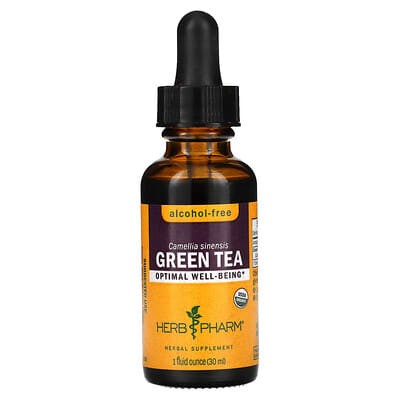
Green Tea Alcohol-Free

Herb Pharm
4.8
★ ★ ★ ★ ★
(28 ratings)
Green Tea 824 mg
Product Image
Score60
A focused green tea liquid with reasonable bottle value. Active potency and stimulant exposure cannot be verified is the main drawback.
How scoring works
Quantity:1 Liquid(s) • (42 servings)
Goals:
Anti-Inflammatory Support
Metabolism Boost

Score 60

A focused green tea liquid with reasonable bottle value. Active potency and stimulant exposure cannot be verified is the main drawback.
How scoring works
$11.20($0.26 per serving)
Pure Formulas
$ 15.18
iHerb
$ 11.20
Vitacost
$ 16.59
Report prices

Analysis

824 mg of green-tea leaf extract of green tea material provides a direct source of catechins that may support antioxidant defenses and normal metabolic signaling. The total leaf-extract amount is clear, but no catechin, EGCG, or caffeine data are supplied.

Caffeine content is not stated, making stimulant exposure difficult to judge. Active potency and stimulant exposure cannot be verified prevents a fully confident comparison with better-characterized extracts.

The liquid format keeps the product focused and easy to fit into a routine. The alcohol-free liquid may suit tincture users, but flexibility does not compensate for missing active characterization.

Who is it for
  • Adults seeking concentrated green tea catechins
  • People comfortable with potentially caffeinated green tea
Best for
  • Green tea catechin intake
  • Antioxidant support
  • Metabolic-support routines

Pros

  • Provides 824 mg of green-tea leaf extract
  • Identifies EGCG or catechin markers
  • Offers reasonable bottle value
  • Simple liquid format

Cons

  • active potency and stimulant exposure cannot be verified
  • Caffeine amount is not disclosed
  • No absorption-support ingredients
  • Narrow single-botanical scope

Warnings

  • Concentrated green tea extract has occasionally been linked with liver injury, particularly when taken fasting; stop use for dark urine, jaundice, or persistent upper-abdominal pain.
  • Green tea catechins can reduce non-heme iron absorption, so people using oral iron should separate the servings.
  • Caffeine content is not disclosed, so caffeine-sensitive users cannot predict effects on sleep, heart rate, or anxiety.

Nutrient quality

60 Moderate impact

Green tea species is identified, but extract markers and standardization are absent. The concentrated liquid remains difficult to judge because active strength and stimulant exposure are unknown.

Ingredient transparency

65 High impact

The total extract amount is clear, while EGCG, polyphenols, and caffeine are missing. No proprietary blend hides the listed active doses.

Customer satisfaction

62 Moderate impact

The supplied average is very strong, with small response volume. Complaint patterns and purpose-related experiences are not supplied.

Value for money

51 Moderate impact

The asking price is difficult to justify for the disclosed formula. Serving value is weak relative to the green tea support provided.

Report analysis

Goals

Anti-Inflammatory Support
Impact
Moderate effect
B Goal FitF Strength of SupportF CoverageA- Formula Quality
Green Tea · 824 mg

Green tea has relevant antioxidant and inflammatory-pathway activity, but the active catechin and EGCG amounts are not disclosed. The total extract weight therefore does not establish a meaningful anti-inflammatory dose.

Caffeine content, standardization, and absorption support are also unclear. The focused single-botanical design is coherent, yet underdisclosure limits confidence in its practical effect.

Study evidence
Green Tea Mixed 16 studies
Metabolism Boost
Impact
Moderate effect
B Goal FitF Strength of SupportF CoverageA+ Formula Quality
Green Tea · 824 mg

Green tea is directly relevant to fat oxidation and thermogenesis when EGCG and caffeine exposure are known. Here, the label states only total leaf extract, so neither active catechin potency nor stimulant content can be verified.

The alcohol-free liquid is simple and free from unrelated ingredients. Missing standardization, caffeine disclosure, and a defined EGCG amount prevent a credible effective-dose assessment.

Study evidence
Green Tea Supportive 31 studies

Ingredients

IngredientAmount per serving
Green Tea leaf (Camellia sinensis) extract
824 mg
Gluten Free Adults 18–50 Organic
Report overview
Green Tea · 824 mg OverallScore8
F Active Ingredient Quality & BioavailabilityF Dose, Safety & Label TransparencyF Value

The green tea extract does not disclose an active-marker percentage, while no catechin absorption technology or stabilizing cofactor is listed. The label does not disclose a specific EGCG amount, and caffeine content and decaffeination status are not disclosed. The liquid extract offers no verifiable EGCG yield or stimulant disclosure; value per active EGCG amount cannot be verified because EGCG is not disclosed.

Loading alternative details
Report alternatives

Sources

Published studies used for the product analysis and the top-ranked studies for each ingredient and goal.

  1. Effects of green tea or green tea extract on insulin sensitivity and glycaemic control in populations at risk of type 2 diabetes mellitus: a systematic review and meta-analysis of randomised controlled trials.
    Wang X; Tian J; Jiang J; Li L; Ying X; Tian H; Nie M · Journal of human nutrition and dietetics : the official journal of the British Dietetic Association · 2015
    Meta-analysis510 participants7 studies pooledMetabolism Boost forGreen Tea
  2. Metabolic response to green tea extract during rest and moderate-intensity exercise.
    Hodgson AB; Randell RK; Boon N; Garczarek U; Mela DJ; Jeukendrup AE; Jacobs DM · The Journal of nutritional biochemistry · 2013
    Randomized trial27 participantsMetabolism Boost forGreen Tea
  3. Effect of green tea on glucose control and insulin sensitivity: a meta-analysis of 17 randomized controlled trials.
    Liu K; Zhou R; Wang B; Chen K; Shi LY; Zhu JD; Mi MT · The American journal of clinical nutrition · 2013
    Meta-analysis1,133 participants17 studies pooledMetabolism Boost forGreen Tea
  4. Green tea extract ingestion, fat oxidation, and glucose tolerance in healthy humans.
    Venables MC; Hulston CJ; Cox HR; Jeukendrup AE · The American journal of clinical nutrition · 2008
    Randomized trial23 participantsMetabolism Boost forGreen Tea
  5. A 60-Day Green Tea Extract Supplementation Counteracts the Dysfunction of Adipose Tissue in Overweight Post-Menopausal and Class I Obese Women.
    Rondanelli M; Gasparri C; Perna S; Petrangolini G; Allegrini P; Fazia T; Bernardinelli L; Cavioni A; Mansueto F; Oberto L; Patelli Z; Tartara A; Riva A · Nutrients · 2022
    Randomized trial28 participantsMetabolism Boost forGreen Tea
  6. Metabolic response to epigallocatechin-3-gallate in relapsing-remitting multiple sclerosis: a randomized clinical trial.
    Mähler A; Steiniger J; Bock M; Klug L; Parreidt N; Lorenz M; Zimmermann BF; Krannich A; Paul F; Boschmann M · The American journal of clinical nutrition · 2015
    Randomized trial18 participantsMetabolism Boost forGreen Tea
  7. Effect of Acute and Chronic Dietary Supplementation with Green Tea Catechins on Resting Metabolic Rate, Energy Expenditure and Respiratory Quotient: A Systematic Review.
    Rondanelli M; Riva A; Petrangolini G; Allegrini P; Perna S; Faliva MA; Peroni G; Naso M; Nichetti M; Perdoni F; Gasparri C · Nutrients · 2021
    Systematic review499 participants15 studies pooledMetabolism Boost forGreen Tea
  8. Epigallocatechin-3-gallate and postprandial fat oxidation in overweight/obese male volunteers: a pilot study.
    Thielecke F; Rahn G; Böhnke J; Adams F; Birkenfeld AL; Jordan J; Boschmann M · European journal of clinical nutrition · 2011
    Randomized trial10 participantsMetabolism Boost forGreen Tea
  9. Effects of timing of acute catechin-rich green tea ingestion on postprandial glucose metabolism in healthy men.
    Takahashi M; Ozaki M; Miyashita M; Fukazawa M; Nakaoka T; Wakisaka T; Matsui Y; Hibi M; Osaki N; Shibata S · The Journal of nutritional biochemistry · 2020
    Randomized trial17 participantsMetabolism Boost forGreen Tea
  10. Time-of-day-dependent effects of a green tea extract on postprandial glycemia and insulinemia in healthy adults: a randomized, controlled, double-blind, cross-over intervention.
    Sulaimani N; Rosbotham EJ; Warnock R; Polzella L; Judowski R; Nicolotti L; Houghton MJ; Williamson G; Bonham MP · Food & function · 2025
    Randomized trial14 participantsMetabolism Boost forGreen Tea
  11. The effects of green tea on acne vulgaris: A systematic review and meta-analysis of randomized clinical trials.
    Kim S; Park TH; Kim WI; Park S; Kim JH; Cho MK · Phytotherapy research : PTR · 2021
    Meta-analysis247 participants5 studies pooledAnti-Inflammatory Support forGreen Tea
  12. Green Tea Catechin Association with Ultraviolet Radiation-Induced Erythema: A Systematic Review and Meta-Analysis.
    Kapoor MP; Sugita M; Fukuzawa Y; Timm D; Ozeki M; Okubo T · Molecules (Basel, Switzerland) · 2021
    Meta-analysis100 participants6 studies pooledAnti-Inflammatory Support forGreen Tea
  13. Efficacy of (-)-epigallocatechin gallate delivered by a new-type scaler tip during scaling and root planing on chronic periodontitis: a split-mouth, randomized clinical trial.
    Wang Y; Zeng J; Yuan Q; Luan Q · BMC oral health · 2021
    Randomized trial20 participantsAnti-Inflammatory Support forGreen Tea
  14. Camellia Sinensis Mouthwashes in Oral Care: a Systematic Review.
    Tafazoli A; Tafazoli Moghadam E · Journal of dentistry (Shiraz, Iran) · 2020
    Systematic review69 studies pooledAnti-Inflammatory Support forGreen Tea
  15. Skin photoprotection by green tea: antioxidant and immunomodulatory effects.
    Katiyar SK · Current drug targets. Immune, endocrine and metabolic disorders · 2004
    Narrative reviewAnti-Inflammatory Support forGreen Tea
  16. Efficacy of a green tea extract rich in catechin polyphenols and caffeine in increasing 24-h energy expenditure and fat oxidation in humans.
    Dulloo AG; Duret C; Rohrer D; Girardier L; Mensi N; Fathi M; Chantre P; Vandermander J · The American journal of clinical nutrition · 1999
    Randomized trial10 participantsMetabolism Boost forGreen Tea
  17. Epigallocatechin gallate alleviates non-alcoholic fatty liver disease through the inhibition of the expression and activity of Dipeptide kinase 4.
    Yang M; Yan R; Sha R; Wang X; Zhou S; Li B; Zheng Q; Cao Y · Clinical nutrition (Edinburgh, Scotland) · 2024
    Randomized trialMetabolism Boost forGreen Tea