
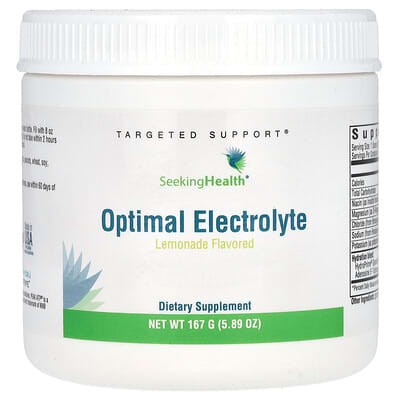

$40.00 $1.33 per serving


Product analysis
Optimal Electrolyte Lemonade supplies minerals involved in blood-pressure regulation and blood-vessel function. Benefits depend on the person and amount used, and the named mineral forms do not establish superior heart-health effects.
AI assessment of the formula, label and price. How scoring works
Nutrient Quality56
The potassium form is a favorable feature, and the niacin preparation is clearly identified. Quality for the other ingredients remains uncertain, including how the two magnesium sources contribute.
Ingredient Transparency67
All listed amounts and several forms are disclosed, helping you compare the serving. Some forms and the proportions of the magnesium mixture are missing, leaving part of the preparation unclear.
Value For Money48
The serving compares favorably for sodium and potassium. Niacin, taurine and creatine are costly for the amounts provided, while value for the remaining ingredients is uncertain.
Customer Satisfaction72
Customer ratings are generally positive across a substantial number of reviews. The feedback describes satisfaction rather than proving cardiovascular benefits.
Product Focus69
The minerals and taurine have a plausible role in blood-pressure and blood-vessel support. Several serving amounts are below those used in the relevant trials, so comparable effects remain uncertain.
- Format
Powder - Container
- 246 Gram(s)
- Per serving
- $1.33
- Also available
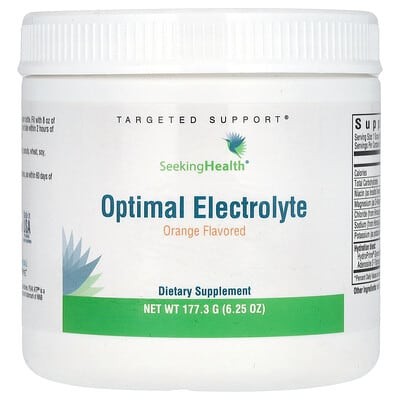 Optimal Electrolyte Orange$40.00
- Customer rating
- 4.2 · 1,586 ratings
Goals

Impact
High effect
Magnesium · 150 mgTaurine · 250 mg
Potassium, magnesium and taurine are relevant to blood pressure and vascular tone, with benefits dependent on population and exposure. The 510 mg potassium serving receives full amount recognition, while magnesium and taurine receive partial recognition. The taurine trial studied 1.6 g/day for 12 weeks in prehypertension, above this 250 mg serving. These comparisons do not establish a clinical prevention regimen or superiority from the named chelated forms.
How this product is rated for Heart Health
Ingredient fit60
The relevant ingredients sit within a broader formula linked to other goals. The counted amounts receive partial recognition overall, without establishing a clinically effective prevention regimen.
Goal fit
The relevant ingredients sit within a broader formula linked to other goals.
Dose adequacy
The counted amounts receive partial recognition overall, without establishing a clinically effective prevention regimen.
Pathways51
Electrolyte and vascular-tone balance is the strongest pathway, through the relevant mineral or taurine contributions. Only one evaluated pathway meets the breadth threshold.
Depth
Electrolyte and vascular-tone balance is the strongest pathway, through the relevant mineral or taurine contributions.
Breadth
Only one evaluated pathway meets the breadth threshold.
Evidence94
Taurine leads the saved finding. The counted preparations receive recognition, without proving the same population, duration or clinical outcome.
Evidence strength
Taurine leads the saved evidence finding; clinical interpretation remains specific to the ingredient and outcome.
Studied preparation
The counted preparations receive recognition, without proving the same population, duration or clinical outcome.
Formulation logic100
Each counted ingredient works independently or has its required partner; no extra combined benefit is established. No configured conflict was matched.
Partner coverage
Each counted ingredient works independently or has its required partner; no extra combined benefit is established.
Conflicts
No configured ingredient conflict was matched.
Effective doses
All counted ingredients meet the amount inclusion criterion, which is distinct from a clinically proven prevention threshold.

Impact
High effect
Potassium · 510 mgMagnesium · 150 mgTaurine · 250 mgNiacin · 25 mg
Potassium relates to blood-pressure regulation, but the 510 mg per serving is below the exposures used in the supplied blood-pressure trials. Taurine has promising blood-pressure findings in adults with prehypertension, although 250 mg per serving is much lower than the 1.6 g daily study amount. Magnesium adds limited vascular support, with inconsistent trial findings.
How this product is rated for Cardiovascular Support
Ingredient fit64
Potassium supplies a meaningful declared amount, while taurine and magnesium are below the supplied daily study exposures.
Goal fit
The formula includes minerals and taurine related to vascular support, alongside ingredients serving other purposes.
Dose adequacy
Potassium supplies a meaningful declared amount, while taurine and magnesium are below the supplied daily study exposures.
Pathways60
The main finding concerns vascular tone and sodium balance. The findings remain concentrated in one main area; other assessed routes contribute less or remain absent.
Depth
The main finding concerns vascular tone and sodium balance.
Breadth
The findings remain concentrated in one main area; other assessed routes contribute less or remain absent.
Evidence88
Taurine leads the saved evidence finding; the supplied trial concerns prehypertension and blood pressure, rather than event prevention.
Evidence strength
Taurine leads the saved evidence finding; the supplied trial concerns prehypertension and blood pressure, rather than event prevention.
Studied preparation
The preparations counted in this finding match recognized forms, without establishing that the complete formula has been studied.
Formulation logic100
The ingredients considered have no missing configured partner or identified conflict. Amount thresholds do not establish event prevention.
Partner coverage
The ingredients considered work independently or have their configured partner; additional benefit from combining them is not established.
Conflicts
No configured ingredient conflict was identified in the supplied findings.
Effective doses
The counted ingredients clear the saved amount threshold, which does not establish an effective cardiovascular treatment dose.
Ingredients
| Ingredient | Amount per serving | Score |
|---|---|---|
Calories | 20 Calorie(s) | |
Total Carbohydrates | 4 Gram(s) | |
Niacin (Inositol Hexanicotinate) | 25 mg | |
Magnesium (Albion DiMagnesium Malate, Creatine MagnaPower Magnesium Creatine Chelate) | 150 mg | |
Sodium (Sodium Bicarbonate) | 140 mg | |
Potassium (Potassium Bicarbonate) | 510 mg | |
D-Ribose | 2 Gram(s) | |
Taurine | 250 mg | |
Creatine (Creatine MagnaPower Magnesium Creatine Chelate) | 225 mg |
Potassium (Potassium Bicarbonate) · 510 mg OverallScore91
Sodium (Sodium Bicarbonate) · 140 mg OverallScore70
A serving provides 140 mg sodium, a small amount for athletic replenishment. The sodium comes from sodium bicarbonate.
How this ingredient is rated
Active Ingredient Quality & Bioavailability70
Sodium is identified as coming from sodium bicarbonate. Sodium bicarbonate is recognized as a buffering form.
Sodium Source Purity & Quality
Sodium is identified as coming from sodium bicarbonate.
Bioavailability of Supporting Electrolytes
A supporting electrolyte has a form the evaluation considers readily absorbed.
Trace Mineral Complex & Buffering Forms
Sodium bicarbonate is recognized as a buffering form.
Dose, Safety & Label Transparency65
The serving has 140 mg sodium, with amounts recorded for the listed electrolytes. The available ingredient information identifies no artificial colors or sweeteners.
Sodium Dosage for Athletic Replenishment
140 mg sodium per serving is a small amount for athletic replenishment.
Ingredient Label Transparency
The listed amounts include sodium at 140 mg, potassium at 510 mg, magnesium at 150 mg per serving.
Artificial Color and Sweetener Disclosure
The available ingredient information identifies no artificial colors or sweeteners.
Value80
The whole-product serving costs about $1.33.
Price Per Serving vs. Collection Median
The whole-product serving costs about $1.33.
Niacin (Inositol Hexanicotinate) · 25 mg OverallScore54
Alternative products
Report alternatives
Sources
Published studies used for the product analysis and the top-ranked studies for each ingredient and goal.
- Circulating and dietary magnesium and risk of cardiovascular disease: a systematic review and meta-analysis of prospective studies.
- Magnesium and the risk of cardiovascular events: a meta-analysis of prospective cohort studies.
- Quantitative Association Between Serum/Dietary Magnesium and Cardiovascular Disease/Coronary Heart Disease Risk: A Dose-Response Meta-analysis of Prospective Cohort Studies.
- Comparative Efficacy of Nutraceuticals on Endothelial Function: A Systematic Review and Network Meta-Analysis.
- Serum magnesium, mortality, and cardiovascular disease in chronic kidney disease and end-stage renal disease patients: a systematic review and meta-analysis.
- The current state of niacin in cardiovascular disease prevention: a systematic review and meta-regression.
- Effects of niacin on apo A1 and B levels: a systematic review and meta-analysis of randomised controlled trials.
- Effect of lipid-lowering therapies on lipoprotein(a) levels: a comprehensive meta-analysis of randomized controlled trials.
- Extended-release niacin vs gemfibrozil for the treatment of low levels of high-density lipoprotein cholesterol. Niaspan-Gemfibrozil Study Group.
- Equivalent efficacy of a time-release form of niacin (Niaspan) given once-a-night versus plain niacin in the management of hyperlipidemia.
- Sex-specific associations between sodium and potassium intake and overall and cause-specific mortality: a large prospective U.S. cohort study, systematic review, and updated meta-analysis of cohort studies.
- Potassium intake, stroke, and cardiovascular disease a meta-analysis of prospective studies.
- Blood pressure response to changes in sodium and potassium intake: a metaregression analysis of randomised trials.
- Twenty-Four-Hour Urinary Sodium and Potassium Excretion and Their Associations With Blood Pressure Among Adults in China: Baseline Survey of Action on Salt China.
- Dietary Sodium and Potassium Intake and Risk of Non-Fatal Cardiovascular Diseases: The Million Veteran Program.
- Taurine Supplementation Lowers Blood Pressure and Improves Vascular Function in Prehypertension: Randomized, Double-Blind, Placebo-Controlled Study.
- Taurine ameliorates blood pressure and vascular function in patients with type 2 diabetes: Randomized, double-blind, placebo-controlled trial.
- Taurine reduces the risk for metabolic syndrome: a systematic review and meta-analysis of randomized controlled trials.
- Effects of Oral Taurine Supplementation on Cardiometabolic Risk Factors: A Meta-analysis and Systematic Review of Randomized Clinical Trials.
- The effects of taurine supplementation on glycemic control and serum lipid profile in patients with type 2 diabetes: a randomized, double-blind, placebo-controlled trial.