
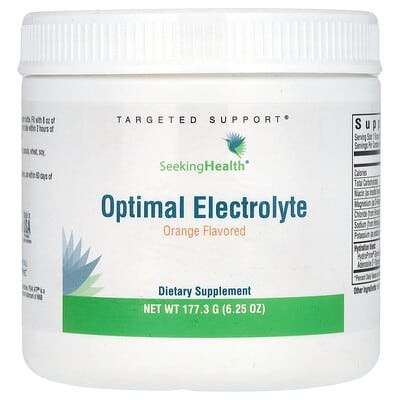

$40.00 $1.33 per serving


Product analysis
Optimal Electrolyte Orange supplies potassium that may contribute to normal blood-pressure regulation. The taurine and creatine additions are costly relative to the amounts they provide.
AI assessment of the formula, label and price. How scoring works
Nutrient Quality62
Potassium is supplied in a favorable, clearly identified form, and the niacin type is disclosed. Other ingredients have less certain quality, even where their sources are named.
Ingredient Transparency83
Ingredient amounts are disclosed, making serving quantities easy to compare. Some forms are unnamed, leaving the label less specific about what it supplies.
Value For Money52
Sodium and potassium provide the more favorable part of the value. The full serving cost is difficult to justify for taurine, niacin or creatine alone.
Customer Satisfaction79
Customer ratings are strongly positive. The larger review base gives a broader picture of customer satisfaction.
Product Focus67
The two heart-related purposes largely overlap around potassium and limited blood-pressure support. Potassium and taurine amounts are below the relevant research exposures, so the expected contribution is modest.
- Format
Powder - Container
- 244 Gram(s)
- Per serving
- $1.33
- Also available
 Optimal Electrolyte Lemonade$40.00
- Customer rating
- 4.8 · 475 ratings
Goals

Impact
High effect
Taurine · 250 mg
Potassium offers limited nutritional blood-pressure support whose effects depend on baseline intake and blood pressure. The serving amount is below the supplied potassium trial exposures. Taurine's blood-pressure and vascular findings came from 1.6 g daily for 12 weeks in people with prehypertension; 250 mg per serving provides only a partial exposure comparison. These findings do not establish event prevention.
How this product is rated for Heart Health
Ingredient fit56
The relevant ingredients provide a mixed heart-health connection. Declared amounts partly meet the saved exposure references.
Goal fit
Broader product aims or ingredients outside the credited heart-health roles reduce specific focus.
Dose adequacy
Declared amounts provide partial coverage of the exposure references; these are not proven clinical-dose thresholds.
Pathways44
The strongest connection concerns electrolyte and vascular-tone balance. One assessed pathway reaches the breadth threshold.
Depth
The strongest saved connection concerns electrolyte and vascular-tone balance, without establishing a corresponding clinical outcome.
Breadth
One assessed pathway reaches the saved breadth threshold.
Evidence94
Taurine provides the leading evidence contribution. Included preparations satisfy the saved identity check, which does not establish clinical-event prevention.
Evidence strength
Taurine supplies the leading contribution, with its population and outcome limits retained.
Studied preparation
Included ingredients satisfy the saved preparation check, without proving efficacy of the finished product.
Formulation logic100
No required partner is missing and no configured conflict was matched. Included ingredients clear the minimum amount comparison.
Partner coverage
No required partner is missing from the included contributions.
Conflicts
No configured ingredient conflict was matched.
Effective doses
Included ingredients clear the minimum amount comparison; this does not establish effective treatment.

Impact
High effect
Potassium · 510 mgTaurine · 250 mgNiacin · 25 mg
Potassium relates to blood-pressure regulation, but the 510 mg per serving is below the exposures used in the supplied blood-pressure trials. Taurine has promising blood-pressure findings in adults with prehypertension, although 250 mg per serving is much lower than the 1.6 g daily study amount. These findings do not establish prevention of cardiovascular events.
How this product is rated for Cardiovascular Support
Ingredient fit61
Potassium supplies a meaningful declared amount, while taurine is below the supplied daily study exposures.
Goal fit
The formula includes minerals and taurine related to vascular support, alongside ingredients serving other purposes.
Dose adequacy
Potassium supplies a meaningful declared amount, while taurine is below the supplied daily study exposures.
Pathways60
The main finding concerns vascular tone and sodium balance. The findings remain concentrated in one main area; other assessed routes contribute less or remain absent.
Depth
The main finding concerns vascular tone and sodium balance.
Breadth
The findings remain concentrated in one main area; other assessed routes contribute less or remain absent.
Evidence88
Taurine leads the saved evidence finding; the supplied trial concerns prehypertension and blood pressure, rather than event prevention.
Evidence strength
Taurine leads the saved evidence finding; the supplied trial concerns prehypertension and blood pressure, rather than event prevention.
Studied preparation
The preparations counted in this finding match recognized forms, without establishing that the complete formula has been studied.
Formulation logic100
The ingredients considered have no missing configured partner or identified conflict. Amount thresholds do not establish event prevention.
Partner coverage
The ingredients considered work independently or have their configured partner; additional benefit from combining them is not established.
Conflicts
No configured ingredient conflict was identified in the supplied findings.
Effective doses
The counted ingredients clear the saved amount threshold, which does not establish an effective cardiovascular treatment dose.
Ingredients
| Ingredient | Amount per serving | Score |
|---|---|---|
Calories | 20 Calorie(s) | |
Total Carbohydrates | 4 Gram(s) | |
Niacin (Inositol Hexanicotinate) | 25 mg | |
Creatine MagnaPower (Magnesium) | 150 mg | |
Sodium (Sodium Bicarbonate) | 140 mg | |
Potassium (Potassium Bicarbonate) | 510 mg | |
D-Ribose | 2 Gram(s) | |
Taurine | 250 mg | |
Creatine MagnaPower | 225 mg |
Potassium (Potassium Bicarbonate) · 510 mg OverallScore91
A serving supplies 510 mg of potassium, a relatively substantial amount. The stated form is potassium bicarbonate.
How this ingredient is rated
Active Ingredient Quality & Bioavailability100
The stated potassium form is potassium bicarbonate; its presence alone does not establish how much is absorbed.
Potassium Form Quality
The stated potassium form is potassium bicarbonate; its presence alone does not establish how much is absorbed.
Dose, Safety & Label Transparency88
A serving supplies 510 mg of potassium, a relatively substantial amount. The potassium amount is listed, though the saved label evidence does not explicitly use the phrase “elemental potassium.”
Potassium Dosage Potency
A serving supplies 510 mg of potassium, a relatively substantial amount.
Elemental Yield Transparency
The potassium amount is listed, though the saved label evidence does not explicitly use the phrase “elemental potassium.”
Value80
A whole-product serving costs about $1.33.
Potassium Value Efficiency
A whole-product serving costs about $1.33.
Sodium (Sodium Bicarbonate) · 140 mg OverallScore70
A serving provides 140 mg sodium, a small amount for athletic replenishment. The sodium comes from sodium bicarbonate.
How this ingredient is rated
Active Ingredient Quality & Bioavailability70
Sodium is identified as coming from sodium bicarbonate. Sodium bicarbonate is recognized as a buffering form.
Sodium Source Purity & Quality
Sodium is identified as coming from sodium bicarbonate.
Bioavailability of Supporting Electrolytes
A supporting electrolyte has a form the evaluation considers readily absorbed.
Trace Mineral Complex & Buffering Forms
Sodium bicarbonate is recognized as a buffering form.
Dose, Safety & Label Transparency65
The serving has 140 mg sodium, with amounts recorded for the listed electrolytes. The available ingredient information identifies no artificial colors or sweeteners.
Sodium Dosage for Athletic Replenishment
140 mg sodium per serving is a small amount for athletic replenishment.
Ingredient Label Transparency
The listed amounts include sodium at 140 mg, potassium at 510 mg per serving.
Artificial Color and Sweetener Disclosure
The available ingredient information identifies no artificial colors or sweeteners.
Value80
The whole-product serving costs about $1.33.
Price Per Serving vs. Collection Median
The whole-product serving costs about $1.33.
Niacin (Inositol Hexanicotinate) · 25 mg OverallScore54
Each serving supplies 25 undefined of niacin as inositol hexanicotinate. The amount has a provisional assessment, and the whole-product serving costs about $1.33.
How this ingredient is rated
Active Ingredient Quality & Bioavailability57
Inositol hexanicotinate is the identified niacin form. Its fit for general use and source assessment are both less certain in the evaluation.
Niacin Form & Goal Alignment
Inositol hexanicotinate receives a moderate assessment for the general product context.
Precursor Source Quality
The evaluation gives inositol hexanicotinate a provisional source assessment.
Dose, Safety & Label Transparency67
The label identifies inositol hexanicotinate and 25 undefined of niacin per serving. The amount has a provisional assessment, and no no-flush claim is recorded in the saved facts.
Clarity of Chemical Form
The saved facts identify the niacin form as Inositol Hexanicotinate.
Form-Specific Dosage Efficacy
The evaluation gives the 25 undefined niacin amount a provisional assessment for this form.
Flush Risk & Safety Labeling
No no-flush claim is recorded in the saved facts; the form receives a neutral flush assessment.
Value20
A whole-product serving costs about $1.33, which the evaluation considers high for this form; the price covers the whole product.
Price Per Effective Serving
A whole-product serving costs about $1.33, which the evaluation considers high for this form; the price covers the whole product.
Alternative products
Report alternatives
Sources
Published studies used for the product analysis and the top-ranked studies for each ingredient and goal.
- The current state of niacin in cardiovascular disease prevention: a systematic review and meta-regression.
- Effects of niacin on apo A1 and B levels: a systematic review and meta-analysis of randomised controlled trials.
- Effect of lipid-lowering therapies on lipoprotein(a) levels: a comprehensive meta-analysis of randomized controlled trials.
- Extended-release niacin vs gemfibrozil for the treatment of low levels of high-density lipoprotein cholesterol. Niaspan-Gemfibrozil Study Group.
- Equivalent efficacy of a time-release form of niacin (Niaspan) given once-a-night versus plain niacin in the management of hyperlipidemia.
- Sex-specific associations between sodium and potassium intake and overall and cause-specific mortality: a large prospective U.S. cohort study, systematic review, and updated meta-analysis of cohort studies.
- Potassium intake, stroke, and cardiovascular disease a meta-analysis of prospective studies.
- Blood pressure response to changes in sodium and potassium intake: a metaregression analysis of randomised trials.
- Twenty-Four-Hour Urinary Sodium and Potassium Excretion and Their Associations With Blood Pressure Among Adults in China: Baseline Survey of Action on Salt China.
- Dietary Sodium and Potassium Intake and Risk of Non-Fatal Cardiovascular Diseases: The Million Veteran Program.
- Taurine Supplementation Lowers Blood Pressure and Improves Vascular Function in Prehypertension: Randomized, Double-Blind, Placebo-Controlled Study.
- Taurine ameliorates blood pressure and vascular function in patients with type 2 diabetes: Randomized, double-blind, placebo-controlled trial.
- Taurine reduces the risk for metabolic syndrome: a systematic review and meta-analysis of randomized controlled trials.
- Effects of Oral Taurine Supplementation on Cardiometabolic Risk Factors: A Meta-analysis and Systematic Review of Randomized Clinical Trials.
- The effects of taurine supplementation on glycemic control and serum lipid profile in patients with type 2 diabetes: a randomized, double-blind, placebo-controlled trial.
- Differential effect of two nicotinic acid preparations on low-density lipoprotein subclass distribution in patients classified as low-density lipoprotein pattern A, B, or I.
- The ARBITER 6-HALTS Trial (Arterial Biology for the Investigation of the Treatment Effects of Reducing Cholesterol 6-HDL and LDL Treatment Strategies in Atherosclerosis): final results and the impact of medication adherence, dose, and treatment duration.
- The effects of extended-release niacin on carotid intimal media thickness, endothelial function and inflammatory markers in patients with the metabolic syndrome.
- Effect of niacin therapy on cardiovascular outcomes in patients with coronary artery disease.
- Effect of niacin on endothelial function: a systematic review and meta-analysis of randomized controlled trials.