
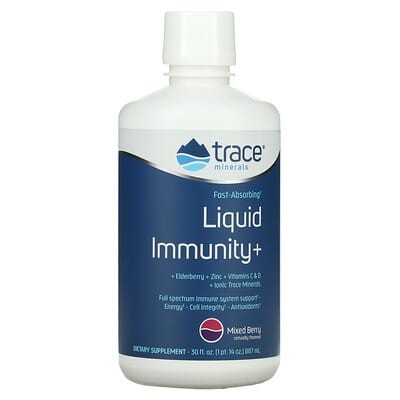
Liquid Immunity+ Mixed Berry

Goals
$27.99 $0.93 per serving


Product analysis
Liquid Immunity+ Mixed Berry supplies vitamin C, zinc and vitamin D for normal immune function, especially when intake falls short. Its zinc sources and blend lack a full breakdown, making precise ingredient comparisons harder.
AI assessment of the formula, label and price. How scoring works
Nutrient Quality34
Several named forms cannot be judged confidently for quality. Unspecified elderberry and blend preparations, along with unknown zinc-source proportions, limit a fuller comparison.
Ingredient Transparency67
Listed amounts and some forms are stated, helping identify the serving. The zinc sources and blend lack a breakdown, and several preparations remain unnamed.
Value For Money36
The serving is relatively costly when judged for vitamin C and offers moderate value for chloride. Value for several remaining ingredients is uncertain.
Customer Satisfaction74
Customer ratings are positive. Feedback comes from 288 ratings, providing useful context for that impression.
Product Focus37
The clearest role is nutritional support for normal immune and antioxidant functions. Elderberry findings depend on particular preparations and do not establish routine daily protection.
- Format
Liquid - Container
- 30 Fluid Ounce(s)
- Per serving
- $0.93
- Customer rating
- 4.7 · 288 ratings
Goals

Impact
Highest effect
Magnesium · 10 mgVitamin C · 1000 mgZinc · 15 mgVitamin D · 30 mcgEuropean Elder · 200 mg
Vitamin C supports immune-cell activity and may modestly shorten colds with regular use. Zinc and vitamin D contribute to normal immune function without establishing additional infection prevention when intake is adequate. Elderberry findings depend on particular extracts and regimens, so the declared amount does not establish the same respiratory benefit.
How this product is rated for Immunity
Ingredient fit76
Immune-related nutrients sit alongside ingredients intended for other nutritional goals, making this a broader formula. The supplied serving provides a partial amount comparison for vitamin c, rather than a proven benefit level.
Goal fit
Immune-related nutrients sit alongside ingredients intended for other nutritional goals, making this a broader formula.
Dose adequacy
The supplied serving provides a partial amount comparison for vitamin c, rather than a proven benefit level.
Pathways80
The strongest saved connection is early immune-cell activity. The ingredient roles support this connection without proving infection protection.
Depth
The strongest saved connection is early immune-cell activity. The ingredient roles support this connection without proving infection protection.
Breadth
Two immune functions reach the saved coverage threshold, indicating a broader set of ingredient connections.
Evidence100
Vitamin C supplies the strongest saved evidence connection; its supported role does not establish broad infection prevention.
Evidence strength
Vitamin C supplies the strongest saved evidence connection; its supported role does not establish broad infection prevention.
Studied preparation
The saved preparation matching is favorable; it does not establish superiority over other nutrient forms.
Formulation logic100
Neither specified zinc conflict applies to the supplied facts; these checks do not establish overall safety.
Partner coverage
The included ingredients require no missing partner under the supplied findings; this does not imply extra benefit from combining them.
Conflicts
Neither specified zinc conflict applies to the supplied facts; these checks do not establish overall safety.
Effective doses
All included ingredients counted here meet the saved minimum amount comparison; this is not proof of clinical effectiveness.

Impact
Highest effect
Vitamin D · 30 mcgMagnesium · 10 mgZinc · 15 mgVitamin C · 1000 mg
Vitamin C and zinc contribute nutrients used in normal antioxidant and immune functions when intake is low, while vitamin D contributes to mineral nutrition. Elderberry received a saved contribution, but limited research on acute respiratory illness does not establish daily prevention or broad wellness benefits. The very small magnesium amount did not add to the saved result, leaving the useful nutritional contribution concentrated in the vitamins and zinc.
How this product is rated for Everyday Health
Ingredient fit80
The contributing ingredients supply partial amounts overall; this comparison does not establish a clinical benefit threshold.
Goal fit
The contributing ingredients are focused on general health, although the product is also linked to other goals.
Dose adequacy
The contributing ingredients supply partial amounts overall; this comparison does not establish a clinical benefit threshold.
Pathways80
The strongest contribution is in antioxidant and immune functions, with substantial support in the supplied comparison. Two areas have meaningful contributions, leaving the product narrower than the full general-health goal.
Depth
The strongest contribution is in antioxidant and immune functions, with substantial support in the supplied comparison.
Breadth
Two areas have meaningful contributions, leaving the product narrower than the full general-health goal.
Evidence82
Vitamin D leads the supplied evidence comparison; normal nutritional functions do not establish additional benefit when intake is adequate.
Evidence strength
Vitamin D leads the supplied evidence comparison; normal nutritional functions do not establish additional benefit when intake is adequate.
Studied preparation
The contributing ingredients with qualifying amounts match accepted preparations, without establishing superior effects from their particular forms.
Formulation logic100
All retained contributors reach the comparison’s minimum amount allowance; this is not a proven clinical treatment threshold.
Partner coverage
The contributing ingredients can act independently or have their required partners; an extra combination benefit is not established.
Conflicts
No configured ingredient conflict was identified in the supplied facts.
Effective doses
All retained contributors reach the comparison’s minimum amount allowance; this is not a proven clinical treatment threshold.

Impact
Highest effect
Vitamin D · 30 mcgVitamin C · 1000 mg
Zinc can help address low intake that contributes to inflammatory signalling. Vitamin C has shown a CRP reduction in people with elevated starting CRP, rather than a consistent benefit across all participants. Vitamin D findings include a transient CRP change without established broad clinical anti-inflammatory benefit. The small magnesium amount received no contribution.
How this product is rated for Inflammation
Ingredient fit73
Relevant ingredients sit within a broader formula, limiting its focus on this particular goal. Smaller or unresolved amounts limit the comparison with the referenced exposures.
Goal fit
Relevant ingredients sit within a broader formula, limiting its focus on this particular goal.
Dose adequacy
Smaller or unresolved amounts limit the comparison with the referenced exposures.
Pathways75
Oxidative and mitochondrial stress is the strongest recorded mechanism; this does not establish broad clinical benefit.
Depth
Oxidative and mitochondrial stress is the strongest recorded mechanism; this does not establish broad clinical benefit.
Breadth
Two inflammatory mechanisms reached the required coverage level; other mechanisms remained less represented.
Evidence93
Vitamin D leads the saved evidence finding, with its specific population and outcome limitations still applying.
Evidence strength
Vitamin D leads the saved evidence finding, with its specific population and outcome limitations still applying.
Studied preparation
Contributing preparations matched those recognized in the saved result; this does not establish a trial of the complete product.
Formulation logic100
No missing required partner or configured conflict reduced recognized contributions. All counted amounts reached the minimum comparison threshold.
Partner coverage
No missing required partner reduced recognized contributions; this does not demonstrate extra benefit from combining ingredients.
Conflicts
No configured ingredient conflict was identified in the supplied calculation.
Effective doses
All counted ingredients reached the minimum comparison threshold, which is not a proven minimum effective clinical dose.

Impact
Moderate effect
Zinc · 15 mgVitamin C · 1000 mg
Vitamin C supports normal collagen formation, while zinc contributes to skin repair and healing. The 1,000 mg vitamin C and 15 mg zinc servings may help cover dietary gaps; additional skin benefits are not assumed in people with adequate intake.
How this product is rated for Skin Health
Ingredient fit64
Skin-related ingredients sit alongside other actives with less direct support for this goal. The relevant amounts largely meet the saved dose comparisons, with some smaller contributions.
Goal fit
Skin-related ingredients sit alongside other actives with less direct support for this goal.
Dose adequacy
The relevant amounts largely meet the saved dose comparisons, with some smaller contributions.
Pathways0
The saved finding identifies a nutritional contribution without coverage of the listed skin areas. None of the listed skin areas reaches the saved coverage benchmark.
Depth
The saved finding identifies a nutritional contribution without coverage of the listed skin areas.
Breadth
None of the listed skin areas reaches the saved coverage benchmark.
Evidence100
Vitamin C provides the strongest support in the supplied finding, subject to its nutritional or study-specific limits. The relevant ingredients meeting the saved amount benchmark have accepted preparation support.
Evidence strength
Vitamin C provides the strongest support in the supplied finding, subject to its nutritional or study-specific limits.
Studied preparation
The relevant ingredients meeting the saved amount benchmark have accepted preparation support.
Formulation logic100
The relevant ingredients can contribute alone or have the needed partner present. No conflict was flagged by the supplied ingredient checks. 2 of 2 included ingredients reach the saved minimum amount benchmark.
Partner coverage
The relevant ingredients can contribute alone or have the needed partner present.
Conflicts
No conflict was flagged by the supplied ingredient checks.
Effective doses
2 of 2 included ingredients reach the saved minimum amount benchmark.

Impact
High effect
Zinc · 15 mgVitamin C · 1000 mg
Zinc, vitamin c have nutritional or antioxidant roles, but their eye-disease evidence concerns defined combinations in selected AMD populations, not routine visual improvement.
How this product is rated for Eye Health
Ingredient fit63
Several declared amounts provide only partial coverage of the saved comparisons, limiting their attributed contribution.
Goal fit
The relevant ingredients form part of a broader formula with several other purposes, limiting its concentration on vision.
Dose adequacy
Several declared amounts provide only partial coverage of the saved comparisons, limiting their attributed contribution.
Pathways47
The strongest identified connection concerns antioxidant protection in the retina and lens.
Depth
The strongest identified connection concerns antioxidant protection in the retina and lens.
Breadth
The identified connections cover antioxidant protection in the retina and lens.
Evidence84
Zinc leads the saved evidence findings, while the supplied context limits what can be claimed for routine vision.
Evidence strength
Zinc leads the saved evidence findings, while the supplied context limits what can be claimed for routine vision.
Studied preparation
The evaluated preparations meet the supplied preparation comparison; study population and outcome limitations still apply.
Formulation logic100
The evaluated ingredients have no unmet partner requirement in the supplied findings.
Partner coverage
The evaluated ingredients have no unmet partner requirement in the supplied findings.
Conflicts
No configured ingredient conflict was identified.
Effective doses
The evaluated ingredients meet the saved minimum amount comparison; this is not a proven threshold for visual benefit.
Ingredients
| Ingredient | Amount per serving | Score |
|---|---|---|
Calories | 40 Calorie(s) | |
Total Carbohydrates | 10 Gram(s) | |
Vitamin C (Ascorbic Acid) | 1000 mg | |
Vitamin D3 (Cholecalciferol) | 30 mcg | |
Magnesium (Ionic Trace Minerals) | 10 mg | |
Zinc (Zinc Gluconate, Zinc Glycinate) | 15 mg | |
Chloride (Ionic Trace Minerals) | 50 mg | |
Black Elderberry | 200 mg | |
Ionic Trace Minerals Complex | 150 mg |
Chloride (Ionic Trace Minerals) · 50 mg OverallScore35
A serving supplies 50 mg chloride, a low amount. The available facts do not identify its salt source.
How this ingredient is rated
Active Ingredient Quality & Bioavailability20
The available facts do not identify the chloride salt.
Chloride source quality
The available facts do not identify the chloride salt.
Dose, Safety & Label Transparency42
A serving provides 50 mg chloride, a low amount. The chloride amount is given, but the available facts do not identify its salt source.
Chloride amount per serving
A serving provides 50 mg chloride, a low amount.
Amount and source disclosure
The chloride amount is given, but the available facts do not identify its salt source.
Value50
The whole-product serving costs about $0.95.
Price per serving
The whole-product serving costs about $0.95.
European Elder · 200 mg OverallScore65
A serving provides 200 mg of black elderberry. The saved details do not identify the scientific species or plant part.
How this ingredient is rated
Composition and Label Disclosure30
The saved details do not identify the scientific species or plant part.
Botanical Identity Detail
The saved details do not identify the scientific species or plant part.
Composition and Label Disclosure100
The saved preparation amount is 200 mg per serving.
Actual Preparation Amount Disclosure
The saved preparation amount is 200 mg per serving.
Commercial Price and Usability
No price or usability rule was evaluated.
Vitamin C (Ascorbic Acid) · 1000 mg OverallScore44
A serving supplies 1,000 mg of vitamin C as ascorbic acid. An artificial color is recorded in the liquid.
How this ingredient is rated
Active Ingredient Quality & Bioavailability30
Ascorbic acid is the named source. The available facts do not establish a specific degree of buffering.
Vitamin C Chemical Form & Delivery System
The vitamin C source is ascorbic acid, with no advanced delivery claim recorded.
Gastric Comfort & pH Balance
The source is ascorbic acid; the available facts do not establish a specific degree of buffering.
Dose, Safety & Label Transparency70
A serving provides 1,000 mg of vitamin C and identifies its source. An artificial color is recorded.
Optimal Dosage Targeting
A serving contains 1,000 mg of vitamin C.
Purity & Excipient Quality
An artificial color is recorded in the product ingredients.
Mineral & Source Transparency
The 1,000 mg vitamin C amount and its ascorbic acid source are recorded; a matching mineral amount is not applicable.
Value20
The whole-product serving price works out to about $0.95 per gram of vitamin C.
Price per Gram of Vitamin C
The whole-product serving price works out to about $0.95 per gram of vitamin C.
Alternative products
Report alternatives
Sources
Published studies used for the product analysis and the top-ranked studies for each ingredient and goal.
- Elderberry Supplementation Reduces Cold Duration and Symptoms in Air-Travellers: A Randomized, Double-Blind Placebo-Controlled Clinical Trial.
- COVID-19: Is There Evidence for the Use of Herbal Medicines as Adjuvant Symptomatic Therapy?
- Perioperative systemic magnesium to minimize postoperative pain: a meta-analysis of randomized controlled trials.
- Long-term outcome after intravenous magnesium sulphate in suspected acute myocardial infarction: the second Leicester Intravenous Magnesium Intervention Trial (LIMIT-2).
- Association of magnesium sulfate use with mortality in critically ill patients with sepsis: a retrospective propensity score-matched cohort study.
- Hypomagnesemia and Mortality in Incident Hemodialysis Patients.
- The effects of magnesium supplementation on abnormal uterine bleeding, alopecia, quality of life, and acne in women with polycystic ovary syndrome: a randomized clinical trial.
- Dietary intake and blood concentrations of antioxidants and the risk of cardiovascular disease, total cancer, and all-cause mortality: a systematic review and dose-response meta-analysis of prospective studies.
- Scientific Opinion on the substantiation of a health claim related to vitamin C and increasing non haem iron absorption pursuant to Article 14 of Regulation (EC) No 1924/2006.
- Vitamin C Depletion and All-Cause Mortality in Renal Transplant Recipients.
- Associations of Serum Biomarkers of Fruit and Vegetable Intake With the Risk of Cause-Specific Mortality and All-Cause Mortality: A National Prospective Cohort Study.
- Relation between plasma ascorbic acid and mortality in men and women in EPIC-Norfolk prospective study: a prospective population study. European Prospective Investigation into Cancer and Nutrition.
- Vitamin D supplementation for prevention of mortality in adults.
- Effect of vitamin D on gastrointestinal symptoms and health-related quality of life in irritable bowel syndrome patients: a randomized double-blind clinical trial.
- The impact of vitamin D administration on mortality in COVID-19 patients: a systematic review and meta-analysis of randomized controlled trials.
- Vitamin D Status and Mortality: A Systematic Review of Observational Studies.
- Meta-analysis of long-term vitamin D supplementation on overall mortality.
- Effectiveness of sodium bicarbonate and zinc chloride mouthwashes in the treatment of oral mucositis and quality of life in patients with cancer under chemotherapy.
- Zinc supplementation in young children with acute diarrhea in India.
- Associations of mortality with ocular disorders and an intervention of high-dose antioxidants and zinc in the Age-Related Eye Disease Study: AREDS Report No. 13.