


Vitamin A Supportive
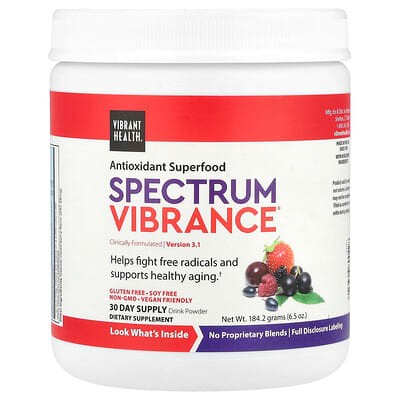
$55.13 $1.83 per serving
Product analysis
Vibrant Health Spectrum Vibrance is a fruit, vegetable and antioxidant powder intended to complement everyday nutrition and healthy aging. One 6.14 g scoop contains 4 mg astaxanthin and 5 mg lycopene, with the astaxanthin offering some potential antioxidant support for skin, though the benefits of the broad blend remain uncertain.
AI assessment of the formula, label and price. How scoring works
Nutrient Quality28
The formula combines many fruit and vegetable powders with more concentrated antioxidant extracts, including astaxanthin. Many preparations lack specific active compound information, making the antioxidant contribution of those ingredients harder to judge.
Ingredient Transparency74
All 44 assessed amounts are disclosed, including the individual preparations rather than a single proprietary blend. Only 13 have detailed form information.
Value For Money23
Many of the antioxidant extracts and vitamins are costly when the full scoop price is assigned to each alone. There are no reliable individual value comparisons for several of the fruit powders.
Customer Satisfaction70
Customers give it an average of 4.6 out of 5. That favorable feedback comes from 152 ratings.
Product Focus22
The formula has a broad nutritional and antioxidant focus rather than a tightly targeted one. Astaxanthin has a modest fit for skin antioxidant support, but there is limited certainty about the other goals.
- Format
Powder - Container
- 184 Gram(s)
- Per serving
- $1.83
- Customer rating
- 4.6 · 152 ratings
Goals

Impact
Moderate effect
Vitamin C · 52 mgAstaxanthin · 4 mgLycopene · 5 mgVitamin E · 1.36 mg
Spectrum Vibrance offers a narrow potential benefit for the skin’s response to photooxidative stress. Astaxanthin at 4 mg matches an amount associated with limited human skin evidence and is the clearest skin-focused ingredient. Lycopene at 5 mg adds a similar antioxidant focus, though its effect at this lower amount remains uncertain.
Vitamin C Supportive
Vitamin E Supportive
Lycopene Supportive
Astaxanthin Supportive

Impact
Lower effect
Vitamin E · 1.36 mgAstaxanthin · 4 mgVitamin C · 52 mg
Vitamin C Supportive
Vitamin E Supportive
Astaxanthin Supportive
Lycopene Supportive

Impact
Lower effect
Vitamin E · 1.36 mgVitamin C · 52 mgVitamin A · 85 mcgAstaxanthin · 4 mg
Vitamin A Supportive
Vitamin E Disputed
Vitamin C Disputed
Astaxanthin Mixed
Lycopene Supportive


Impact
Lower effect
Astaxanthin · 4 mg
Curcumin Supportive
Astaxanthin Mixed
Ingredients
| Ingredient | Amount per serving | Score |
|---|---|---|
Calories | 25 Calorie(s) | |
Total Carbohydrates | 5 Gram(s) | |
Protein | 0.5 Gram(s) | |
Vitamin A (Plant Carotenoids) | 85 mcg | |
Vitamin C | 52 mg | |
Calcium | 25 mg | |
Iron | 1.5 mg | |
Vitamin E | 1.36 mg | |
Vitamin K | 17 mcg | |
Sodium | 10 mg | |
Potassium | 50 mg | |
Goji berry juice powder | 300 mg | |
Raspberry fruit powder | 300 mg | |
Camu-Camu (Vitamin C Extract) | 200 mg | |
Cranberry | 200 mg | |
Strawberry fruit powder | 200 mg | |
Tomato fruit powder | 150 mg | |
Pomegranate standardized extract (Ellagic Acid) | 50 mg | |
Cranberry standardized extract (organic Acids) | 20 mg | |
Goji standardized extract (Polyphenols) | 20 mg | |
Raspberry standardized extract (Ellagic Acid) | 20 mg | |
Lycopene (Beadlets) | 5 mg | |
Astaxanthin (Haematococcus pluvialis) | 4 mg | |
Apricot fruit powder | 300 mg | |
Carrot juice powder | 200 mg | |
Carrot root powder | 200 mg | |
Papaya fruit juice powder | 200 mg | |
Peach fruit powder | 200 mg | |
Pear whole fruit powder | 200 mg | |
Marigold flower extract (Lutein) | 200 mg | |
Curcuminoids 95% standardized extract | 100 mg | |
Turmeric root powder | 100 mg | |
Brussels Sprout powder | 200 mg | |
Green Cabbage powder | 200 mg | |
Kale leaf powder | 200 mg | |
Moringa leaf powder | 200 mg | |
Parsley leaf & stem powder | 200 mg | |
Broccoli sprouts powder | 50 mg | |
Gynostemma pentaphylum std extract (Gypenosides) | 30 mg | |
Prune (Plum) powder | 300 mg | |
Blueberry fruit powder | 220 mg | |
Acai fruit juice powder | 200 mg | |
Blackberry fruit powder | 200 mg | |
Acai fruit 4:1 ext. | 100 mg | |
Elderberry fruit 10:1 extract | 100 mg | |
Phycocyanin (pure Phycocyanin powder) | 60 mg | |
Plum (Polyphenols) | 25 mg | |
Grape skin standardized extract (Polyphenols) | 20 mg | |
Bilberry fruit 4:1 extract | 20 mg |
Astaxanthin (Haematococcus pluvialis) · 4 mg OverallScore62
Vibrant Health Spectrum Vibrance is a reasonable choice for astaxanthin, with 4 mg per labeled serving. The astaxanthin is associated with Haematococcus pluvialis microalgae. The price offers limited value at $0.40 per mg of astaxanthin and $1.61 per labeled serving; the serving price covers the full formula. Light-protective packaging is unconfirmed, so protection from oxidation is uncertain.
European Elder · 100 mg OverallScore72
Vibrant Health Spectrum Vibrance is expensive for European elder at $1.61 per 100 mg of elderberry fruit extract per serving of the full formula. Each serving contains 100 mg of elderberry fruit extract; the species is not specified. The comparison uses preparation weight, not active yield.
Lycopene (Beadlets) · 5 mg OverallScore70
Vibrant Health Spectrum Vibrance is a poor value for lycopene at $3.22 per 10 mg of lycopene, with a full serving costing $1.61. Each serving supplies 5 mg of lycopene, but its source and form are unspecified. The price covers the full formula.
Alternative products
Report alternatives
Sources
Published studies used for the product analysis and the top-ranked studies for each ingredient and goal.
- Effects of astaxanthin-rich Haematococcus pluvialis extract on cognitive function: a randomised, double-blind, placebo-controlled study.
- Effect of astaxanthin-rich extract derived from Paracoccus carotinifaciens on cognitive function in middle-aged and older individuals.
- The Effects of Astaxanthin on Cognitive Function and Neurodegeneration in Humans: A Critical Review.
- Effects of Astaxanthin Supplementation on Fatigue, Motor Function and Cognition: A Meta-Analysis of Randomized Controlled Trials.
- Astaxanthin and improvement of dementia: A systematic review of current clinical trials.
- Curcumin-Rich Curry Consumption Is Associated with Lower Risk of Cognitive Decline and Incidence of Mild Cognitive Impairment or Dementia: An Asian Population-Based Study.
- Curcumin: A Golden Approach to Healthy Aging: A Systematic Review of the Evidence.
- The effect of curcumin supplementation on cognitive function: an updated systematic review and meta-analysis.
- Curcumin and Cognitive Health: Insights from Randomized Controlled Trials.
- Botanicals and phytochemicals active on cognitive decline: The clinical evidence.
- Benefits and Safety of Astaxanthin in the Treatment of Mild-To-Moderate Dry Eye Disease.
- Astaxanthin (AstaReal®) Improved Acute and Chronic Digital Eye Strain in Children: A Randomized Double-Blind Placebo-Controlled Trial.
- Effects of diet containing astaxanthin on visual function in healthy individuals: a randomized, double-blind, placebo-controlled, parallel study.
- Astaxanthin, cell membrane nutrient with diverse clinical benefits and anti-aging potential.
- Nutritional Supplementation for Myopia Prevention and Control: A Systematic Review of Randomized Controlled Trials.
- The Associations of Plasma Carotenoids and Vitamins With Risk of Age-Related Macular Degeneration: Results From a Matched Case-Control Study in China and Meta-Analysis.
- Serum carotenoids and risk of age-related macular degeneration in a chinese population sample.
- Serum antioxidants and age-related macular degeneration in a population-based case-control study.
- Association between serum carotenoid concentrations and risk of major age-related eye diseases among middle-aged and older adults.
- Plasma antioxidant vitamins and carotenoids and age-related cataract