
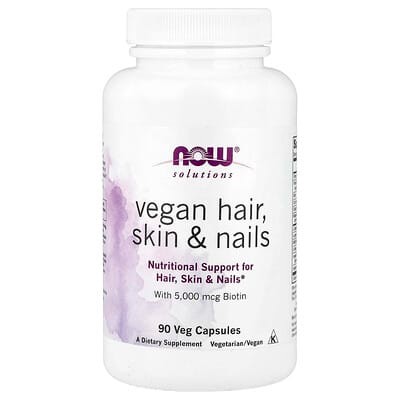

$13.50 $0.30 per serving


Product analysis
Vegan Hair Skin & Nails combines nutrients, amino acids and plant ingredients in one vegan formula for a beauty-focused routine. Missing form and component details make it harder to judge what the combination offers.
AI assessment of the formula, label and price. How scoring works
Nutrient Quality38
Copper and manganese use identifiable, favorably regarded forms. Several other forms are omitted or lack enough information for a firm quality comparison.
Ingredient Transparency65
Every ingredient amount is listed, making serving comparisons possible. Only half the forms are identified, and some component details are missing.
Value For Money50
Value varies across the formula, with favorable comparisons for copper, manganese and cysteine but poor value for lysine. Price comparisons remain uncertain for several other ingredients.
Customer Satisfaction87
Customer ratings are very positive. Thousands of ratings give a reasonably broad picture of buyer opinion.
Product Focus24
The formula brings together many ingredients around one beauty-related purpose. The practical benefit of the full combination remains unclear.
- Format
Capsule - Container
- 90 Capsule(s)
- Per serving
- $0.30
- Customer rating
- 4.7 · 4,251 ratings
Goals

Impact
Situational effect
Copper · 1 mgManganese · 2 mgLysine · 200 mgZinc · 8 mgProline · 200 mgVitamin C · 90 mg
Horsetail Not classified
No linked studies yet.
Ingredients
| Ingredient | Amount per serving | Score |
|---|---|---|
Vitamin C (Ascorbic Acid) | 90 mg | |
Vitamin E (D-Alpha-Tocopherol, Sunflower Oil) | 20 mg | |
Biotin | 5 mg | |
Zinc (Zinc Bisglycinate) | 8 mg | |
Copper (Copper Bisglycinate) | 1 mg | |
Manganese (Manganese Amino Acid Chelate) | 2 mg | |
L-Cysteine | 250 mg | |
Lysine | 200 mg | |
MSM | 200 mg | |
L-Proline | 200 mg | |
Horsetail | 100 mg | |
Hyaluronic Acid (Sodium Hyaluronate) | 50 mg |
Copper (Copper Bisglycinate) · 1 mg OverallScore90
A serving supplies 1 mg of copper as copper bisglycinate, a form considered readily absorbed. It also supplies 8 mg of zinc, giving a 8:1 zinc-to-copper ratio.
How this ingredient is rated
Active Ingredient Quality & Bioavailability100
Copper Bisglycinate is an amino acid chelate considered readily absorbed, and the copper amount and source are identified in the saved facts.
Copper Form Bioavailability
Copper Bisglycinate is an amino acid chelate considered readily absorbed.
Elemental Copper Labeling Clarity
The saved facts identify 1 mg of elemental copper and a named source.
Dose, Safety & Label Transparency86
A serving supplies 1 mg of copper and 8 mg of zinc. Their 8:1 zinc-to-copper ratio is within the balance favored in the evaluation.
Copper Dosage Safety & Efficacy
The selected serving supplies 1 mg of copper.
Zinc-to-Copper Balance
The 8 mg zinc and 1 mg copper give a 8:1 zinc-to-copper ratio, within the balance favored in the evaluation.
Value80
A whole-product serving costs about $0.30.
Price Per Serving Efficiency
A whole-product serving costs about $0.30.
Manganese (Manganese Amino Acid Chelate) · 2 mg OverallScore78
Each serving provides 2 mg of manganese as a manganese amino acid chelate. The whole-product serving costs about $0.30, a relatively low price in this comparison.
How this ingredient is rated
Active Ingredient Quality & Bioavailability70
The source is a manganese amino acid chelate; the specific amino acid is not identified in the available facts.
Manganese Chemical Form
The source is a manganese amino acid chelate; the specific amino acid is not identified in the available facts.
Dose, Safety & Label Transparency86
The evaluation considers 2 mg per serving sufficient for nutritional maintenance, though less aimed at targeted bone support. The manganese amount is stated per serving.
Manganese Dosage Efficacy & Safety
The evaluation considers 2 mg per serving sufficient for nutritional maintenance, though less aimed at targeted bone support.
Elemental Weight Disclosure
The manganese amount and its source are both stated, making the 2 mg per serving clear.
Value80
A whole-product serving costs about $0.30, a relatively low price in this comparison.
Price per Serving vs. Median
A whole-product serving costs about $0.30, a relatively low price in this comparison.
Proline · 200 mg OverallScore79
Each serving lists 200 mg of L-proline, a modest amount. The whole-product price works out to about $0.75 per 500 mg of proline.
How this ingredient is rated
Active Ingredient Quality & Bioavailability100
The label identifies the ingredient as L-proline.
Proline Form & Source Purity
L-proline is the form named on the label.
Dose, Safety & Label Transparency68
The label lists 200 mg of proline per serving, a modest amount.
Proline Dosage Strength
A serving contains 200 mg of proline, a modest amount.
Label Transparency & Disclosure
The proline amount is disclosed as 200 mg per serving.
Value60
At about $0.75 per 500 mg of proline, the whole-product price is moderate for the amount supplied.
Price Per 500mg of Proline
The whole-product price is about $0.75 per 500 mg of proline, which is moderate for that quantity.
Alternative products
Report alternatives
Sources
Published studies used for the product analysis and the top-ranked studies for each ingredient and goal.
- The Association between Dietary and Circulating Copper Levels and Osteoporosis: a Scoping Review.
- Association between dietary copper, iron, zinc, selenium intake and osteopenia or osteoporosis in elderly hypertensive patients: a retrospective cohort study.
- Associations of dietary copper intake with total bone mineral density and lumbar spine bone mineral density in American adults.
- The association between dietary mineral intake and bone mineral density: a cross-sectional study.
- Association between dietary copper intake and bone mineral density in children and adolescents aged 8-19 years: A cross-sectional study.
- Amino Acid Intakes Are Associated With Bone Mineral Density and Prevalence of Low Bone Mass in Women: Evidence From Discordant Monozygotic Twins.
- Dietary L-lysine and calcium metabolism in humans.
- Risk of Environmental Chemicals on Bone Fractures Is Independent of Low Bone Mass in US Adults: Insights from 2017 to 2018 NHANES.
- The Manganese-Bone Connection: Investigating the Role of Manganese in Bone Health.
- Associations of multiple metals with bone mineral density: A population-based study in US adults.
- Sex-specific associations of urinary mixed-metal concentrations with femoral bone mineral density among older people: an NHANES (2017-2020) analysis.
- Relationship between blood manganese and bone mineral density and bone mineral content in adults: A population-based cross-sectional study.
- Human bone collagen synthesis is a rapid, nutritionally modulated process.
- Osteogenesis imperfecta: recent findings shed new light on this once well-understood condition.
- Can Dietary Intake of Vitamin C-Oriented Foods Reduce the Risk of Osteoporosis, Fracture, and BMD Loss? Systematic Review With Meta-Analyses of Recent Studies.
- Dietary vitamin C intake and the risk of hip fracture: a dose-response meta-analysis.
- Smoking, antioxidant vitamins, and the risk of hip fracture.
- Micronutrients and the risk of hip fracture: Case-control study.
- Favorable effect of dietary vitamin C on bone mineral density in postmenopausal women (KNHANES IV, 2009): discrepancies regarding skeletal sites, age, and vitamin D status.
- Increased incidence of fractures in middle-aged and elderly men with low intakes of phosphorus and zinc.