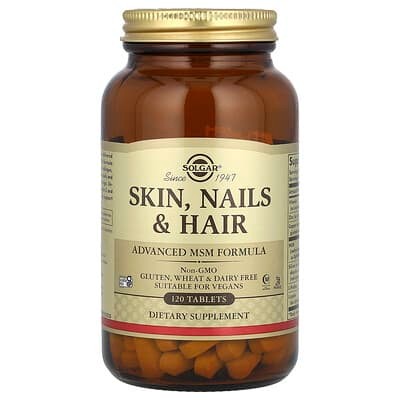
Skin Nails & Hair

Skin Nails & Hair

Solgar4.7 (83,722 ratings)
Format:Tablet Quantity: 120 Tablet(s) · 60 servings
Goals

About this product

Nutritional support for skin, hair and nails is the clearest use, especially when zinc or copper intake falls short. The serving provides 15 mg zinc as citrate and 2 mg copper as glycinate, both clearly identified mineral sources. Vitamin C at 120 mg also supports normal collagen formation.

The ingredients aimed at visible cosmetic changes have more important limits. OptiMSM supplies 1000 mg, below the 3000 mg exposure associated with the controlled cosmetic findings, while the silicon dioxide and red-algae mixture is not established as the preparation linked to hair and nail outcomes. Its source proportions are unclear, so the silicon declaration alone cannot predict those results.

The 50 mg amounts of L-proline and lysine add little support for the main goals. The formula fits someone seeking combined mineral and connective-tissue nutrition, but evidence for visible improvement is less certain once nutrient needs are met. Its value rests more on the combined nutrients than on obtaining a meaningful amount of proline.

Who is it for
  • Adults seeking skin, hair and nail nutrition when dietary mineral intake is low
  • People who want zinc supplied alongside a disclosed copper amount
Best for
  • Combined zinc and copper nutrition
  • Supporting normal connective-tissue nutrient needs

Pros

  • Zinc citrate and copper glycinate are favorable identified mineral sources
  • Vitamin C complements the minerals' normal connective-tissue roles
  • Individual active amounts are disclosed

Cons

  • Silicon source proportions and equivalence to the relevant studied preparation remain unclear
  • MSM amount is below the controlled cosmetic comparison exposure
  • The small proline amount contributes little value as a proline supplement

Product analysis

65 out of 100

Skin Nails & Hair provides zinc, copper and vitamin C to support normal skin and hair nutrition, particularly when intake is low. Its silicon blend is not equivalent to the preparations linked with stronger hair or nails, so those benefits remain uncertain.

AI assessment of the formula, label and price. How scoring works

Nutrient Quality50

Zinc citrate and copper glycinate are favorable mineral forms. The silicon blend has uncertain proportions and limited absorption potential, while the quality of several other ingredients cannot be established.

Ingredient Transparency76

All active ingredient amounts are listed, making serving sizes easier to compare. Proline’s form and the proportions of the silicon blend are missing, leaving parts of the formula less clear.

Value For Money57

Value varies across the ingredients, with favorable comparisons for copper and silicon but poor value for the amount of proline. Several other ingredients lack enough information for a firm value judgment.

Customer Satisfaction92

Customer ratings are very positive, based on a large body of feedback. These ratings describe satisfaction and do not establish effectiveness or safety.

Product Focus67

The blend mainly supports normal skin, hair and connective-tissue nutrition. Its wider benefits depend on nutrient needs, and several beauty claims rely on preparations that do not match this formula.

Format
Tablet
Container
120 Tablet(s)
Per serving
$0.31
Customer rating
4.7 · 83,722 ratings
Report analysis

Goals

Skin Health
Impact
High effect
B Ingredient FitC PathwaysB+ EvidenceA+ Formulation Logic
Zinc · 15 mgVitamin C · 120 mgCopper · 2 mgProline · 50 mgSilicon · 50 mg
Study evidence
Copper Supportive 16 studies
Proline Disputed 4 studies
Silicon Supportive 16 studies
Vitamin C Supportive 53 studies
Zinc Supportive 66 studies
Hair Health
Impact
High effect
B Ingredient FitF PathwaysA EvidenceA+ Formulation Logic
Zinc · 15 mgLysine · 50 mgVitamin C · 120 mg
Study evidence
Copper Adverse 4 studies
Lysine Supportive 1 study
Silicon Supportive 2 studies
Zinc Supportive 22 studies
Nail Health
Impact
Moderate effect
B- Ingredient FitD+ PathwaysF EvidenceA+ Formulation Logic
Silicon · 50 mg
Study evidence
Silicon Supportive 2 studies
Vitamin C Supportive 1 study
Zinc No effect 1 study
Everyday Health
Impact
Moderate effect
D- Ingredient FitF PathwaysB- EvidenceA+ Formulation Logic
Zinc · 15 mgVitamin C · 120 mg
Study evidence
Vitamin C Supportive 56 studies
Zinc Supportive 60 studies
Immunity
Impact
High effect
C- Ingredient FitD- PathwaysA+ EvidenceA+ Formulation Logic
Vitamin C · 120 mgZinc · 15 mg
Study evidence
Lysine Supportive 2 studies
Vitamin C Supportive 53 studies
Zinc Supportive 73 studies
Bone Health
Impact
Highest effect
A- Ingredient FitC PathwaysA EvidenceA+ Formulation Logic
Copper · 2 mgLysine · 50 mgZinc · 15 mgProline · 50 mgVitamin C · 120 mg
Study evidence
Copper Disputed 20 studies
Lysine Supportive 2 studies
Proline Disputed 2 studies
Silicon Supportive 13 studies
Vitamin C Supportive 46 studies
Zinc Supportive 33 studies

Ingredients

IngredientAmount per servingScore
Vitamin C (L-Ascorbic Acid)
120 mg
Zinc (Zinc Citrate)
15 mg 78
Copper (Copper Glycinate Amino Acid Chelate)
2 mg 90
MSM (OptiMSM)
1000 mg
Silicon (L. calcareum, Silicon Dioxide)
50 mg 52
L-Proline
50 mg 63
L-Lysine (L-Lysine Hydrochloride)
50 mg 46
Gluten Free Adults 18–50 Vegan Kosher Dairy Free Sugar Free Halal Vegetarian
Report overview
A+ Active Ingredient Quality & BioavailabilityA- Dose, Safety & Label TransparencyB+ Value
Each serving provides 2 mg of copper at a moderate cost. The copper comes as copper glycinate. It also supplies 15 mg of zinc.
How this ingredient is rated

Active Ingredient Quality & Bioavailability100

The copper comes as copper glycinate. The copper amount and source are stated.
Copper Form Bioavailability
The copper comes as copper glycinate.
Elemental Copper Labeling Clarity
The label states 2 mg of copper and names its source.

Dose, Safety & Label Transparency85

The selected serving contains 2 mg of copper. The serving also contains 15 mg of zinc, giving a zinc-to-copper ratio of about 7.5:1.
Copper Dosage Safety & Efficacy
The selected serving contains 2 mg of copper.
Zinc-to-Copper Balance
The serving also contains 15 mg of zinc, giving a zinc-to-copper ratio of about 7.5:1.

Value80

The cost per serving is moderate.
Price Per Serving Efficiency
The cost per serving is moderate.
B+ Active Ingredient Quality & BioavailabilityA- Dose, Safety & Label TransparencyC Value
The serving provides 15 mg zinc, a moderate amount, at a moderate cost per serving. It uses Zinc Citrate. It also supplies 2 mg copper.
How this ingredient is rated

Active Ingredient Quality & Bioavailability80

It uses Zinc Citrate.
Zinc Form Bioavailability
It uses Zinc Citrate.

Dose, Safety & Label Transparency85

The zinc amount is clearly stated. The serving provides 2 mg copper, giving a zinc-to-copper ratio of 7.5:1.
Elemental Dose Transparency
The label states the elemental zinc amount and its source.
Zinc Dosage Safety & Effectiveness
15 mg zinc is an amount used for maintenance.
Zinc-to-Copper Mineral Balance
The serving provides 2 mg copper, giving a zinc-to-copper ratio of 7.5:1.

Value60

The cost per labeled serving is moderate.
Price Per Serving Efficiency
The cost per labeled serving is moderate.
F Active Ingredient Quality & BioavailabilityD+ Dose, Safety & Label TransparencyA+ Value
A serving provides 50 mg of elemental silicon, at a low cost per serving. Silicon Dioxide is named, but the remaining chemical form is unknown.
How this ingredient is rated

Active Ingredient Quality & Bioavailability31

Silicon Dioxide is named, but the remaining chemical form is unknown. No silica percentage or extract ratio is supplied.
Silicon Chemical Form & Absorption
Silicon Dioxide is named, but the remaining chemical form is unknown.
Botanical Standardization & Extract Quality
No silica percentage or extract ratio is supplied.
Trademark and Source Transparency
The specific chemical source is unclear.

Dose, Safety & Label Transparency50

The elemental silicon amount is listed as 50 mg per serving.
Elemental Silicon Dosage Adequacy
A serving provides 50 mg of elemental silicon.
Label Transparency: Source vs. Active Yield
The elemental silicon amount is listed as 50 mg per serving.

Value100

The cost per serving is low.
Price per Serving Relative to Median
The cost per serving is low.
Report alternatives

Sources

Published studies used for the product analysis and the top-ranked studies for each ingredient and goal.

  1. The Association between Dietary and Circulating Copper Levels and Osteoporosis: a Scoping Review.
    Ju Y; Xiong W; Pang Y; Chen Z; Hou J; Zheng S; Li Z; Liu T; Xia H; Xia M; Zhong Y; Li J; Jiang X · Biological trace element research · 2026
    Scoping review18 studies pooledBone Health forCopper
  2. Association between dietary copper, iron, zinc, selenium intake and osteopenia or osteoporosis in elderly hypertensive patients: a retrospective cohort study.
    Chen M; Jia L; Gao R · Frontiers in nutrition · 2024
    Cohort study5,286 participantsBone Health forCopper
  3. Associations of dietary copper intake with total bone mineral density and lumbar spine bone mineral density in American adults.
    Hu M; Wang Z; Li C; Zheng Y; Hu J · Medicine · 2025
    Cross-sectional studyBone Health forCopper
  4. The association between dietary mineral intake and bone mineral density: a cross-sectional study.
    Wei M; Wei J; Huang S · Journal of health, population, and nutrition · 2025
    Cross-sectional study11,520 participantsBone Health forCopper
  5. Association between dietary copper intake and bone mineral density in children and adolescents aged 8-19 years: A cross-sectional study.
    Cui A; Yan J; Li H; Fan Z; Wei X; Wang H; Zhuang Y · PloS one · 2024
    Cross-sectional study6,965 participantsBone Health forCopper
  6. Amino Acid Intakes Are Associated With Bone Mineral Density and Prevalence of Low Bone Mass in Women: Evidence From Discordant Monozygotic Twins.
    Jennings A; MacGregor A; Spector T; Cassidy A · Journal of bone and mineral research : the official journal of the American Society for Bone and Mineral Research · 2016
    Cross-sectional study135 participantsBone Health forLysine
  7. Dietary L-lysine and calcium metabolism in humans.
    Civitelli R; Villareal DT; Agnusdei D; Nardi P; Avioli LV; Gennari C · Nutrition (Burbank, Los Angeles County, Calif.) · 1993
    Clinical trial75 participantsBone Health forLysine
  8. Human bone collagen synthesis is a rapid, nutritionally modulated process.
    Babraj JA; Smith K; Cuthbertson DJ; Rickhuss P; Dorling JS; Rennie MJ · Journal of bone and mineral research : the official journal of the American Society for Bone and Mineral Research · 2005
    Methods validation study8 participantsBone Health forProline
  9. Osteogenesis imperfecta: recent findings shed new light on this once well-understood condition.
    Basel D; Steiner RD · Genetics in medicine : official journal of the American College of Medical Genetics · 2009
    Narrative reviewBone Health forProline
  10. The effect of choline-stabilized orthosilicic acid in patients with peri-implantitis: an exploratory randomized, double-blind, placebo controlled study.
    Teughels W; Celik GU; Tarce M; De Cock I; Persyn SM; Haytac MC · BMC oral health · 2021
    Randomized trial21 participantsBone Health forSilicon
  11. Calcium Phosphate Modified with Silicon vs. Bovine Hydroxyapatite for Alveolar Ridge Preservation: Densitometric Evaluation, Morphological Changes and Histomorphometric Study.
    Cadenas-Vacas G; Martínez-Rodríguez N; Barona-Dorado C; Sánchez-Labrador L; Cortés-Bretón Brinkmann J; Meniz-García C; Martínez-González JM · Materials (Basel, Switzerland) · 2021
    Non-randomized trialBone Health forSilicon
  12. Silicon: a review of its potential role in the prevention and treatment of postmenopausal osteoporosis.
    Price CT; Koval KJ; Langford JR · International journal of endocrinology · 2013
    Narrative reviewBone Health forSilicon
  13. Osteogenic Effect of a Bioactive Calcium Alkali Phosphate Bone Substitute in Humans.
    Knabe C; Adel-Khattab D; Rezk M; Cheng J; Berger G; Gildenhaar R; Wilbig J; Günster J; Rack A; Heiland M; Knauf T; Stiller M · Bioengineering (Basel, Switzerland) · 2023
    Clinical trial38 participantsBone Health forSilicon
  14. Silicon and bone health.
    Jugdaohsingh R · The journal of nutrition, health & aging · 2007
    Narrative reviewBone Health forSilicon
  15. Can Dietary Intake of Vitamin C-Oriented Foods Reduce the Risk of Osteoporosis, Fracture, and BMD Loss? Systematic Review With Meta-Analyses of Recent Studies.
    Zeng LF; Luo MH; Liang GH; Yang WY; Xiao X; Wei X; Yu J; Guo D; Chen HY; Pan JK; Huang HT; Liu Q; Guan ZT; Han YH; Zhao D; Zhao JL; Hou SR; Wu M; Lin JT; Li JH; Liang WX; Ou AH; Wang Q; Li ZP; Liu J · Frontiers in endocrinology · 2020
    Meta-analysis19,484 participants17 studies pooledBone Health forVitamin C
  16. Dietary vitamin C intake and the risk of hip fracture: a dose-response meta-analysis.
    Sun Y; Liu C; Bo Y; You J; Zhu Y; Duan D; Cui H; Lu Q · Osteoporosis international : a journal established as result of cooperation between the European Foundation for Osteoporosis and the National Osteoporosis Foundation of the USA · 2019
    Meta-analysis6 studies pooledBone Health forVitamin C
  17. Smoking, antioxidant vitamins, and the risk of hip fracture.
    Melhus H; Michaëlsson K; Holmberg L; Wolk A; Ljunghall S · Journal of bone and mineral research : the official journal of the American Society for Bone and Mineral Research · 1999
    Cohort study66,651 participantsBone Health forVitamin C
  18. Micronutrients and the risk of hip fracture: Case-control study.
    Torbergsen AC; Watne LO; Wyller TB; Frihagen F; Strømsøe K; Bøhmer T; Mowe M · Clinical nutrition (Edinburgh, Scotland) · 2018
    Case-control study189 participantsBone Health forVitamin C
  19. Favorable effect of dietary vitamin C on bone mineral density in postmenopausal women (KNHANES IV, 2009): discrepancies regarding skeletal sites, age, and vitamin D status.
    Kim YA; Kim KM; Lim S; Choi SH; Moon JH; Kim JH; Kim SW; Jang HC; Shin CS · Osteoporosis international : a journal established as result of cooperation between the European Foundation for Osteoporosis and the National Osteoporosis Foundation of the USA · 2016
    Cross-sectional study1,196 participantsBone Health forVitamin C
  20. Increased incidence of fractures in middle-aged and elderly men with low intakes of phosphorus and zinc.
    Elmståhl S; Gullberg B; Janzon L; Johnell O; Elmståhl B · Osteoporosis international : a journal established as result of cooperation between the European Foundation for Osteoporosis and the National Osteoporosis Foundation of the USA · 1999
    Cohort study6,576 participantsBone Health forZinc