
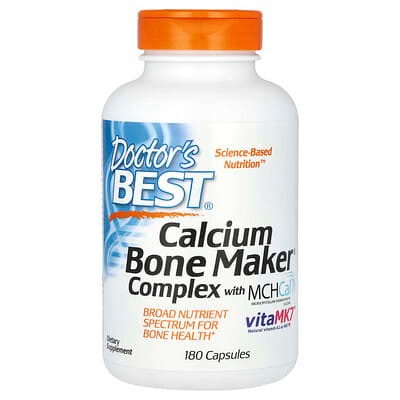
Calcium Bone Maker Complex with MCH-Cal and VitaMK7

Goals
$18.08 $0.30 per serving


Product analysis
Calcium Bone Maker Complex with MCH-Cal and VitaMK7 combines a favorable calcium form with vitamins and minerals. The calcium appears to offer favorable value, although the supporting comparison is older.
AI assessment of the formula, label and price. How scoring works
Nutrient Quality51
The bone-derived calcium form is the clearest quality strength, with boron citrate also a reasonably favorable choice. The calcium and copper comparisons are older, while quality across the other named forms remains uncertain.
Ingredient Transparency88
All nutrient amounts and forms are named, making the ingredients easier to compare. The exact calcium mixture composition remains uncertain.
Value For Money47
Calcium and copper appear to offer favorable value, though both comparisons are older. Boron is relatively costly for its amount, and value for most other nutrients remains uncertain.
Customer Satisfaction90
Customer feedback is very positive. The number of reviews gives more context to satisfaction but does not establish effectiveness or safety.
Product Focus74
The ingredients have support for one intended goal, though benefits remain uncertain. None of the included ingredients is confirmed to be unnecessary.
- Format
Capsule - Container
- 180 Capsule(s)
- Per serving
- $0.30
- Customer rating
- 4.7 · 7,356 ratings
Goals

Impact
High effect
Vitamin K · 40 mcgMagnesium · 150 mgCalcium · 1363 mgVitamin D · 23 mcgCopper · 0.6 mgManganese · 1 mgBoron · 2 mgZinc · 6 NPVitamin C · 125 mg
Calcium supplies mineral for normal bone mineralization and can fill a dietary intake gap. Its serving amount is not a target for supplemental intake, and fracture results are mixed. Vitamin D supports calcium absorption and deficiency-related mineralization, without established routine fracture prevention in adequately nourished adults. MK-7 vitamin K has limited, mixed support for bone-density measures in postmenopausal women; changes in protein activation do not establish fracture prevention. Magnesium supports normal bone metabolism when intake is low; supplementation has not established reliable osteoporosis or fracture prevention.
How this product is rated for Bone Health
Ingredient fit72
The bone-related nutrients sit within a broader formula with other actives.
Goal fit
The bone-related nutrients sit within a broader formula with other actives.
Dose adequacy
The disclosed amounts only partly meet the saved comparison ranges; small or unresolved amounts limit this finding.
Pathways60
The strongest recorded connection concerns calcium absorption and regulation, without proving improved bone density or fewer fractures.
Depth
The strongest recorded connection concerns calcium absorption and regulation, without proving improved bone density or fewer fractures.
Breadth
Only part of the selected bone mechanisms reaches the saved coverage threshold.
Evidence100
Calcium leads the saved evidence finding; its nutritional or preparation-specific limits still apply.
Evidence strength
Calcium leads the saved evidence finding; its nutritional or preparation-specific limits still apply.
Studied preparation
The saved findings recognize the evaluated preparations; this does not imply superiority over other nutrient forms.
Formulation logic97
No required partner is missing in the saved findings; this does not demonstrate extra combination benefit.
Partner coverage
No required partner is missing in the saved findings; this does not demonstrate extra combination benefit.
Conflicts
No matched ingredient conflict was recorded in the supplied findings.
Effective doses
Zinc does not reach the saved minimum amount threshold.
Ingredients
| Ingredient | Amount per serving | Score |
|---|---|---|
Vitamin C (Ascorbic Acid) | 125 mg | |
Vitamin D3 (Cholecalciferol) | 23 mcg | |
Vitamin K2 (Menaquinone-7) | 40 mcg | |
Calcium (MCH-Cal) | 300 mg | |
Phosphorus (MCH-Cal) | 123 mg | |
Magnesium (DiMagnesium Malate) | 150 mg | |
Zinc (Zinc Monomethionine) | 6 NP | |
Copper (Copper Gluconate) | 0.6 mg | |
Manganese (Manganese Citrate) | 1 mg | |
Potassium (Potassium Citrate) | 49 mg | |
MCH-Cal (Bovine Bone Extract) | 1363 mg | |
Boron (Boron Citrate) | 2 mg |
Calcium (MCH-Cal) · 300 mg OverallScore82
Each serving provides 300 mg of calcium as microcrystalline hydroxyapatite. A flow agent is listed, and the whole-product serving costs about $0.30.
How this ingredient is rated
Active Ingredient Quality & Bioavailability100
The label identifies calcium microcrystalline hydroxyapatite as the calcium source and specifies the calcium amount.
Calcium Form & Absorption Potential
Calcium microcrystalline hydroxyapatite is the identified calcium source.
Elemental Calcium Transparency
The label specifies 300 mg of elemental calcium per serving.
Dose, Safety & Label Transparency66
A serving supplies 300 mg of calcium. A flow agent is listed in the ingredients.
Absorption-Optimized Serving Dose
A serving supplies 300 mg of calcium.
Formulation Purity & Additives
A flow agent is listed in the ingredients.
Value80
At about $0.30 per whole-product serving, the price covers the entire product.
Price Per Serving Efficiency
A whole-product serving costs about $0.30.
Boron (Boron Citrate) · 2 mg OverallScore64
Each serving provides 2 mg of boron as boron citrate. The estimated whole-product cost is $0.45 per 3 mg of boron.
How this ingredient is rated
Active Ingredient Quality & Bioavailability64
The saved facts identify boron citrate as the boron form, without a recognized branded or purity claim.
Boron Form & Bioavailability
The evaluation recognizes boron citrate as a boron form.
Trademarked & High-Purity Sources
The saved facts identify a generic source, without a recognized branded or purity claim.
Dose, Safety & Label Transparency80
The serving has a disclosed 2 mg of boron, a modest amount.
Elemental Dose Transparency
The saved facts identify 2 mg of elemental boron per serving.
Dosage Efficacy & Safety Margin
The serving provides 2 mg of boron, a modest amount.
Value30
The estimated cost is $0.45 per 3 mg of boron based on the whole-product price, which is relatively high in this comparison.
Price per 3mg Elemental Boron
The whole-product price works out to about $0.45 per 3 mg of boron.
Copper (Copper Gluconate) · 0.6 mg OverallScore51
Each serving provides 0.6 mg of copper as copper gluconate, a small amount in the evaluation. The saved facts do not establish a zinc-to-copper ratio, so their balance cannot be assessed.
How this ingredient is rated
Active Ingredient Quality & Bioavailability58
Copper gluconate is a common organic copper salt. The copper row gives both its source and amount.
Copper Form Bioavailability
Copper gluconate is a common organic copper salt.
Elemental Copper Labeling Clarity
The copper row identifies 0.6 mg per serving and names copper gluconate as its source.
Dose, Safety & Label Transparency29
Each serving supplies 0.6 mg of copper, a small amount in the evaluation. The saved facts do not establish a zinc-to-copper ratio, so their balance cannot be assessed.
Copper Dosage Safety & Efficacy
Each serving supplies 0.6 mg of copper, a small amount in the evaluation.
Zinc-to-Copper Balance
The saved facts do not establish a zinc-to-copper ratio, so their balance cannot be assessed.
Value80
The whole-product price is about $0.30 per serving.
Price Per Serving Efficiency
A whole-product serving costs about $0.30; that price covers the product, not copper alone.
Alternative products
Report alternatives
Sources
Published studies used for the product analysis and the top-ranked studies for each ingredient and goal.
- [Comparative study of the urinary excretion of boron, calcium, magnesium and phosphorus in postmenopausal women with and without osteoporosis].
- Effect of dietary boron on mineral, estrogen, and testosterone metabolism in postmenopausal women.
- The relationship between boron and magnesium status and bone mineral density in the human: a review.
- Effects of boron supplementation on bone mineral density and dietary, blood, and urinary calcium, phosphorus, magnesium, and boron in female athletes.
- Metabolic responses of postmenopausal women to supplemental dietary boron and aluminum during usual and low magnesium intake: boron, calcium, and magnesium absorption and retention and blood mineral concentrations
- What is the impact of daily oral supplementation of vitamin D3 (cholecalciferol) plus calcium on the incidence of hip fracture in older people? A systematic review and meta-analysis.
- Calcium supplementation prevents seasonal bone loss and changes in biochemical markers of bone turnover in elderly New England women: a randomized placebo-controlled trial.
- The effects of calcium supplementation (milk powder or tablets) and exercise on bone density in postmenopausal women.
- The efficacy of calcium supplementation alone in elderly Thai women over a 2-year period: a randomized controlled trial.
- Calcium-enriched foods and bone mass growth in prepubertal girls: a randomized, double-blind, placebo-controlled trial.
- Effect of Calcium and Vitamin D Supplementation With and Without Collagen Peptides on Volumetric and Areal Bone Mineral Density, Bone Geometry and Bone Turnover in Postmenopausal Women With Osteopenia.
- Bone turnover and bone collagen maturation in osteoporosis: effects of antiresorptive therapies.
- A calcium-collagen chelate dietary supplement attenuates bone loss in postmenopausal women with osteopenia: a randomized controlled trial.
- Assessment of Osteoporosis in Lumbar Spine: In Vivo Quantitative MR Imaging of Collagen Bound Water in Trabecular Bone.
- Effect of calcium and vitamin D supplementation with and without collagen peptides on bone turnover in postmenopausal women with osteopenia.
- The Association between Dietary and Circulating Copper Levels and Osteoporosis: a Scoping Review.
- Association between dietary copper, iron, zinc, selenium intake and osteopenia or osteoporosis in elderly hypertensive patients: a retrospective cohort study.
- Associations of dietary copper intake with total bone mineral density and lumbar spine bone mineral density in American adults.
- The association between dietary mineral intake and bone mineral density: a cross-sectional study.
- Association between dietary copper intake and bone mineral density in children and adolescents aged 8-19 years: A cross-sectional study.