
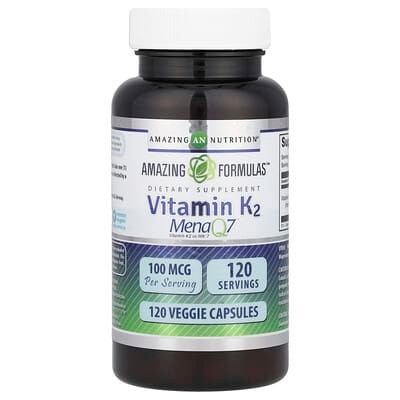
Vitamin K2 MenaQ7 100 mcg

Goals
$17.99 $0.14 per serving


Product analysis
Vitamin K2 MenaQ7 100 mcg provides vitamin K that helps proteins in bones work normally, with good value for its K2 content. Additional bone and artery benefits have limited support, mainly in women past menopause.
AI assessment of the formula, label and price. How scoring works
Nutrient Quality100
MenaQ7 identifies a favorable MK-7 form of vitamin K2. That clear identity helps relate the ingredient to findings for that particular preparation.
Ingredient Transparency100
The vitamin K quantity and source are stated, with MenaQ7 identifying the MK-7 preparation. That makes the dose and preparation straightforward to compare.
Value For Money100
The vitamin K2 content offers very good value at the full serving cost. The favorable cost comparison does not establish broader bone or heart benefits.
Customer Satisfaction77
Customer ratings are very positive across several hundred reviews. The review base gives useful satisfaction context without establishing bone or artery outcomes.
Product Focus70
Bone-protein function is the clearest purpose, with more limited evidence for bone density and artery flexibility. The 100 mcg serving is below the 180 mcg daily exposure used in one favorable long-term trial.
- Format
Capsule - Container
- 120 Capsule(s)
- Per serving
- $0.14
- Customer rating
- 4.8 · 347 ratings
Goals

Impact
High effect
Vitamin K · 100 mcg
The declared MenaQ7 identifies MK-7, a vitamin K form involved in activating bone proteins. Limited studies in postmenopausal women suggest possible bone-density benefits, but results are mixed and do not establish general fracture prevention. The 100 mcg serving is below the 180 mcg daily exposure used in one favorable long-term trial. Its contribution is focused on bone-protein activation rather than supplying calcium.
How this product is rated for Bone Health
Ingredient fit76
MK-7 gives this formula a focused bone-protein role. Its serving is below the exposure in the favorable long-term postmenopausal trial.
Goal fit
The sole active ingredient has a direct connection to bone-protein activation.
Dose adequacy
The MK-7 serving provides partial coverage of the saved amount reference.
Pathways42
The contribution is confined to bone-protein activation. It does not supply bone minerals or support the other assessed areas.
Depth
Bone-protein activation is partially covered.
Breadth
Only bone-protein activation reaches the saved coverage criterion.
Evidence98
The identified MK-7 preparation matches the preparation-specific evidence. Its bone-density findings remain limited and population-specific.
Evidence strength
MK-7 provides the strongest saved evidence contribution, with mixed postmenopausal bone-density findings.
Studied preparation
The counted preparations match those recognized in the supplied findings; this does not guarantee an individual benefit.
Formulation logic100
The credited ingredients work independently or have their required partners. No assessed ingredient conflict was found.
Partner coverage
The credited ingredients work independently or have their required partners.
Conflicts
No assessed formulation conflict was identified.
Effective doses
All counted ingredients meet the saved minimum amount criterion, which is not proof of clinical effectiveness.

Impact
High effect
Vitamin K · 100 mcg
Vitamin K supplies a nutrient contribution that can help fill low dietary intake. Its MenaQ7 identity does not establish superior general-health outcomes within the supplied nutritional scope. The amount per serving does not establish cardiovascular protection or added benefit from combining vitamin K with vitamin D.
How this product is rated for Everyday Health
Ingredient fit74
The formula is concentrated on an included ingredient, although it is linked to other goals.
Goal fit
The formula is concentrated on an included ingredient, although it is linked to other goals.
Dose adequacy
The included amounts partly meet the saved references; an unresolved amount cannot establish a dose contribution.
Pathways17
The strongest represented mechanism is bone and mineral metabolism. This describes ingredient roles rather than demonstrated health improvement.
Depth
The strongest represented mechanism is bone and mineral metabolism. This describes ingredient roles rather than demonstrated health improvement.
Breadth
No mechanism reaches the saved coverage threshold.
Evidence78
Vitamin K supplies the strongest included evidence contribution; preparation and population limitations still apply.
Evidence strength
Vitamin K supplies the strongest included evidence contribution; preparation and population limitations still apply.
Studied preparation
The included preparations match the saved references, without transferring nutrient availability into broader health benefits.
Formulation logic100
No matching ingredient conflict was identified in the supplied findings.
Partner coverage
The included contributors can act independently or have their required partner; this does not establish combination synergy.
Conflicts
No matching ingredient conflict was identified in the supplied findings.
Effective doses
All included contributors meet the saved minimum amount threshold, which is not a proven minimum effective dose.

Impact
High effect
Vitamin K · 100 mcg
The identified MK-7 vitamin K preparation has limited evidence for arterial stiffness, particularly in healthy postmenopausal women. The 100 mcg per serving receives a partial amount contribution. Changes in this vascular marker do not establish prevention of heart attacks, and the serving does not establish sustained use or personal applicability.
How this product is rated for Heart Health
Ingredient fit72
The relevant ingredients provide specific nutrient or vascular connections, with amounts and preparation identity determining their contribution.
Goal fit
The relevant ingredient is the formula's main connection to heart health, although it also has broader uses.
Dose adequacy
The declared amounts receive a partial contribution; some are below the exposure scale used for the relevant comparisons.
Pathways19
The strongest represented route is arterial calcification control. This route does not by itself establish prevention of cardiovascular events.
Depth
The strongest represented route is arterial calcification control, which describes a biological route rather than a demonstrated reduction in heart events.
Breadth
The represented route remains below the comparison's substantial-coverage level, and other listed routes receive no substantial coverage.
Evidence77
The evidence concerns limited, population-specific vascular or nutrient findings.
Evidence strength
Vitamin K provides the leading saved evidence contribution, with benefits limited to the specific population and outcome described.
Studied preparation
The contributing preparations are accepted as studied in the supplied findings; that does not establish product-level trial equivalence.
Formulation logic100
The contributing ingredients have no missing required partners or configured conflicts.
Partner coverage
The contributing ingredients have no missing required partners in the supplied findings.
Conflicts
No configured ingredient conflict was identified in the supplied facts.
Effective doses
All contributing ingredients meet the minimum amount criterion used in the saved findings; that criterion is not a proven effective clinical dose.

Impact
High effect
Vitamin K · 100 mcg
MenaQ7 vitamin K has a narrow connection to arterial flexibility. A three-year trial in postmenopausal women found improvements in selected stiffness measures, with some results depending on high baseline stiffness. The 100 mcg selected serving is below the 180 mcg daily study exposure. These results do not establish fewer cardiovascular events, benefit in all adults or longer life.
How this product is rated for Longevity
Ingredient fit76
Vitamin K leads the recorded ingredient contribution. Amount limitations reduce its relevance.
Goal fit
Vitamin K provides a focused connection to the goal's narrow outcomes.
Dose adequacy
The serving receives partial amount-based recognition; this does not establish a proven anti-aging dose.
Pathways42
The recorded connection centers on arterial calcification control, with limited breadth. This does not establish slower whole-body aging.
Depth
The strongest recorded connection is to arterial calcification control; it does not establish slower biological aging.
Breadth
One process carries the main recorded contribution; broader coverage of aging-related processes is limited.
Evidence80
Vitamin K leads the saved evidence findings, with important limits in the outcome, population or preparation studied.
Evidence strength
Vitamin K leads the saved evidence findings, but its supplied human results do not establish broad anti-aging benefit.
Studied preparation
The saved findings recognize the contributing preparation; population, duration and clinical effects still depend on the specific study.
Formulation logic100
The retained ingredients have no missing configured partner or identified conflict.
Partner coverage
The retained contributions have no missing configured partner in the supplied findings.
Conflicts
No configured ingredient conflict was identified in the supplied calculation.
Effective doses
The retained contributions clear the saved amount threshold, which is not proof of a clinical anti-aging effect.

Impact
High effect
Vitamin K · 100 mcg
MK-7 has limited evidence for improving selected arterial-stiffness measures in postmenopausal women, particularly with greater initial stiffness. MenaQ7 identifies the MK-7 form here. The 100 mcg per serving is below the studied 180 mcg daily exposure, and marker findings do not establish fewer cardiovascular events or a benefit from pairing it with vitamin D.
How this product is rated for Cardiovascular Support
Ingredient fit72
Vitamin K provides the principal recognized connection. Amount or disclosure limitations reduce the combined finding.
Goal fit
The recognized ingredients provide a focused connection, with links to other goals also affecting focus.
Dose adequacy
The declared amounts receive partial combined recognition; lower or unresolved amounts limit comparison with the supplied reference exposures.
Pathways19
The strongest recognized area is arterial calcification control. Coverage remains concentrated in one area.
Depth
Arterial calcification control is the strongest recognized area; this is a marker connection, not a prediction of clinical-event prevention.
Breadth
No area meets the supplied coverage requirement.
Evidence69
Vitamin K leads the saved evidence finding. The supplied preparation, population and outcome limitations constrain the practical claim.
Evidence strength
Vitamin K has the strongest recognized evidence among counted ingredients; marker changes and essential functions do not automatically establish fewer cardiovascular events.
Studied preparation
The saved findings recognize the eligible preparations; this does not establish identical exposure, population or outcomes to the cited interventions.
Formulation logic100
No required partner is missing and no assessed conflict is recorded.
Partner coverage
The counted ingredients work without an additional missing partner; no extra combination benefit is established.
Conflicts
No assessed conflict is recorded; this does not establish comprehensive interaction testing.
Effective doses
All counted ingredients meet the saved minimum amount criterion, which is not proof of a clinically effective cardiovascular dose.
Ingredients
| Ingredient | Amount per serving | Score |
|---|---|---|
Vitamin K2 (Natto) | 100 mcg |
Vitamin K (Natto) · 100 mcg OverallScore93
Alternative products
Report alternatives
Sources
Published studies used for the product analysis and the top-ranked studies for each ingredient and goal.
- Vitamin K and the prevention of fractures: systematic review and meta-analysis of randomized controlled trials.
- Three-year low-dose menaquinone-7 supplementation helps decrease bone loss in healthy postmenopausal women.
- Effect of combined administration of vitamin D3 and vitamin K2 on bone mineral density of the lumbar spine in postmenopausal women with osteoporosis.
- Efficacy and safety of vitamin K2 for postmenopausal women with osteoporosis at a long-term follow-up: meta-analysis and systematic review.
- Low-dose vitamin K2 (MK-4) supplementation for 12 months improves bone metabolism and prevents forearm bone loss in postmenopausal Japanese women.
- Vitamin K Intake and Atherosclerotic Cardiovascular Disease in the Danish Diet Cancer and Health Study.
- Menaquinone-7 supplementation improves arterial stiffness in healthy postmenopausal women. A double-blind randomised clinical trial.
- Effects of One-Year Menaquinone-7 Supplementation on Vascular Stiffness and Blood Pressure in Post-Menopausal Women.
- Dietary Vitamin K1 Intake and Incident Aortic Valve Stenosis.
- Association between vitamin K1 intake and mortality in the Danish Diet, Cancer, and Health cohort.
- Dietary vitamin K intake associates with reduced all-cause mortality in non-alcoholic fatty liver disease patients.
- Vitamin K status, cardiovascular disease, and all-cause mortality: a participant-level meta-analysis of 3 US cohorts.
- The Effect of Topical Vitamin K1 on the Treatment of Cetuximab-Induced Skin Rashes in Metastatic Colorectal Cancer Patients.
- Effect of vitamin K on improving post‑kidney transplant outcomes: a meta‑analysis.
- Vitamin K1 intake is associated with lower risk for all-cause and cardiovascular disease mortality in community-dwelling older Australian women.
- The effect of vitamin K1 on arterial calcification activity in subjects with diabetes mellitus: a post hoc analysis of a double-blind, randomized, placebo-controlled trial.
- Topical Menaquinone‑7 (Vitamin K2, MK-7) as a Mitochondrial Bioenergetic Activator for Skin Anti-Aging: Mechanistic Evidence in Skin Cells and a Randomized Split-Face/Neck Study.
- Vitamin K status and cognitive function in healthy older adults.
- High dephospho-uncarboxylated matrix Gla protein concentrations, a plasma biomarker of vitamin K, in relation to frailty: the Longitudinal Aging Study Amsterdam.
- Vitamin K Concentration and Cognitive Status in Elderly Patients on Anticoagulant Therapy: A Pilot Study.