
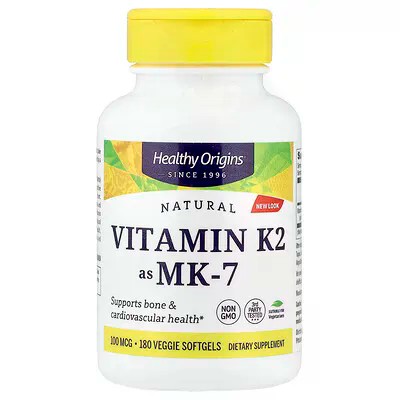
Vitamin K2 as MK-7 100 mcg

Goals
$27.99 $0.15 per serving


Product analysis
Vitamin K2 as MK-7 100 mcg offers good-value vitamin K to help activate proteins involved in normal bone and mineral nutrition.
AI assessment of the formula, label and price. How scoring works
Nutrient Quality100
Vitamin K is clearly identified as MK-7, a favorable form. That makes it straightforward to select this particular type of vitamin K.
Ingredient Transparency100
The vitamin K amount and form are both stated. The simple label makes comparison with other MK-7 products easier.
Value For Money100
The MK-7 serving offers strong value. Cost is an appealing feature if vitamin K is the nutrient you need.
Customer Satisfaction79
Customer ratings are very positive across several hundred buyers. They give useful perspective on satisfaction without proving bone or heart benefits.
Product Focus66
Vitamin K supports normal bone proteins and can help fill a dietary gap. The serving is lower than in some favorable long-term findings, leaving the same bone or arterial effects uncertain.
- Format
Softgel - Container
- 180 Softgel(s)
- Per serving
- $0.15
- Customer rating
- 4.7 · 762 ratings
Goals

Impact
High effect
Vitamin K · 100 mcg

Impact
High effect
Vitamin K · 100 mcg

Impact
High effect
Vitamin K · 100 mcg


Impact
High effect
Vitamin K · 100 mcg
Ingredients
| Ingredient | Amount per serving | Score |
|---|---|---|
Vitamin K2 (Menaquinone-7) | 100 mcg |
Vitamin K (Menaquinone-7) · 100 mcg OverallScore93
A serving supplies 100 mcg of MK-7 at a low cost per serving. The MK-7 isomer is not specified.
How this ingredient is rated
Active Ingredient Quality & Bioavailability82
The vitamin K comes as vitamin K2 as MK-7. The MK-7 isomer is unspecified.
Vitamin K Form (MK-7 vs. MK-4 vs. K1)
The source is vitamin K2 as MK-7.
MK-7 Isomer Disclosure
The MK-7 isomer is not specified as trans or all-trans.
Dose, Safety & Label Transparency100
The serving provides 100 mcg of MK-7. The amount and form are stated.
Vitamin K2 (MK-7) Dosage Efficacy
100 mcg of MK-7 is provided per serving.
Form and Subtype Transparency
The vitamin K amount and form are stated.
Value100
The cost per serving is low.
Price per Effective MK-7 Serving
The cost per serving is low.
Alternative products
Report alternatives
Sources
Published studies used for the product analysis and the top-ranked studies for each ingredient and goal.
- Vitamin K and the prevention of fractures: systematic review and meta-analysis of randomized controlled trials.
- Three-year low-dose menaquinone-7 supplementation helps decrease bone loss in healthy postmenopausal women.
- Effect of combined administration of vitamin D3 and vitamin K2 on bone mineral density of the lumbar spine in postmenopausal women with osteoporosis.
- Efficacy and safety of vitamin K2 for postmenopausal women with osteoporosis at a long-term follow-up: meta-analysis and systematic review.
- Low-dose vitamin K2 (MK-4) supplementation for 12 months improves bone metabolism and prevents forearm bone loss in postmenopausal Japanese women.
- Vitamin K Intake and Atherosclerotic Cardiovascular Disease in the Danish Diet Cancer and Health Study.
- Menaquinone-7 supplementation improves arterial stiffness in healthy postmenopausal women. A double-blind randomised clinical trial.
- Effects of One-Year Menaquinone-7 Supplementation on Vascular Stiffness and Blood Pressure in Post-Menopausal Women.
- Dietary Vitamin K1 Intake and Incident Aortic Valve Stenosis.
- Association between vitamin K1 intake and mortality in the Danish Diet, Cancer, and Health cohort.
- Dietary vitamin K intake associates with reduced all-cause mortality in non-alcoholic fatty liver disease patients.
- Vitamin K status, cardiovascular disease, and all-cause mortality: a participant-level meta-analysis of 3 US cohorts.
- The Effect of Topical Vitamin K1 on the Treatment of Cetuximab-Induced Skin Rashes in Metastatic Colorectal Cancer Patients.
- Effect of vitamin K on improving post‑kidney transplant outcomes: a meta‑analysis.
- Vitamin K1 intake is associated with lower risk for all-cause and cardiovascular disease mortality in community-dwelling older Australian women.
- The effect of vitamin K1 on arterial calcification activity in subjects with diabetes mellitus: a post hoc analysis of a double-blind, randomized, placebo-controlled trial.
- Topical Menaquinone‑7 (Vitamin K2, MK-7) as a Mitochondrial Bioenergetic Activator for Skin Anti-Aging: Mechanistic Evidence in Skin Cells and a Randomized Split-Face/Neck Study.
- Vitamin K status and cognitive function in healthy older adults.
- High dephospho-uncarboxylated matrix Gla protein concentrations, a plasma biomarker of vitamin K, in relation to frailty: the Longitudinal Aging Study Amsterdam.
- Vitamin K Concentration and Cognitive Status in Elderly Patients on Anticoagulant Therapy: A Pilot Study.