
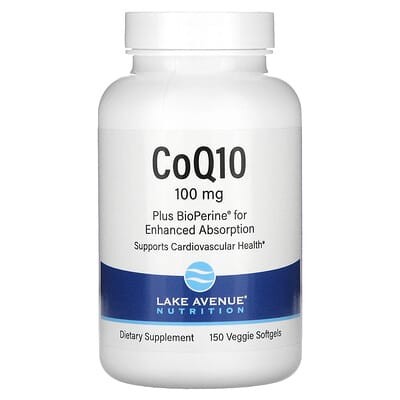
CoQ10 100 mg plus BioPerine

Goals
$16.12 $0.10 per serving

Product analysis
CoQ10 100 mg plus BioPerine offers economical CoQ10 for cellular energy support, with possible fatigue or blood-vessel benefits in selected settings. Everyday benefits are less certain for healthy adults.
AI assessment of the formula, label and price. How scoring works
Nutrient Quality36
CoQ10 is identified as ubiquinone, but that alone does not establish an absorption advantage. The unspecified black-pepper preparation leaves another part of the quality picture uncertain.
Ingredient Transparency81
Ingredient amounts are stated, but some forms are not identified. That limits a full comparison of ingredient quality.
Value For Money88
The CoQ10 amount offers favorable value for its cost. The added black-pepper contribution cannot be compared confidently.
Customer Satisfaction93
Customer feedback is very positive, with a substantial number of ratings. Ratings reflect satisfaction and cannot establish effectiveness or safety.
Product Focus70
CoQ10 provides the main connection to cellular energy and selected cardiovascular measures. The black pepper does not establish an additional clinical benefit for those goals.
- Format
Softgel - Container
- 150 Softgel(s)
- Per serving
- $0.10
- Also available
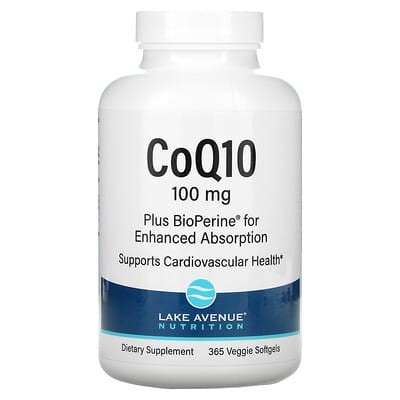 CoQ10 100 mg plus BioPerine$37.00
- Customer rating
- 4.8 · 13,892 ratings
Goals

Impact
Highest effect
Coenzyme Q-10 · 100 mg
Conventional CoQ10 has limited evidence for selected blood-pressure, vascular-function or lipid changes in specific populations. Its declared active amount receives partial exposure support, without establishing an oxidation state or delivery advantage. Heart-failure results do not establish routine cardiovascular-event prevention. Black pepper adds no independent heart-health contribution in these supplied findings.
How this product is rated for Heart Health
Ingredient fit86
The included connections come from Coenzyme Q-10. Their exposure support does not establish a proven cardiovascular treatment.
Goal fit
The included ingredients are the main assessed connection to heart health, although the product is also linked to other goals.
Dose adequacy
The included amounts receive partial support against the saved exposure references; these comparisons do not establish proven treatment doses.
Pathways53
The saved findings focus on blood-vessel lining function. They do not establish broad support across the other heart-health pathways.
Depth
The strongest configured connection is to blood-vessel lining function, rather than evidence of a clinical outcome.
Breadth
Only blood-vessel lining function reaches the saved breadth requirement; the other configured pathways do not.
Evidence98
The strongest included evidence contribution comes from Coenzyme Q-10. Matching a studied preparation does not remove population limits or establish event prevention.
Evidence strength
Coenzyme Q-10 supplies the strongest included evidence contribution, without establishing cardiovascular-event prevention.
Studied preparation
The included preparations meet the saved study-matching check, which does not establish that this finished product or serving prevents cardiovascular events.
Formulation logic100
The counted ingredients meet the minimum amount requirement, with no missing required partner or matched conflict.
Partner coverage
No counted ingredient lacks a required partner; this finding does not imply an additional combination benefit.
Conflicts
No configured ingredient conflict was matched in the supplied facts.
Effective doses
All counted ingredients meet the saved minimum amount requirement, which is distinct from a proven clinical treatment dose.

Impact
Highest effect
Coenzyme Q-10 · 100 mg
Coenzyme Q10 may support selected blood-pressure, lipid or endothelial markers. The 100 mg per serving is declared as ubiquinone and receives partial amount credit for that preparation. Supporting findings come from particular trials, including adults with abnormal blood lipids, and do not establish equivalent effects in all adults or prevention of cardiovascular events. The black-pepper extract does not establish an additional cardiovascular effect.
How this product is rated for Cardiovascular Support
Ingredient fit86
CoQ10 gives the relevant contribution, with partial amount credit for ubiquinone.
Goal fit
CoQ10 provides a clear cardiovascular connection, although the product is linked to several goals.
Dose adequacy
The 100 mg ubiquinone serving receives partial amount credit for its preparation.
Pathways53
The saved findings concentrate on endothelial nitric-oxide function.
Depth
Endothelial function gives the strongest saved coverage.
Breadth
Only endothelial function reaches the saved coverage threshold.
Evidence88
CoQ10 provides the leading evidence contribution, limited to particular marker findings and populations.
Evidence strength
CoQ10 supplies the strongest credited evidence in this product.
Studied preparation
The declared CoQ10 preparation receives studied-preparation credit.
Formulation logic100
CoQ10 meet the saved contribution threshold, with no missing required partner or evaluated ingredient conflict.
Partner coverage
Every credited ingredient can contribute without a missing required partner.
Conflicts
No evaluated ingredient conflict was identified.
Effective doses
All ingredients included in this check meet the saved amount threshold; this does not establish a clinical effective dose.

Impact
High effect
Coenzyme Q-10 · 100 mg
CoQ10 participates in cellular energy production and has limited, preparation-specific evidence for fatigue relief. This product supplies 100 mg per serving in the ubiquinone form. Findings from clinical populations do not establish the same benefit for healthy adults, and this is not an acute alertness effect.
How this product is rated for Energy
Ingredient fit73
CoQ10 accounts for the main relevant ingredients. The 100 mg serving receives partial amount recognition for this preparation; it is not a proven fatigue-treatment dose.
Goal fit
CoQ10 provides the main connection to energy here.
Dose adequacy
The 100 mg serving receives partial amount recognition for this preparation; it is not a proven fatigue-treatment dose.
Pathways17
The main saved connection is mitochondrial energy production, with limited fatigue evidence.
Depth
The main saved connection is mitochondrial energy production, with limited fatigue evidence.
Breadth
No tracked pathway reaches the saved breadth threshold. This does not erase relevant nutrient-sufficiency roles.
Evidence84
Coenzyme Q-10 leads the saved evidence finding, with preparation and population limits.
Evidence strength
Coenzyme Q-10 leads the saved evidence finding, with preparation and population limits.
Studied preparation
The qualifying CoQ10 preparation meets the saved preparation check; this alone does not establish broader fatigue benefits.
Formulation logic100
The relevant ingredients have no unmet partner requirement in the saved findings; this does not establish an added combination benefit.
Partner coverage
The relevant ingredients have no unmet partner requirement in the saved findings; this does not establish an added combination benefit.
Conflicts
No configured ingredient conflict was matched in the supplied facts.
Effective doses
All counted ingredients meet the saved minimum amount check; that threshold is not proof of clinical benefit.

Impact
Moderate effect
Coenzyme Q-10 · 100 mg
CoQ10 at 100 mg provides the main biological connection through mitochondrial energy and antioxidant activity. Piperine may influence CoQ10 absorption, but greater circulating exposure is not evidence of an anti-aging benefit. The relevant skin trial remains preparation specific.
How this product is rated for Longevity
Ingredient fit73
The assessed ingredient mix is relatively focused on the goal’s biological processes. The counted amounts provide partial support relative to the supplied dose ranges.
Goal fit
The assessed ingredient mix is relatively focused on the goal’s biological processes.
Dose adequacy
The counted amounts provide partial support relative to the supplied dose ranges.
Pathways10
The strongest assessed connection is mitochondrial energy production, with limited coverage. No mechanism reaches the saved broader-coverage threshold.
Depth
The strongest assessed connection is mitochondrial energy production, with limited coverage.
Breadth
No mechanism reaches the saved broader-coverage threshold.
Evidence30
Coenzyme Q-10 provides the strongest relevant evidence among ingredients counted at meaningful amounts. That comparison does not establish lifespan extension. The assessed material is not matched to the specific preparation used in the reviewed aging-related trial.
Evidence strength
Coenzyme Q-10 provides the strongest relevant evidence among ingredients counted at meaningful amounts. That comparison does not establish lifespan extension.
Studied preparation
The assessed material is not matched to the specific preparation used in the reviewed aging-related trial.
Formulation logic100
The counted ingredients can contribute independently or have their required partner. No ingredient conflict was identified in the saved assessment. 1 of 1 counted ingredients reach the saved meaningful-amount threshold.
Partner coverage
The counted ingredients can contribute independently or have their required partner.
Conflicts
No ingredient conflict was identified in the saved assessment.
Effective doses
1 of 1 counted ingredients reach the saved meaningful-amount threshold.

Impact
High effect
Coenzyme Q-10 · 100 mg
CoQ10 helps transfer electrons in mitochondria as cells produce energy. This normal role and changes in metabolic-health markers do not establish a rise in whole-body energy expenditure. Piperine has an absorption-enhancing role, but no energy-expenditure dose or added metabolic-rate benefit is established. CoQ10's 100 mg per serving makes a partial amount contribution.
How this product is rated for Metabolism Support
Ingredient fit73
CoQ10 supplies the included connection; piperine has no separately established energy-expenditure contribution. The CoQ10 serving makes a partial contribution below the saved amount plateau.
Goal fit
CoQ10 supplies the included connection; piperine has no separately established energy-expenditure contribution.
Dose adequacy
The CoQ10 serving makes a partial contribution below the saved amount plateau.
Pathways17
The strongest saved connection concerns mitochondrial energy and fat oxidation; this category does not establish extra calorie expenditure. No biological category meets the saved breadth comparison.
Depth
The strongest saved connection concerns mitochondrial energy and fat oxidation; this category does not establish extra calorie expenditure.
Breadth
No biological category meets the saved breadth comparison.
Evidence75
CoQ10 supplies the evidence connection, but mitochondrial function does not establish a whole-body metabolic-rate boost.
Evidence strength
CoQ10 supplies the evidence connection, but mitochondrial function does not establish a whole-body metabolic-rate boost.
Studied preparation
Eligible included preparations match the saved comparison; this does not establish product-specific thermogenesis.
Formulation logic100
No missing required partner or configured ingredient conflict was found.
Partner coverage
The included ingredients do not lack a required partner; this does not establish an added metabolism benefit from combining them.
Conflicts
No configured ingredient conflict was identified.
Effective doses
All included ingredients meet the saved minimum amount comparison, which is not a proven effective metabolism-boosting dose.

Impact
High effect
Coenzyme Q-10 · 100 mg
Coenzyme Q-10 supports mitochondrial and antioxidant processes. Its anti-inflammatory relevance comes from a small ubiquinone trial in statin-treated coronary disease, where one inflammatory marker improved but CRP and IL-6 did not. This serving is below the trial's 300 mg daily exposure, so the amount does not establish the same response.
How this product is rated for Inflammation
Ingredient fit66
Ubiquinone provides the main relevant contribution; black pepper adds no independent contribution here.
Goal fit
Ubiquinone provides the main relevant contribution; black pepper adds no independent contribution here.
Dose adequacy
The 100 mg serving provides limited amount-based support relative to the studied ubiquinone exposure.
Pathways13
Oxidative and mitochondrial stress is the main area represented. Coverage of other areas is limited.
Depth
Oxidative and mitochondrial stress is the strongest area in the saved findings; this mapping does not establish a clinical effect.
Breadth
No pathway reaches the saved threshold for substantial coverage.
Evidence93
Coenzyme Q-10 leads the saved evidence finding. The preparation is recognized, while the clinical limitations described above still apply.
Evidence strength
Coenzyme Q-10 leads the saved evidence finding; this does not establish routine clinical anti-inflammatory benefit.
Studied preparation
The saved findings recognize the preparations of all credited ingredients; this does not establish equivalence for every clinical outcome.
Formulation logic100
The credited ingredients have no unmet partner requirement or matched conflict in the saved findings. Their amounts clear the threshold used for inclusion.
Partner coverage
Each credited ingredient can contribute independently or has its required partner.
Conflicts
No configured conflict was matched; this is limited to the combinations evaluated.
Effective doses
All credited ingredients clear the amount threshold used for inclusion; this is not proof of an effective clinical dose.
Ingredients
| Ingredient | Amount per serving | Score |
|---|---|---|
Coenzyme Q-10 (Ubiquinone) | 100 mg | |
Black Pepper fruit extract | 5 mg |
Coenzyme Q-10 (Ubiquinone) · 100 mg OverallScore67
Alternative products
Report alternatives
Sources
Published studies used for the product analysis and the top-ranked studies for each ingredient and goal.
- Effects of Coenzyme Q10 Supplementation on Lipid Profiles in Adults: A Meta-analysis of Randomized Controlled Trials.
- Six-month supplementation with high dose coenzyme Q10 improves liver steatosis, endothelial, vascular and myocardial function in patients with metabolic-dysfunction associated steatotic liver disease: a randomized double-blind, placebo-controlled trial.
- The effect of coenzyme Q10 on morbidity and mortality in chronic heart failure: results from Q-SYMBIO: a randomized double-blind trial.
- [Coenzyme Q-10 in the treatment of patients with chronic heart failure and reduced left ventricular ejection fraction: systematic review and meta-analysis].
- Effect of coenzyme Q10 in Europeans with chronic heart failure: A sub-group analysis of the Q-SYMBIO randomized double-blind trial.
- Effects of Coenzyme Q10 on Statin-Induced Myopathy: An Updated Meta-Analysis of Randomized Controlled Trials.
- Coenzyme Q10 Supplementation in Athletes: A Systematic Review.
- Effectiveness of Coenzyme Q10 Supplementation for Reducing Fatigue: A Systematic Review and Meta-Analysis of Randomized Controlled Trials.
- Antifatigue effects of coenzyme Q10 during physical fatigue.
- Effect of coenzyme Q10 supplementation on fatigue: A systematic review of interventional studies.
- Ubiquinol Ameliorates Endothelial Dysfunction in Subjects with Mild-to-Moderate Dyslipidemia: A Randomized Clinical Trial.
- Dose-Response Effect of Coenzyme Q10 Supplementation on Blood Pressure among Patients with Cardiometabolic Disorders: A Grading of Recommendations Assessment, Development, and Evaluation (GRADE)-Assessed Systematic Review and Meta-Analysis of Randomized Controlled Trials.
- Effects of Coenzyme Q10 on Lipid, Glycemic, and Inflammatory Markers in Metabolic Disorders: A Systematic Review and Meta-Analysis.
- Treatment of coenzyme Q10 for 24 weeks improves lipid and glycemic profile in dyslipidemic individuals.
- The effect of coenzyme Q10 supplementation on inflammatory and endothelial dysfunction markers in overweight/obese polycystic ovary syndrome patients.
- The effects of coenzyme Q10 supplementation on metabolic profiles and parameters of mental health in women with polycystic ovary syndrome.
- Efficacy and Optimal Dose of Coenzyme Q10 Supplementation on Inflammation-Related Biomarkers: A GRADE-Assessed Systematic Review and Updated Meta-Analysis of Randomized Controlled Trials.
- Can coenzyme Q10 supplementation effectively reduce human tumor necrosis factor-α and interleukin-6 levels in chronic inflammatory diseases? A systematic review and meta-analysis of randomized controlled trials.
- Promising efficacy of coenzyme Q10 supplementation as adjunctive therapy in juvenile idiopathic arthritis: a randomized-controlled pilot study.
- Coenzyme Q10 and Degenerative Disorders Affecting Longevity: An Overview.