
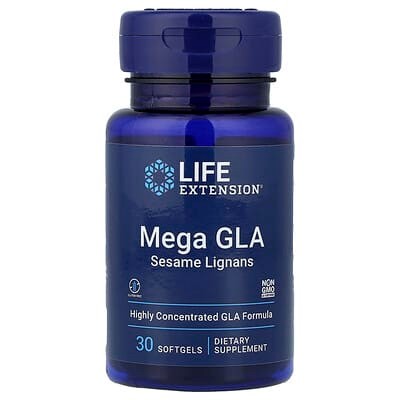

$21.00 $0.70 per serving


Product analysis
Mega GLA Sesame Lignans is aimed at skin moisture support, but incomplete oil details make it harder to compare with the preparations behind the limited evidence.
AI assessment of the formula, label and price. How scoring works
Nutrient Quality25
The borage oil source does not provide enough detail to judge the quality of its active components. The sesame preparation is also unnamed, leaving the full mixture uncertain.
Ingredient Transparency33
Some component amounts are missing, making the full serving difficult to check. The oil composition and most forms are also unclear, which limits comparisons with alternatives.
Value For Money40
Value cannot be judged confidently from the available component comparison. A reliable price judgment would need usable costs for the amounts supplied.
Customer Satisfaction78
Customer feedback is very positive across a sizeable review sample. The volume provides a useful view of satisfaction without establishing skin benefits.
Product Focus78
The intended uses center on skin moisture and inflammation-related support. Evidence comes from particular oil preparations or selected clinical settings, so the same effects cannot be assumed for this serving.
- Format
Softgel - Container
- 30 Softgel(s)
- Per serving
- $0.70
- Customer rating
- 4.6 · 891 ratings
Goals

Impact
High effect
Gamma Linolenic Acid · 400 mg

Impact
Highest effect
Gamma Linolenic Acid · 400 mg
Ingredients
| Ingredient | Amount per serving | Score |
|---|---|---|
Calories | 5 Calorie(s) | |
Total Fat | 0.5 Gram(s) | |
Saturated Fat | 0 Gram(s) | |
Gamma-Linolenic Acid (Borage Seed Oil) | 400 mg | |
Sesame seed Lignan extract | 10 mg |
Gamma Linolenic Acid (Borage Seed Oil) · 400 mg OverallScore85
A serving provides 400 mg of GLA, a larger amount, at a moderately low cost per amount. The GLA comes from borage seed oil. The extraction method and antioxidant protection are unclear.
How this ingredient is rated
Active Ingredient Quality & Bioavailability72
The GLA comes from borage seed oil. The extraction method and antioxidant protection are unclear.
Botanical Source & GLA Concentration
The GLA comes from borage seed oil.
Extraction Method & Oxidative Stability
The extraction method and antioxidant protection are unclear.
Dose, Safety & Label Transparency100
The label lists 400 mg of GLA per serving, a larger amount.
Active GLA Dosage Potency
A serving provides 400 mg of GLA, a larger amount.
GLA Yield Disclosure
The active GLA amount is listed separately as 400 mg per serving.
Value80
The cost per amount of GLA is moderately low.
Price per 100mg Active GLA
The cost per amount of GLA is moderately low.
Alternative products
Report alternatives
Sources
Published studies used for the product analysis and the top-ranked studies for each ingredient and goal.
- Effects of altering dietary essential fatty acids on requirements for non-steroidal anti-inflammatory drugs in patients with rheumatoid arthritis: a double blind placebo controlled study.
- Systemic immune inflammation mediates the association of serum omega-3 and omega-6 polyunsaturated fatty acids with biological aging: a national population-based study.
- Evidence of effectiveness of herbal medicinal products in the treatment of arthritis. Part 2: Rheumatoid arthritis.
- Evening primrose oil in patients with rheumatoid arthritis and side-effects of non-steroidal anti-inflammatory drugs.
- Prospective clinical trial examining the impact of genetic variation in FADS1 on the metabolism of linoleic acid- and ɣ-linolenic acid-containing botanical oils.
- Effect of Evening Primrose Oil on Korean Patients With Mild Atopic Dermatitis: A Randomized, Double-Blinded, Placebo-Controlled Clinical Study.
- Meta-analysis of placebo-controlled studies of the efficacy of Epogam in the treatment of atopic eczema. Relationship between plasma essential fatty acid changes and clinical response.
- Reduced levels of prostaglandin precursors in the blood of atopic patients: defective delta-6-desaturase function as a biochemical basis for atopy.
- Effect of borage oil consumption on fatty acid metabolism, transepidermal water loss and skin parameters in elderly people.
- Effects of oral supplementation with evening primrose oil for six weeks on plasma essential fatty acids and uremic skin symptoms in hemodialysis patients.