
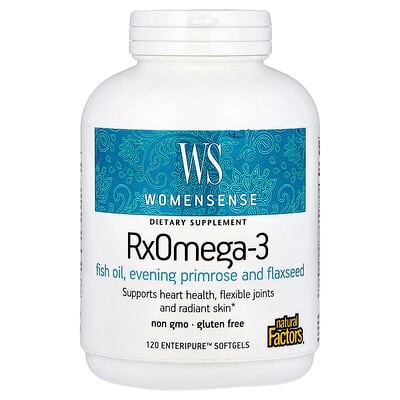

$20.97 $0.34 per serving


Product analysis
RxOmega-3 makes its EPA and DHA contributions easier to check than a total oil amount alone. EPA offers favorable value, while unspecified chemical forms limit closer comparisons.
AI assessment of the formula, label and price. How scoring works
Nutrient Quality21
The fish sources are identified, but the fatty acids' chemical forms are unspecified. Fish species alone do not establish absorption advantages or the quality of the complete oil combination.
Ingredient Transparency66
Most quantities and fatty-acid composition details are stated. Some source proportions remain uncertain, and the EPA and DHA chemical forms are not identified.
Value For Money45
EPA offers favorable value at the full serving cost. DHA and gamma-linolenic acid are more expensive for the amounts supplied, while value for the other fatty acids remains uncertain.
Customer Satisfaction94
Ratings indicate very high satisfaction across a large review pool. Popularity does not establish oil purity, absorption or health effects.
Product Focus59
The formula centers on a combination of fatty acids with a relatively small range of uses. Those related ingredients do not establish extra benefits simply because they are combined.
- Format
Softgel - Container
- 120 Softgel(s)
- Per serving
- $0.34
- Customer rating
- 4.8 · 19,268 ratings
Goals

Impact
High effect
Fish Oil · 1070 mg
The declared EPA and DHA amounts relate to triglyceride metabolism. Oral studies support triglyceride lowering, but the supplied study exposures were higher than these declared component amounts per serving. This is support for a blood-fat marker, with no established general prevention of cardiovascular events.
How this product is rated for Cardiovascular Support
Ingredient fit60
Declared fatty-acid amounts drive the findings; oil carrier mass does not substitute for active EPA or DHA.
Goal fit
Relevant ingredients sit alongside several actives directed at other goals.
Dose adequacy
The saved amount finding is partial; lower or unresolved amounts limit the contribution attributed to this serving.
Pathways60
The saved findings are strongest for triglyceride metabolism.
Depth
The strongest saved contribution concerns triglyceride metabolism. This describes a selected mechanism rather than demonstrated event prevention.
Breadth
Only triglyceride metabolism reaches the saved coverage criterion.
Evidence83
EPA and DHA evidence supports triglyceride-marker effects.
Evidence strength
The omega-3 evidence concerns triglyceride markers, with no automatic cardiovascular-event benefit.
Studied preparation
The included preparations meet the saved preparation finding; this does not imply identical effects across populations or superior forms.
Formulation logic100
Partner requirements are satisfied and no matched conflicts were recorded; minimum amount findings vary by ingredient.
Partner coverage
No unmet partner requirement was recorded for the included ingredients; this does not establish extra benefit from combining them.
Conflicts
No matched formulation conflict was recorded in the supplied assessment.
Effective doses
The included ingredients meet the saved minimum amount criterion; it is not a proven effective clinical dose.

Impact
Moderate effect
Fish Oil · 1070 mgGamma Linolenic Acid · 50 mg
Marine omega-3 fats may lower some inflammation-related markers in the blood. A change in these markers doesn’t guarantee relief from pain or other symptoms. EPA and DHA are declared separately, while the seed-oil amount doesn’t tell you how much active GLA it supplies.
How this product is rated for Inflammation
Ingredient fit52
Marine omega-3 fats may lower some inflammation-related markers in the blood.
Goal fit
Marine omega-3 fats may lower some inflammation-related markers in the blood.
Dose adequacy
DHA 200 mg; EPA 400 mg. The serving amount alone doesn’t predict symptom relief.
Pathways8
EPA and DHA are related to fatty-acid signals that regulate inflammation.
Depth
EPA and DHA are related to fatty-acid signals that regulate inflammation.
Breadth
The ingredients don’t demonstrate broad relief through several distinct inflammatory processes.
Evidence70
Marine omega-3 fats may lower some inflammation-related markers in the blood.
Evidence strength
Marine omega-3 fats may lower some inflammation-related markers in the blood.
Studied preparation
Effects depend on the particular ingredient preparation; matching a name alone doesn’t guarantee symptom relief.
Formulation logic88
No particular conflict or missing ingredient partner is identified. A combination doesn’t automatically provide an additional anti-inflammatory effect.
Partner coverage
No required ingredient partner is identified as missing.
Conflicts
No particular ingredient conflict is identified.
Effective doses
DHA 200 mg; EPA 400 mg. These amounts don’t by themselves establish routine symptom relief.
Ingredients
| Ingredient | Amount per serving | Score |
|---|---|---|
Calories | 20 Calorie(s) | |
Total Fat | 2 Gram(s) | |
Polyunsaturated Fat | 2 Gram(s) | |
Cholesterol | 5 mg | |
pharmaceutical grade Fish Oil concentrate (Anchovy, Mackerel, Sardine) | 1070 mg | |
Eicosapentaenoic Acid | 400 mg | |
Docosahexaenoic Acid | 200 mg | |
Evening Primrose Oil | 500 mg | |
Gamma-Linolenic Acid | 50 mg | |
organic Flaxseed Oil | 500 mg | |
Alpha-Linolenic Acid | 260 mg |
EPA (Eicosapentaenoic Acid) · 400 mg OverallScore65
A serving provides 400 mg of EPA and 200 mg of DHA, giving it more EPA than DHA. Its EPA costs about $0.87 per gram.
How this ingredient is rated
Active Ingredient Quality & Bioavailability50
The EPA molecular form is unresolved in the available information. EPA is only part of the stated fish oil amount.
Molecular Form and Bioavailability
The available information does not establish the molecular form; an ethyl ester form cannot be assumed.
EPA Concentration Density
EPA makes up about 37.4% of the stated fish oil amount per serving.
Oxidation Protection
Tocopherols are included; their presence does not measure the oil’s freshness.
Dose, Safety & Label Transparency72
The serving provides 400 mg EPA and 200 mg DHA.
Absolute EPA Dose per Serving
Each serving provides 400 mg of EPA.
EPA-Centric Ratio
The serving has 400 mg of EPA and 200 mg of DHA, so it contains more EPA than DHA.
Purity and Contaminant Testing
The oil is described as purified, but the saved evaluation does not establish a qualifying contaminant-specific testing or certification claim.
Value80
At about $0.87 per gram of EPA, the EPA cost is relatively low in this comparison.
Price per Gram of EPA
The estimate uses the stated EPA amount and price per whole-product serving.
Fish Oil (Anchovy, Mackerel, Sardine) · 1070 mg OverallScore57
A serving provides 600 mg of EPA and DHA combined in 1,070 mg of fish oil. That is about 56.1% of the oil, and the whole-product price works out to about $0.58 per gram of EPA and DHA.
How this ingredient is rated
Active Ingredient Quality & Bioavailability44
The molecular form of the oil is not established in the saved facts. A specific purification method is recorded for the oil; the claim is not independently verified.
Omega-3 Molecular Form
The molecular form of the oil is not established in the saved facts.
Purification & Filtration Method
A specific purification method is recorded for the oil; the claim is not independently verified.
Third-Party Purity & Potency Verification
Independent testing is not established in the saved facts.
Source & Sustainability
A named fish source is recognized in the saved evaluation; the catch method is not established.
Dose, Safety & Label Transparency59
A serving provides 600 mg of EPA and DHA combined. EPA and DHA together account for about 56.1% of the 1,070 mg of fish oil per serving.
Total Active Omega-3 Dose (EPA + DHA)
A serving provides 600 mg of EPA and DHA combined.
Omega-3 Potency & Concentration
EPA and DHA together account for about 56.1% of the 1,070 mg of fish oil per serving.
EPA & DHA Individual Disclosure
The saved facts list EPA and DHA separately: 400 mg of EPA and 200 mg of DHA per serving.
Oxidation Protection (Stabilizers)
The saved facts do not establish a qualifying antioxidant; the oil’s oxidation status remains unknown.
Value80
The whole-product price is about $0.58 per gram of combined EPA and DHA.
Cost Per Gram of Active EPA + DHA
The whole-product price is about $0.58 per gram of combined EPA and DHA.
Gamma Linolenic Acid · 50 mg OverallScore42
A serving provides 50 mg of gamma-linolenic acid (GLA) from evening primrose oil. At the whole-product serving price, that works out to about $0.70 per 100 mg of GLA.
How this ingredient is rated
Active Ingredient Quality & Bioavailability48
The GLA is associated with evening primrose oil; no qualifying pressing or hexane-free claim is recorded.
Botanical Source & GLA Concentration
The recorded source of GLA is evening primrose oil.
Extraction Method & Oxidative Stability
An antioxidant is recorded, but no qualifying pressing or hexane-free claim is recorded.
Dose, Safety & Label Transparency51
The GLA amount is stated separately as 50 mg per serving.
Active GLA Dosage Potency
The recorded GLA amount is 50 mg per serving.
GLA Yield Disclosure
The GLA amount is explicitly recorded in milligrams.
Value10
At the whole-product serving price, the cost is about $0.70 per 100 mg of GLA.
Price per 100mg Active GLA
The whole-product serving price corresponds to about $0.70 per 100 mg of GLA.
Alternative products
Report alternatives
Sources
Published studies used for the product analysis and the top-ranked studies for each ingredient and goal.
- Marine Omega-3 Supplementation and Cardiovascular Disease: An Updated Meta-Analysis of 13 Randomized Controlled Trials Involving 127 477 Participants.
- Impact of omega-3 fatty acids on hypertriglyceridemia, lipidomics, and gut microbiome in patients with type 2 diabetes.
- A systematic review of fish-oil supplements for the prevention and treatment of hypertension.
- Effects of fish oil-derived fatty acids on suboptimal cardiovascular health: A multicenter, randomized, double-blind, placebo-controlled trial.
- Effect of High-Dose Marine Omega-3 Fatty Acids on Atherosclerosis: A Systematic Review and Meta-Analysis of Randomized Clinical Trials.
- Dose-dependent effects of fish oil on cardio-metabolic biomarkers in healthy middle-aged and elderly Chinese people: a double-blind randomized controlled trial.
- Eicosapentaenoic acid supplementation alleviates pruritus, enhances skin moisture, and mitigates depression in maintenance hemodialysis patients.
- Lowering effects of fish oil supplementation on proinflammatory markers in hypertension: results from a randomized controlled trial.
- The effects of ω-3 fish oil emulsion-based parenteral nutrition plus combination treatment for acute paraquat poisoning.
- Effects of Omega-3 Fatty Acid Intake in Patients Undergoing Dialysis: A Systematic Review and Meta-Analysis of Randomized Controlled Trials.
- Comparisons of the effects of different flaxseed products consumption on lipid profiles, inflammatory cytokines and anthropometric indices in patients with dyslipidemia related diseases: systematic review and a dose-response meta-analysis of randomized controlled trials.
- The effects of n-3 fatty acids from flaxseed oil on genetic and metabolic profiles in patients with gestational diabetes mellitus: a randomised, double-blind, placebo-controlled trial.
- Effect of flaxseed consumption on flow-mediated dilation and inflammatory biomarkers in patients with coronary artery disease: a randomized controlled trial.
- A comparison between the effects of flaxseed oil and fish oil supplementation on cardiovascular health in type 2 diabetic patients with coronary heart disease: A randomized, double-blinded, placebo-controlled trial.
- Effect of flaxseed oil on serum systemic and vascular inflammation markers and oxidative stress in hemodialysis patients: a randomized controlled trial.
- Effects of altering dietary essential fatty acids on requirements for non-steroidal anti-inflammatory drugs in patients with rheumatoid arthritis: a double blind placebo controlled study.
- Systemic immune inflammation mediates the association of serum omega-3 and omega-6 polyunsaturated fatty acids with biological aging: a national population-based study.
- Evidence of effectiveness of herbal medicinal products in the treatment of arthritis. Part 2: Rheumatoid arthritis.
- Evening primrose oil in patients with rheumatoid arthritis and side-effects of non-steroidal anti-inflammatory drugs.
- Prospective clinical trial examining the impact of genetic variation in FADS1 on the metabolism of linoleic acid- and ɣ-linolenic acid-containing botanical oils.