
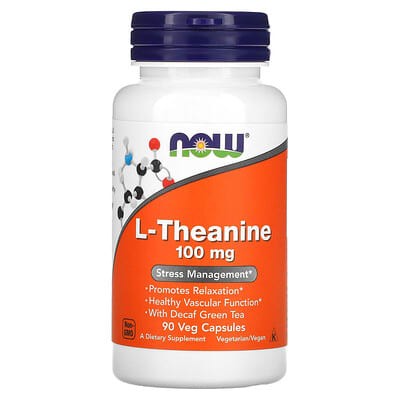

$12.70 $0.14 per serving


Product analysis
L-Theanine 100 mg combines theanine and green tea, with favorable value for the theanine amount provided.
AI assessment of the formula, label and price. How scoring works
Nutrient Quality20
Associated ingredient details identify L-theanine specifically, which gives a clearer identity than unspecified theanine. The main listing omits the ingredient forms, and green tea quality cannot be compared confidently.
Ingredient Transparency63
Amounts are disclosed, so serving contents can be compared. The ingredient listing omits the forms, limiting a closer comparison.
Value For Money74
The L-theanine contribution is inexpensive for the amount supplied. The green tea contribution cannot be compared reliably on cost.
Customer Satisfaction91
Customer feedback is very positive across a substantial number of ratings. The ratings reflect satisfaction and do not establish effectiveness or safety.
Product Focus59
The compact formula appears reasonably aligned with its intended uses. Its wide range of uses spreads the focus beyond a single purpose.
- Format
Capsule - Container
- 90 Capsule(s)
- Per serving
- $0.14
- Customer rating
- 4.7 · 17,078 ratings
Goals

Impact
Moderate effect
Theanine · 100 mg
Theanine may help you relax and feel less tense during stressful tasks. That makes it more relevant to moments of tension than to a promise of lasting calm. Its effects on ongoing mood and anxiety are less consistent, so feeling more relaxed in the moment doesn't necessarily mean everyday stress will stay lower.
How this product is rated for Stress Relief
Ingredient fit57
Theanine is relevant to tension; green tea adds a separate ingredient without a clear independent stress benefit here. The selected serving provides 100 mg theanine, compared with a 200 mg reference amount.
Goal fit
Theanine is relevant to tension; green tea adds a separate ingredient without a clear independent stress benefit here.
Dose adequacy
The selected serving provides 100 mg theanine, compared with a 200 mg reference amount.
Pathways15
Theanine's clearest connection is to relaxation and reduced tension.
Depth
Theanine's clearest connection is to relaxation and reduced tension.
Breadth
The ingredient connections are concentrated rather than covering every aspect of stress.
Evidence77
Theanine may ease tension, while lasting mood and anxiety benefits remain uncertain.
Evidence strength
Theanine may ease tension, while lasting mood and anxiety benefits remain uncertain.
Studied preparation
The declared L-theanine matches the relevant ingredient identity.
Formulation logic100
The relevant ingredients have no identified missing partner or particular ingredient conflict.
Partner coverage
The relevant ingredients can act alone or have their required partners present.
Conflicts
No particular ingredient conflict is identified.
Effective doses
The selected serving provides 100 mg theanine, compared with a 200 mg reference amount.

Impact
High effect
Theanine may support calm attention, with limited evidence from small acute studies. The 100 mg serving makes a smaller contribution than the higher amount used as the comparison endpoint. Decaffeinated green tea does not establish a caffeine dose or an additional cognitive benefit from combining the ingredients.
How this product is rated for Brain Health
Ingredient fit71
The ingredient selection connects to brain health, with serving amounts and the formula’s wider purpose shaping how focused that connection is.
Goal fit
The formula centers on ingredients connected to brain health, though its intended uses extend beyond this goal.
Dose adequacy
The recognized amounts provide partial overall coverage of the saved references, rather than establishing a proven effective cognitive dose.
Pathways14
The strongest saved connection is stress and arousal regulation; this describes the ingredient grouping rather than a demonstrated brain-health outcome. No area reaches the saved coverage threshold, so the connection remains limited.
Depth
The strongest saved connection is stress and arousal regulation; this describes the ingredient grouping rather than a demonstrated brain-health outcome.
Breadth
No area reaches the saved coverage threshold, so the connection remains limited.
Evidence78
The saved evidence findings recognize ingredients and preparations, while the supplied scientific context limits expectations for general cognitive improvement.
Evidence strength
Theanine leads the saved evidence finding, while the supplied research context limits claims of broad cognitive improvement.
Studied preparation
The saved findings recognize the included preparations; this does not establish equivalence where the supplied scientific context distinguishes extracts or populations.
Formulation logic100
The saved findings identify no missing required partners or configured conflicts. Amount recognition does not itself establish an effective cognitive outcome.
Partner coverage
The recognized ingredients have no missing required partner in the saved findings; this does not establish an added benefit from combining them.
Conflicts
No configured conflict was identified. The caffeine-specific checks do not apply because no qualifying caffeine amount is established.
Effective doses
All ingredients included in this finding meet its minimum amount threshold, which is a comparison reference rather than a proven cognitive dose.

Impact
Moderate effect
Theanine may ease tension and anxiety associated with stress, which can help with the emotional strain of a demanding moment. That is a narrower benefit than a lasting improvement in depressed mood, which remains unclear. The green tea here doesn't provide a separate, known mood benefit or increase the declared theanine amount.
How this product is rated for Mood Support
Ingredient fit71
Theanine may ease stress-related tension; a lasting antidepressant effect is unclear.
Goal fit
Theanine may ease stress-related tension; a lasting antidepressant effect is unclear.
Dose adequacy
Per serving: Green tea 250 mg; Theanine 100 mg. These amounts don't guarantee a mood effect.
Pathways12
Theanine’s useful connection is stress-related tension and anxiety.
Depth
Theanine’s useful connection is stress-related tension and anxiety.
Breadth
Theanine’s useful connection is stress-related tension and anxiety.
Evidence61
Theanine may ease stress-related tension; a lasting antidepressant effect is unclear.
Evidence strength
Theanine may ease stress-related tension; a lasting antidepressant effect is unclear.
Studied preparation
The declared ingredient forms do not guarantee a greater mood effect.
Formulation logic100
The relevant ingredients do not require a missing partner, and no particular ingredient conflict is identified.
Partner coverage
The relevant ingredients can be used without a required missing partner.
Conflicts
No particular ingredient conflict is identified in this combination.
Effective doses
Per serving: Green tea 250 mg; Theanine 100 mg. Reference comparisons are not a promise of benefit.

Impact
Moderate effect
Theanine · 100 mg
L-theanine may support relaxation before bed and some aspects of sleep quality, but it is not established as an immediate sedative. At 100 mg, its likely contribution to sleep remains modest and uncertain.
The product also lists 250 mg of decaffeinated green tea, but no caffeine amount is supplied. That leaves any caffeine-related sleep effect unclear, while L-theanine remains its only clearly sleep-related active.
How this product is rated for Sleep Support
Ingredient fit57
L-theanine is the main sleep-related ingredient; the decaffeinated green tea has no declared caffeine amount.
Goal fit
L-theanine is the only clear sleep-related active; green tea is listed as decaffeinated.
Dose adequacy
The 100 mg L-theanine amount may offer some relaxation, but its sleep contribution remains uncertain.
Pathways17
L-theanine offers a calming direction, but the product has no separate timing or precursor role.
Depth
The main route is calming, rather than direct sleep timing.
Breadth
Theanine's role is limited to calming, with no distinct timing or precursor contribution.
Evidence86
L-theanine may support relaxation and some sleep-quality aspects, but no immediate sedative effect is established.
Evidence strength
L-theanine may support some sleep-quality aspects, but it is not an established immediate sedative.
Studied preparation
L-theanine is clearly named; the decaffeinated green tea adds no second sleep-specific role.
Formulation logic100
L-theanine supplies the potential calming role on its own; green tea's caffeine content is not specified.
Partner coverage
L-theanine can provide the potential calming role alone; no partner is needed.
Conflicts
The green tea is labeled decaffeinated, and no caffeine amount is declared to establish a sleep conflict.
Effective doses
The serving lists 100 mg of L-theanine, but that amount does not guarantee a sleep effect.

Impact
High effect
Theanine · 100 mg
Theanine has a limited sustained-attention signal from a small crossover study, using 100 mg as supplied in this serving. Fewer attention errors are a proxy for focus, rather than measured work output. The decaffeinated green-tea amount does not establish caffeine exposure, and theanine does not guarantee calmness or freedom from jitters.
How this product is rated for Productivity Boost
Ingredient fit71
Theanine anchors the relevant findings. The serving amounts align only partly with the saved comparison ranges, limiting the amount-based contribution.
Goal fit
The relevant ingredient focus is concentrated, although the product also relates to other goals.
Dose adequacy
The serving amounts align only partly with the saved comparison ranges, limiting the amount-based contribution.
Pathways40
The main saved connection concerns calm attention. This is a limited mechanism comparison rather than demonstrated work improvement.
Depth
The strongest saved connection concerns calm attention, without proving improved work output.
Breadth
The saved findings reach one principal area, with limited breadth across other productivity mechanisms.
Evidence74
Theanine has a small sustained-attention study; attention tests do not measure work output.
Evidence strength
Theanine has a small sustained-attention study; attention tests do not measure work output.
Studied preparation
The saved preparation comparison is satisfied; matching a form does not establish a productivity benefit.
Formulation logic100
The counted ingredients have no missing required partner or configured conflict. Their serving amounts clear the saved inclusion threshold.
Partner coverage
The counted ingredients have no missing required partner.
Conflicts
No configured ingredient conflict was identified in the supplied findings.
Effective doses
The counted ingredients clear the saved inclusion threshold; that threshold is not a proven effective productivity dose.

Impact
High effect
Green Tea · 250 mgTheanine · 100 mg
Theanine has limited support for selected verbal-fluency and executive-function outcomes, with improvement concentrated in a low-baseline subgroup in a small trial. The 100 mg per serving is below the trial’s 200 mg daily exposure, so benefit at this amount is uncertain. Green tea extract does not establish caffeine or theanine content beyond the separately declared theanine, and antioxidant activity does not prove improved cognition.
How this product is rated for Cognitive Support
Ingredient fit71
The relevance and declared amounts depend on the specific ingredient and preparation.
Goal fit
The identified ingredients connect to cognitive nutrition or the specific studied tasks, though broader product uses also influence its focus.
Dose adequacy
Theanine is below the daily amount in the small cognitive trial; green tea mass cannot establish its active components.
Pathways19
The findings concentrate on stress and arousal regulation, rather than demonstrating broad cognitive improvement.
Depth
The findings concentrate on stress and arousal regulation, rather than demonstrating broad cognitive improvement.
Breadth
No pathway reaches the saved coverage threshold.
Evidence81
Theanine’s cognitive evidence is small and limited mainly to a subgroup with lower baseline performance.
Evidence strength
Theanine’s cognitive evidence is small and limited mainly to a subgroup with lower baseline performance.
Studied preparation
The saved comparison recognizes the preparations, but this does not transfer evidence between different extracts, magnesium salts or nutrient forms.
Formulation logic100
The findings consider partner support, amount thresholds and identified conflicts.
Partner coverage
No missing required ingredient partner was identified; this does not establish added benefit from combining the ingredients.
Conflicts
No ingredient conflict was identified in the supplied comparison.
Effective doses
The counted ingredients meet the saved amount threshold; it is not a proven effective cognitive dose.
Ingredients
| Ingredient | Amount per serving | Score |
|---|---|---|
L-Theanine | 100 mg | |
decaffeinated Green Tea | 250 mg |
Theanine · 100 mg OverallScore92
Each serving provides 100 mg of L-theanine. The cost works out to about $0.14 per 100 mg of L-theanine, based on the whole-product price.
How this ingredient is rated
Active Ingredient Quality & Bioavailability80
The ingredient is identified as L-theanine; the saved facts provide no evidence of a branded source or an additional purity claim.
Isomer Specificity (L-Theanine)
The ingredient is specifically identified as L-theanine.
Branded Forms & Purity Standards
The saved facts provide no evidence of a branded source or an additional purity claim.
Dose, Safety & Label Transparency100
Each serving provides 100 mg of L-theanine, a form often used for relaxation and focus. The amount and source are individually disclosed.
Theanine Dosage Efficacy
Each serving provides 100 mg of L-theanine, a form often used for relaxation and focus.
Label Transparency & Blends
The label information identifies the source and lists 100 mg of L-theanine per serving.
Value100
The whole-product cost works out to about $0.14 per 100 mg of L-theanine, based on the whole-product price.
Price per 100mg L-Theanine
The whole-product cost works out to about $0.14 per 100 mg of L-theanine, based on the whole-product price.
Green Tea · 250 mg OverallScore16
A serving records 250 mg of green tea, described as decaffeinated. The saved facts do not establish the EGCG content or the whole-product caffeine total.
How this ingredient is rated
Composition and Label Disclosure0
The serving records 250 mg of green tea; the saved facts do not establish its EGCG, polyphenol or catechin concentrations.
Declared Green Tea Marker Concentration
The serving records 250 mg of green tea; the saved facts do not establish its EGCG, polyphenol or catechin concentrations.
Composition and Label Disclosure40
The green tea is described as decaffeinated, but the whole-product caffeine amount is not established.
Whole-Product Caffeine Disclosure
The green tea is described as decaffeinated, but the whole-product caffeine amount is not established.
Commercial Price and Usability0
The EGCG amount is unavailable, so a price per EGCG quantity cannot be calculated. A whole-product serving costs about $0.14.
Cost per 200 mg Declared EGCG
The EGCG amount is unavailable, so a price per EGCG quantity cannot be calculated. A whole-product serving costs about $0.14.
Alternative products
Report alternatives
Sources
Published studies used for the product analysis and the top-ranked studies for each ingredient and goal.
- Effects of L-Theanine Administration on Stress-Related Symptoms and Cognitive Functions in Healthy Adults: A Randomized Controlled Trial.
- A Randomized, Triple-Blind, Placebo-Controlled, Crossover Study to Investigate the Efficacy of a Single Dose of AlphaWave® L-Theanine on Stress in a Healthy Adult Population.
- Effects of Tea (Camellia sinensis) or its Bioactive Compounds l-Theanine or l-Theanine plus Caffeine on Cognition, Sleep, and Mood in Healthy Participants: A Systematic Review and Meta-Analysis of Randomized Controlled Trials.
- Assessing the effects of caffeine and theanine on the maintenance of vigilance during a sustained attention task.
- Effects of l-Theanine on Cognitive Function in Middle-Aged and Older Subjects: A Randomized Placebo-Controlled Study.
- Safety and efficacy of cognitive training plus epigallocatechin-3-gallate in young adults with Down's syndrome (TESDAD): a double-blind, randomised, placebo-controlled, phase 2 trial.
- Association between tea consumption and risk of cognitive disorders: A dose-response meta-analysis of observational studies.
- Investigating the Impact of Tea Consumption on Cognitive Function and Exploring Tea-Genetic Interactions in Older Adults Aged 65-105 Years: Findings from the 2002-2018 CLHLS Data.
- Consumption of green tea, but not black tea or coffee, is associated with reduced risk of cognitive decline.
- Green Tea Consumption and the Risk of Incident Dementia in Elderly Japanese: The Ohsaki Cohort 2006 Study.
- Dose-response effect of L-theanine on psychomotor speed, sustained attention, and inhibitory control: a double-blind, placebo-controlled, crossover study.
- Acute effects of theanine, caffeine and theanine-caffeine combination on attention.
- Green tea catechins and blood pressure: a systematic review and meta-analysis of randomised controlled trials.
- Effect of Green Tea on Blood Pressure in Healthy Individuals: A Meta-Analysis.
- Green tea extract reduces blood pressure, inflammatory biomarkers, and oxidative stress and improves parameters associated with insulin resistance in obese, hypertensive patients.
- Green tea intake lowers fasting serum total and LDL cholesterol in adults: a meta-analysis of 14 randomized controlled trials.
- Effects of green tea on lipid profile in overweight and obese women.
- The effects of green tea on acne vulgaris: A systematic review and meta-analysis of randomized clinical trials.
- Green Tea Catechin Association with Ultraviolet Radiation-Induced Erythema: A Systematic Review and Meta-Analysis.
- Efficacy of (-)-epigallocatechin gallate delivered by a new-type scaler tip during scaling and root planing on chronic periodontitis: a split-mouth, randomized clinical trial.