
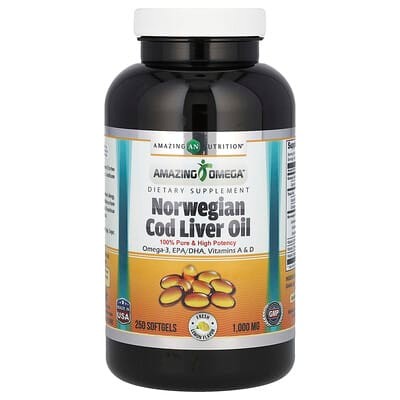
Norwegian Cod Liver Oil 1000 mg Fresh Lemon Flavor

Goals
$24.70 $0.09 per serving


Product analysis
Norwegian Cod Liver Oil 1000 mg Fresh Lemon Flavor combines cod liver oil with vitamins A, D and E. Its fish source matters if you avoid fish-derived ingredients.
AI assessment of the formula, label and price. How scoring works
Nutrient Quality50
Vitamin D3 and natural vitamin E are favorably characterized forms. The fish oil and vitamin A lack enough comparative detail for the same conclusion.
Ingredient Transparency65
Amounts are disclosed, and the vitamin sources are named. The relative contributions of the different vitamin A and D sources are not disclosed, limiting a closer comparison.
Value For Money68
The vitamin A and E contributions offer favorable value for the amounts supplied. Vitamin D offers less favorable value, while the fish oil contribution cannot be compared reliably on cost.
Customer Satisfaction81
Customer feedback is very positive across several hundred ratings. The ratings reflect satisfaction and do not establish effectiveness or safety.
Product Focus30
The formula covers a limited range of intended uses. Its fit with those uses remains uncertain despite the clear vitamin forms.
- Format
Softgel - Container
- 250 Softgel(s)
- Per serving
- $0.09
- Also available
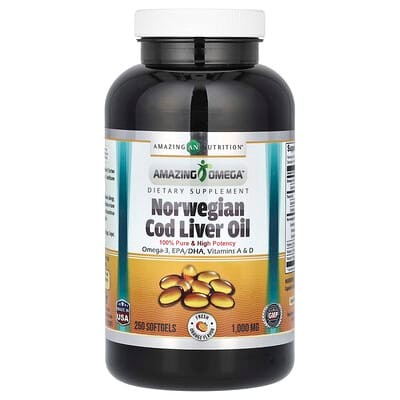 Norwegian Cod Liver Oil 1000 mg Fresh Orange Flavor$9.99
- Customer rating
- 4.7 · 896 ratings
Goals

Impact
Situational effect
Vitamin E · 10 IUVitamin A · 5000 IU

Impact
Situational effect
Vitamin E · 10 IU
Ingredients
| Ingredient | Amount per serving | Score |
|---|---|---|
Energy | 10 Calorie(s) | |
Total Fat | 1 Gram(s) | |
Norwegian Cod Liver Oil concentrate | 1000 mg | |
Vitamin A (Cod Fish Liver, Retinyl Palmitate) | 5000 IU | |
Vitamin D (Cholecalciferol, Cod Fish Liver) | 500 IU | |
Vitamin E Natural (D-Alpha-Tocopherol) | 10 IU |
Vitamin A (Cod Fish Liver, Retinyl Palmitate) · 5000 IU OverallScore65
The serving provides 5,000 IU of vitamin A. The cost is low for the amount of vitamin A. The vitamin A source is Retinyl Palmitate.
How this ingredient is rated
Active Ingredient Quality & Bioavailability30
The vitamin A source is Retinyl Palmitate.
Vitamin A Chemical Form & Source
The vitamin A source is Retinyl Palmitate.
Dose, Safety & Label Transparency82
The serving provides 5,000 IU of vitamin A. The vitamin A source is Retinyl Palmitate.
Dosage Efficacy & Safety Thresholds
The serving provides 5,000 IU of vitamin A.
Label Transparency of Specific Forms
The vitamin A source is Retinyl Palmitate.
Value100
The cost is low for the amount of vitamin A.
Price per 5,000 IU Dose
The cost is low for the amount of vitamin A.
Vitamin D (Cholecalciferol, Cod Fish Liver) · 500 IU OverallScore65
Each serving provides 500 IU of vitamin D as D3, with a high estimated cost per 1,000 IU. A GMP manufacturing claim is reported; independent product testing is not specified.
How this ingredient is rated
Active Ingredient Quality & Bioavailability100
Cholecalciferol is vitamin D3. The form is named, though the source material is not specified in the available details.
Vitamin D3 vs. D2 Superiority
Cholecalciferol is vitamin D3.
Sourcing and Active Marker Disclosure
The form is named, though the source material is not specified in the available details.
Dose, Safety & Label Transparency46
Each serving provides 500 IU of vitamin D. A GMP manufacturing claim is reported; independent product testing is not specified.
Daily Dosage Appropriateness
Each serving provides 500 IU of vitamin D.
Excipient and Additive Purity
No titanium dioxide, artificial colors or hydrogenated oils are identified in the available information.
Purity and Quality Certification
A GMP manufacturing claim is reported; independent product testing is not specified.
Value30
The estimated cost per 1,000 IU is high.
Price per 1,000 IU Efficiency
The estimated cost per 1,000 IU is high.
Vitamin E (D-Alpha-Tocopherol) · 10 IU OverallScore50
Alternative products
Report alternatives
Sources
Published studies used for the product analysis and the top-ranked studies for each ingredient and goal.
- A randomized trial of vitamin A and vitamin E supplementation for retinitis pigmentosa.
- Efficacy and safety of retinol palmitate ophthalmic solution in the treatment of dry eye: a Japanese Phase II clinical trial.
- Vitamin A supplementation for preventing morbidity and mortality in children from six months to five years of age.
- Vitamin A supplementation improves retinal function in infants at risk of retinopathy of prematurity.
- Effect of short-term, high-dose retinol on dark adaptation in aging and early age-related maculopathy.
- Associations Between Vitamin D Intake and Progression to Incident Advanced Age-Related Macular Degeneration.
- Circulating vitamin D concentration and age-related macular degeneration: Systematic review and meta-analysis.
- Low serum vitamin D is associated with axial length and risk of myopia in young children.
- The effect of vitamin D supplementation on the outcome of treatment with bevacizumab in diabetic macular edema: a randomized clinical trial.
- Vitamin D Deficiency and Dry Eye Disease: A Retrospective Cohort Study.
- Antioxidant vitamin and mineral supplements for preventing age-related macular degeneration.
- Dietary n-3 Fatty Acid, α-Tocopherol, Zinc, vitamin D, vitamin C, and β-carotene are Associated with Age-Related Macular Degeneration in Japan.
- Dietary carotenoids, vitamins C and E, and risk of cataract in women: a prospective study.
- Long-term nutrient intake and 5-year change in nuclear lens opacities.
- Dietary intake of antioxidants and risk of age-related macular degeneration.
- Efficacy and Tolerability of Topical 0.1% Stabilized Bioactive Retinol for Photoaging: A Vehicle-Controlled Integrated Analysis.
- Tensile properties and contours of aging facial skin. A controlled double-blind comparative study of the effects of retinol, melibiose-lactose and their association.
- Antiaging action of retinol: from molecular to clinical.
- An Updated Review of Topical Tretinoin in Dermatology: From Acne and Photoaging to Skin Cancer.
- Novel Cyclized Hexapeptide-9 Outperforms Retinol Against Skin Aging: A Randomized, Double-Blinded, Active- and Vehicle-Controlled Clinical Trial.