
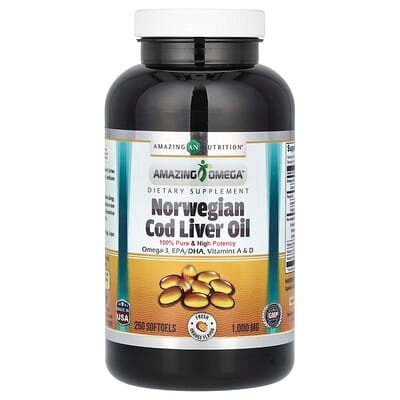
Norwegian Cod Liver Oil 1000 mg Fresh Orange Flavor

Goals
$9.99 $0.03 per serving


Product analysis
Norwegian Cod Liver Oil 1000 mg Fresh Orange Flavor combines cod liver oil with vitamins A, D and E. Its fish source matters if you avoid fish-derived ingredients.
AI assessment of the formula, label and price. How scoring works
Nutrient Quality50
Vitamin D3 and natural vitamin E are favorably characterized forms. The fish oil and vitamin A lack enough comparative detail for the same conclusion.
Ingredient Transparency65
Amounts are disclosed, and the vitamin sources are named. The relative contributions of the different vitamin A and D sources are not disclosed, limiting a closer comparison.
Value For Money75
The vitamin A and E contributions offer favorable value for the amounts supplied. Vitamin D offers moderate value, while the fish oil contribution cannot be compared reliably on cost.
Customer Satisfaction82
Customer feedback is very positive across a substantial number of ratings. The ratings reflect satisfaction and do not establish effectiveness or safety.
Product Focus30
The formula covers a limited range of intended uses. Its fit with those uses remains uncertain despite the clear vitamin forms.
- Format
Softgel - Container
- 250 Softgel(s)
- Per serving
- $0.03
- Also available
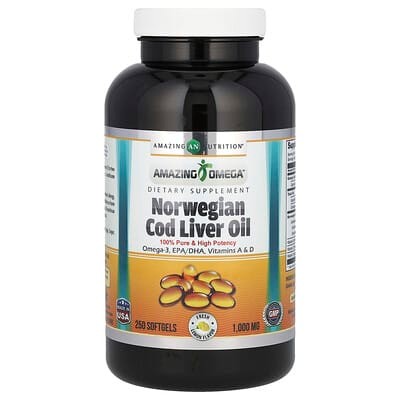 Norwegian Cod Liver Oil 1000 mg Fresh Lemon Flavor$24.70
- Customer rating
- 4.7 · 1,245 ratings
Goals

Impact
Situational effect
Vitamin E · 10 IUVitamin A · 5000 IU

Impact
Situational effect
Vitamin E · 10 IU
Ingredients
| Ingredient | Amount per serving | Score |
|---|---|---|
Energy | 10 Calorie(s) | |
Total Fat | 1 Gram(s) | |
Norwegian Cod Liver Oil concentrate | 1000 mg | |
Vitamin A (Cod Fish Liver, Retinyl Palmitate) | 5000 IU | |
Vitamin D (Cholecalciferol, Cod Fish Liver) | 500 IU | |
Vitamin E Natural (D-Alpha-Tocopherol) | 10 IU |
Vitamin A (Cod Fish Liver, Retinyl Palmitate) · 5000 IU OverallScore65
A serving lists 5,000 IU of vitamin A as preformed retinyl palmitate. The whole-product price works out to about $0.04 per 5,000 IU of vitamin A.
How this ingredient is rated
Active Ingredient Quality & Bioavailability30
Vitamin A comes from retinyl palmitate, a preformed vitamin A form.
Vitamin A Chemical Form & Source
Retinyl palmitate is preformed vitamin A, which the body regulates less tightly than provitamin A.
Dose, Safety & Label Transparency82
A serving lists 5,000 IU of preformed vitamin A as retinyl palmitate.
Dosage Efficacy & Safety Thresholds
A serving lists 5,000 IU of vitamin A.
Label Transparency of Specific Forms
The form is identified, but explicit source percentages are not recorded in the saved information.
Value100
The whole-product price works out to about $0.04 per 5,000 IU of vitamin A.
Price per 5,000 IU Dose
The whole-product price works out to about $0.04 per 5,000 IU of vitamin A.
Vitamin D (Cholecalciferol, Cod Fish Liver) · 500 IU OverallScore71
Each serving provides 500 IU of vitamin D3, a small amount. Its cod liver oil source is identified, and the whole-product serving costs about $0.04.
How this ingredient is rated
Active Ingredient Quality & Bioavailability100
The vitamin D is D3, and its cod liver oil source is identified.
Vitamin D3 vs. D2 Superiority
Cholecalciferol is vitamin D3, which generally raises and maintains vitamin D levels more effectively than D2.
Sourcing and Active Marker Disclosure
Cod liver oil is identified as the raw source of the vitamin D.
Dose, Safety & Label Transparency46
The serving provides 500 IU of vitamin D3. A GMP claim is recorded, but independent content verification is not established.
Daily Dosage Appropriateness
A serving provides 500 IU of vitamin D3, a small amount.
Excipient and Additive Purity
The evaluated ingredient information does not flag titanium dioxide, artificial colors, or hydrogenated oils.
Purity and Quality Certification
A GMP claim is recorded; independent verification of vitamin D content is not established.
Value60
The whole-product serving costs about $0.04, equivalent to about $0.08 per 1,000 IU of vitamin D3.
Price per 1,000 IU Efficiency
The whole-product serving costs about $0.04, equivalent to about $0.08 per 1,000 IU of vitamin D3.
Vitamin E (D-Alpha-Tocopherol) · 10 IU OverallScore50
Each serving provides 10 IU of vitamin E as natural d-alpha-tocopherol. A whole-product serving costs about $0.04.
How this ingredient is rated
Active Ingredient Quality & Bioavailability46
The recorded vitamin E form is natural d-alpha-tocopherol.
Natural (d-alpha) vs. Synthetic (dl-alpha)
D-alpha-tocopherol is identified as a natural form of vitamin E.
Mixed Tocopherol Isomer Diversity
The available facts do not establish a mixed-tocopherol complex or its gamma and delta forms.
Tocotrienol Complex Inclusion
The available facts do not establish tocotrienol content.
Dose, Safety & Label Transparency29
10 IU of vitamin E is recorded per serving, with its form named.
Therapeutic Dosage Range
The serving provides 10 IU of vitamin E.
Label Transparency and Isomer Specificity
The vitamin E form and serving amount are recorded; separate alpha, gamma and delta amounts are not established.
Value100
The whole-product serving costs about $0.04 and supplies 10 IU of vitamin E.
Cost per Natural-Form Therapeutic Serving
The whole-product serving costs about $0.04; its vitamin E is natural.
Alternative products
Report alternatives
Sources
Published studies used for the product analysis and the top-ranked studies for each ingredient and goal.
- A randomized trial of vitamin A and vitamin E supplementation for retinitis pigmentosa.
- Efficacy and safety of retinol palmitate ophthalmic solution in the treatment of dry eye: a Japanese Phase II clinical trial.
- Vitamin A supplementation for preventing morbidity and mortality in children from six months to five years of age.
- Vitamin A supplementation improves retinal function in infants at risk of retinopathy of prematurity.
- Effect of short-term, high-dose retinol on dark adaptation in aging and early age-related maculopathy.
- Associations Between Vitamin D Intake and Progression to Incident Advanced Age-Related Macular Degeneration.
- Circulating vitamin D concentration and age-related macular degeneration: Systematic review and meta-analysis.
- Low serum vitamin D is associated with axial length and risk of myopia in young children.
- The effect of vitamin D supplementation on the outcome of treatment with bevacizumab in diabetic macular edema: a randomized clinical trial.
- Vitamin D Deficiency and Dry Eye Disease: A Retrospective Cohort Study.
- Antioxidant vitamin and mineral supplements for preventing age-related macular degeneration.
- Dietary n-3 Fatty Acid, α-Tocopherol, Zinc, vitamin D, vitamin C, and β-carotene are Associated with Age-Related Macular Degeneration in Japan.
- Dietary carotenoids, vitamins C and E, and risk of cataract in women: a prospective study.
- Long-term nutrient intake and 5-year change in nuclear lens opacities.
- Dietary intake of antioxidants and risk of age-related macular degeneration.
- Efficacy and Tolerability of Topical 0.1% Stabilized Bioactive Retinol for Photoaging: A Vehicle-Controlled Integrated Analysis.
- Tensile properties and contours of aging facial skin. A controlled double-blind comparative study of the effects of retinol, melibiose-lactose and their association.
- Antiaging action of retinol: from molecular to clinical.
- An Updated Review of Topical Tretinoin in Dermatology: From Acne and Photoaging to Skin Cancer.
- Novel Cyclized Hexapeptide-9 Outperforms Retinol Against Skin Aging: A Randomized, Double-Blinded, Active- and Vehicle-Controlled Clinical Trial.