
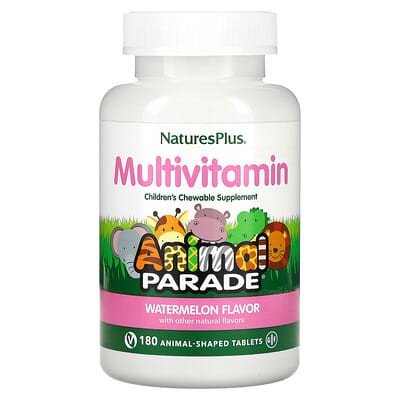
Children's Chewable Multi-Vitamin & Mineral Supplement Natural Watermelon Flavor!

Goals
$29.28 $0.32 per serving


Product analysis
Children's Chewable Multi-Vitamin & Mineral Supplement Natural Watermelon Flavor! offers a broad vitamin and mineral mixture in a chewable format.
AI assessment of the formula, label and price. How scoring works
Nutrient Quality43
Vitamin D3 and natural vitamin E are favorable features of the named nutrient forms. Most other forms do not establish a clear absorption advantage.
Ingredient Transparency88
The listed amounts and most nutrient forms are disclosed, helping you compare the serving. Several additional entries have no specific form identified.
Value For Money41
The vitamin A and vitamin E components offer favorable value, while vitamin D is relatively costly at the full serving price. Value for most other nutrients remains uncertain.
Customer Satisfaction91
Customer ratings are very favorable across a sizeable review pool. The breadth of feedback supports satisfaction but does not establish health benefits.
Product Focus16
The broad mixture is better understood as nutritional coverage than a focused vision supplement. Riboflavin can help when intake is low, but extra intake does not establish better everyday vision.
- Format
Tablet - Container
- 180 Animal(s)
- Per serving
- $0.32
- Also available
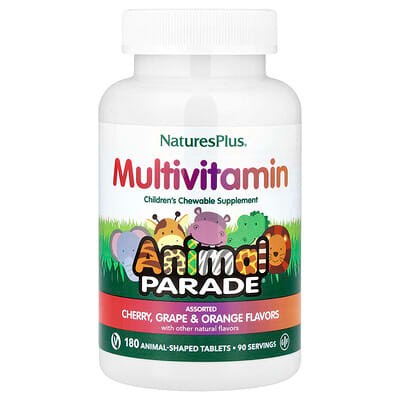 Children's Chewable Multi-Vitamin & Mineral Supplement Natural Assorted Flavors Cherry Orange & Grape$28.99
- Customer rating
- 4.9 · 3,188 ratings
Goals

Impact
Lower effect
Zinc · 3 mgVitamin C · 60 mgCopper · 0.05 mgVitamin E · 30 IU

Impact
Moderate effect
Zinc · 3 mgVitamin E · 30 IUVitamin C · 60 mgCopper · 0.05 mgVitamin A · 5000 IU
Riboflavin deficiency can cause eye problems, so getting enough matters when intake is low. That role doesn't mean extra riboflavin improves sight when you're already adequately nourished. Vitamin C is also present, but its eye-related benefits concern specific combinations for selected people with age-related macular degeneration, rather than general improvements in everyday vision.
How this product is rated for Eye Health
Ingredient fit34
Riboflavin matters for avoiding eye problems caused by deficiency.
Goal fit
Riboflavin matters for avoiding eye problems caused by deficiency.
Dose adequacy
Vitamin A, Vitamin E: the individual usable amounts remain unresolved; other nutrient amounts are declared per serving.
Pathways41
The relevant nutrient connections mainly concern the retina and lens; these roles do not promise a noticeable improvement in sight.
Depth
The relevant nutrient connections mainly concern the retina and lens; these roles do not promise a noticeable improvement in sight.
Breadth
The ingredient connection is concentrated in one aspect of eye function, rather than broad improvements in everyday sight.
Evidence82
Correcting riboflavin deficiency differs from improving sight in an adequately nourished adult.
Evidence strength
Correcting riboflavin deficiency differs from improving sight in an adequately nourished adult.
Studied preparation
The declared nutrient forms are identifiable, but their forms alone do not imply a noticeable vision benefit.
Formulation logic83
No particular ingredient conflict is identified. The declared combination does not imply extra visual benefit from taking its ingredients together.
Partner coverage
No required ingredient partner is missing for the individual nutrient roles described here.
Conflicts
No particular ingredient conflict is identified for the declared serving.
Effective doses
Vitamin A, Vitamin E: unresolved amounts limit comparison with the other declared nutrient quantities.
Ingredients
| Ingredient | Amount per serving | Score |
|---|---|---|
Calories | 10 Calorie(s) | |
Total Carbohydrate | 2 Gram(s) | |
Sugars | 2 Gram(s) | |
Vitamin A (Beta-Carotene) | 5000 IU | |
Vitamin C (Ascorbic Acid) | 60 mg | |
Vitamin D3 (Cholecalciferol) | 400 IU | |
Vitamin E (D-Alpha-Tocopheryl Acetate) | 30 IU | |
Thiamine (Thiamine Hydrochloride) | 1.5 mg | |
Riboflavin | 1.7 mg | |
Niacin (Niacinamide) | 20 mg | |
Vitamin B6 (Pyridoxine Hydrochloride) | 2 mg | |
Folate (Calcium-L-5-Methyltetrahydrofolate) | 10 mcg | |
Vitamin B12 (Methylcobalamin) | 6 mcg | |
Biotin | 50 mcg | |
Pantothenic Acid (Calcium Pantothenate) | 10 mg | |
Calcium (Calcium Aminoate) | 20 mg | |
Iron (Iron Aminoate) | 5 mg | |
Magnesium (Magnesium Aminoate) | 10 mg | |
Zinc (Zinc Aminoate) | 3 mg | |
Copper (Copper Aminoate) | 0.05 mg | |
Manganese (Manganese Aminoate) | 0.05 mg | |
Potassium (Potassium Aminoate) | 1 mg | |
Pineapple | 50 mg | |
Apple | 50 mg | |
Sunflower Oil | 20 mg | |
Lemon Bioflavonoid Complex (Citrus limon) | 20 mg | |
Para-Aminobenzoic Acid | 400 mcg | |
Choline (Choline Bitartrate) | 10 mcg | |
Inositol | 10 mcg |
Vitamin A (Beta-Carotene) · 5000 IU OverallScore69
It supplies 5,000 IU of vitamin A per serving at a moderate cost for the amount supplied. The vitamin A comes from beta-carotene, but its natural or synthetic origin is unclear.
How this ingredient is rated
Active Ingredient Quality & Bioavailability50
The vitamin A comes from beta-carotene; its natural or synthetic origin is unclear.
Vitamin A Chemical Form & Source
The vitamin A comes from beta-carotene; its natural or synthetic origin is unclear.
Dose, Safety & Label Transparency82
A serving provides 5,000 IU of vitamin A. Beta-carotene is named, but a source percentage is not disclosed.
Dosage Efficacy & Safety Thresholds
A serving provides 5,000 IU of vitamin A.
Label Transparency of Specific Forms
Beta-carotene is named, but a source percentage is not disclosed.
Value80
The cost for the amount of vitamin A supplied is moderate.
Price per 5,000 IU Dose
The cost for the amount of vitamin A supplied is moderate.
Vitamin E (D-Alpha-Tocopheryl Acetate) · 30 IU OverallScore65
The serving provides 30 IU of vitamin E at a low cost per serving. It uses natural D-Alpha-Tocopheryl Acetate. The available information doesn't establish mixed tocopherols or tocotrienols.
How this ingredient is rated
Active Ingredient Quality & Bioavailability46
The vitamin E includes natural D-Alpha-Tocopheryl Acetate. Mixed tocopherols and tocotrienols aren't established in the available information.
Natural (d-alpha) vs. Synthetic (dl-alpha)
D-Alpha-Tocopheryl Acetate is a natural form.
Mixed Tocopherol Isomer Diversity
The available information doesn't establish a mixed-tocopherol complex.
Tocotrienol Complex Inclusion
The available information doesn't establish tocotrienols.
Dose, Safety & Label Transparency66
The serving provides 30 IU, a maintenance vitamin E amount. The form and total IU are named, but individual isomer amounts aren't supplied.
Therapeutic Dosage Range
The serving provides 30 IU of vitamin E, a maintenance amount.
Label Transparency and Isomer Specificity
The form and total IU are named, but individual isomer amounts aren't supplied.
Value100
The serving cost is low. It uses natural vitamin E.
Cost per Natural-Form Therapeutic Serving
The serving cost is low. It uses natural vitamin E.
Iron (Iron Aminoate) · 5 mg OverallScore51
At 5 mg iron per serving, the contribution is small and the cost per serving is moderate. The iron comes from iron aminoate. Zinc is also present and may compete with iron for absorption.
How this ingredient is rated
Active Ingredient Quality & Bioavailability31
The iron comes from iron aminoate. Zinc is also present and may compete with iron for absorption. The formula also provides 60 mg vitamin C and vitamin B12 and folate.
Iron Chemical Form & Bioavailability
The iron comes from iron aminoate.
Absorption Support & Blocker Avoidance
Zinc is also present and may compete with iron for absorption. The formula also provides 60 mg vitamin C and vitamin B12 and folate.
Dose, Safety & Label Transparency70
A serving provides 5 mg iron, a small amount. The iron amount per serving is stated.
Elemental Iron Label Clarity
The iron amount per serving is stated.
Dosage Effectiveness & Safety Range
A serving provides 5 mg iron, a small amount.
Value50
The cost per serving is moderate.
Price per Effective Serving
The cost per serving is moderate.
Alternative products
Report alternatives
Sources
Published studies used for the product analysis and the top-ranked studies for each ingredient and goal.
- What did we learn in 35 years of research on nutrition and supplements for age-related macular degeneration: a systematic review.
- Dietary Nutrient Intake and Progression to Late Age-Related Macular Degeneration in the Age-Related Eye Disease Studies 1 and 2.
- Association between late age-related macular degeneration and dietary intake of copper, iron, zinc and selenium: a 2005-2008 NHANES cross-sectional observational study.
- Associations between dietary nutrient intake and the risk of multiple age-related ocular diseases: evidence from longitudinal analysis.
- Dietary habits and dietary nutrient intake in patients with age-related macular degeneration: A case-control study.
- U.S. Multicenter Clinical Trial of Corneal Collagen Crosslinking for Treatment of Corneal Ectasia after Refractive Surgery.
- United States Multicenter Clinical Trial of Corneal Collagen Crosslinking for Keratoconus Treatment.
- EpiSmart Crosslinking for Keratoconus: A Phase 2 Study.
- Prospective Randomized Trial of Corneal Cross-linking Riboflavin Dosing Frequencies for Treatment of Keratoconus and Corneal Ectasia.
- Corneal collagen cross-linking for keratoconus: results of 3-year follow-up in Pakistani population.
- A randomized trial of vitamin A and vitamin E supplementation for retinitis pigmentosa.
- Efficacy and safety of retinol palmitate ophthalmic solution in the treatment of dry eye: a Japanese Phase II clinical trial.
- Vitamin A supplementation for preventing morbidity and mortality in children from six months to five years of age.
- Vitamin A supplementation improves retinal function in infants at risk of retinopathy of prematurity.
- Effect of short-term, high-dose retinol on dark adaptation in aging and early age-related maculopathy.
- Role of Oral Vitamin 'C' on Astigmatic Errors in Phacoemulsification.
- Ascorbic acid metabolites are involved in intraocular pressure control in the general population.
- Nutritional modulation of cataract.
- Dietary n-3 Fatty Acid, α-Tocopherol, Zinc, vitamin D, vitamin C, and β-carotene are Associated with Age-Related Macular Degeneration in Japan.
- Adherence to a Mediterranean diet, lifestyle and age-related macular degeneration: the Coimbra Eye Study - report 3.