Product Image

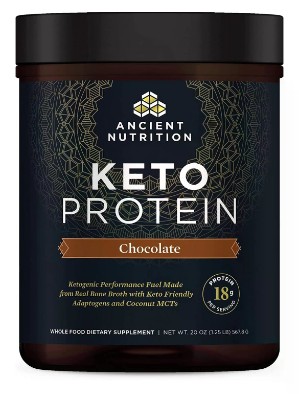
Keto Protein Chocolate

Ancient Nutrition
4.5
★ ★ ★ ★ ★
(74 ratings)
Sodium 170 mg
Potassium 310 mg
Protein 18 Gram(s)
Product Image
Score54
The high-fat, low-carbohydrate profile fits a keto-style shake. A proprietary blend, modest protein, and premium serving cost limit broader value.
How scoring works
Quantity:20 Ounce(s) • (17 servings)
Goals:

Score 54

The high-fat, low-carbohydrate profile fits a keto-style shake. A proprietary blend, modest protein, and premium serving cost limit broader value.
How scoring works
$44.15($2.59 per serving)
Pure Formulas
$ 55.21
Daily Vita
$ 55.21
Vitacost
$ 44.15
Report prices

Analysis

The 18 g protein serving comes with 10 g fat and only 2 g carbohydrate, fitting people who deliberately want a higher-fat keto-style shake. A 30.2 g KetoPROTEIN Blend is listed, but its individual components and amounts are not supplied.

Potassium at 310 mg offers a moderate contribution, while sodium is also present at 170 mg. The balance is not a focused heart intervention, and the product does not supply defined ingredients for lipids, vascular tone, or cardiac energy.

The premium serving cost is difficult to justify when potassium or protein efficiency is the main goal. The proprietary blend also makes source quality, allergen suitability, and the contribution of each ingredient hard to assess.

Who is it for
  • Adults following a higher-fat keto-style diet
  • People wanting a low-carbohydrate protein shake
  • Users comfortable with a proprietary protein blend
Best for
  • Keto-oriented meal supplementation
  • Low-carbohydrate protein intake
  • General nutrition rather than electrolyte replacement

Pros

  • Provides 18 g protein
  • Contains only 2 g carbohydrate
  • Supplies 310 mg potassium
  • Higher fat content fits some keto-style diets

Cons

  • KetoPROTEIN Blend components are not quantified
  • Protein amount is modest for the serving size
  • Premium serving cost
  • Potassium form is not identified

Warnings

  • The 10 g fat serving may not fit people limiting dietary fat
  • The proprietary blend prevents clear allergen screening from the supplied data
  • The 170 mg sodium amount is not sufficient for demanding sweat replacement

Nutrient quality

68 High impact

Protein and fat create a coherent low-carbohydrate nutrition profile. Unknown ingredient sources and weak heart-purpose alignment reduce confidence.

.

Ingredient transparency

44 Lower impact

Core nutrition totals are clear enough for basic comparison. Missing complete ingredients, use directions, and detailed protein or blend composition leave notable gaps.

.

Customer satisfaction

57 Moderate impact

Aggregate satisfaction data are favorable. Specific firsthand comments were not supplied, leaving repeated complaints and purpose fit uncertain.

.

Value for money

48 Lower impact

Formula opacity or weak serving economics limit value. More transparent or efficient alternatives are likely to be more practical.

.
Report analysis

Ingredients

IngredientAmount per serving
Calories
160 Calorie(s)
Total Fat
10 Gram(s)
Cholesterol
15 mg
Total Carbohydrates
2 Gram(s)
Protein
18 Gram(s)
Sodium
170 mg
Potassium
310 mg
KetoPROTEIN Blend
30.2 Gram(s)
Adults 18–50
Report overview
Sodium · 170 mg OverallScore56
D Active Ingredient Quality & BioavailabilityC Dose, Safety & Label TransparencyB- Value

The sodium serving is too small for intense exercise and comes from an unidentified source. Potassium provides limited breadth because its form is not supplied, while the protein blend dominates the formula. Value is neutralized because the high serving cost largely reflects non-electrolyte nutrition.

Potassium · 310 mg OverallScore39
F Active Ingredient Quality & BioavailabilityC Dose, Safety & Label TransparencyF Value

Food-derived potassium in the protein blend lacks a stated chemical form and verified buffering value. The amount is near the upper end of the moderate range but still misses the collection target. A premium serving cost makes it poor value for potassium-focused use.

Loading alternative details
Report alternatives

Sources

Published studies used for the product analysis and the top-ranked studies for each ingredient and goal.

  1. Oral potassium supplementation for management of essential hypertension: A meta-analysis of randomized controlled trials.
    Poorolajal J; Zeraati F; Soltanian AR; Sheikh V; Hooshmand E; Maleki A · PloS one · 2017
    Meta-analysis1,213 participants23 studies pooledHeart Health forPotassium
  2. Effect of Potassium Supplementation on Endothelial Function: A Systematic Review and Meta-Analysis of Intervention Studies.
    D'Elia L; Cappuccio FP; Masulli M; La Fata E; Rendina D; Galletti F · Nutrients · 2023
    Meta-analysis332 participants5 studies pooledHeart Health forPotassium
  3. Associations between sodium, potassium, and blood pressure: results from the Hispanic Community Health Study/Study of Latinos, a prospective cohort study.
    Swift SL; Sotres-Alvarez D; Raij L; Wassertheil-Smoller S; Schneiderman N; Llabre M; Zeki Al Hazzouri A; Rundek T; Van Horn L; Daviglus M; Castaneda S; Youngblood M; Mossavar-Rahmani Y; Elfassy T · The American journal of clinical nutrition · 2024
    Cohort study11,429 participantsHeart Health forPotassium
  4. Serum potassium levels provide prognostic information in symptomatic heart failure beyond traditional clinical variables.
    Toledo CC; Vellosa Schwartzmann P; Miguel Silva L; da Silva Ferreira G; Bianchini Cardoso F; Citelli Ribeiro V; Paim LR; Antunes-Correa LM; Carvalho Sposito A; Matos Souza JR; Modolo R; Nadruz W; Fernandes de Carvalho LS; Coelho-Filho OR · ESC heart failure · 2021
    Cohort study178 participantsHeart Health forPotassium