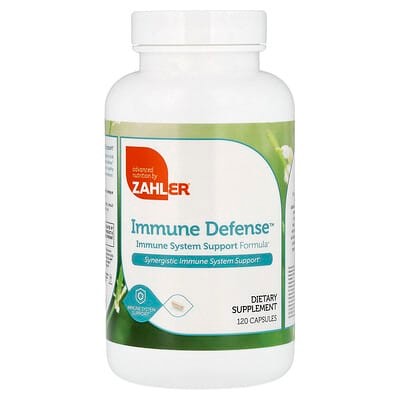
Immune Defense

Immune Defense

Advanced Nutrition by Zahler4.9 (50 ratings)
Format:Capsule Quantity: 120 Capsule(s) · 30 servings
Goals
$32.47 $1.08 per serving

About this product

The formula supplies 600 mg vitamin C, 900 mg olive leaf extract, 900 mg bee propolis powder, and 500 mg pantothenic acid. Pine-bark ingredients add another antioxidant-related pathway.

Propolis is raw powder rather than a characterized extract, so flavonoid and phenolic exposure is unknown. Olive leaf has no marker level, while Pycnogenol is present at only 10 mg.

Four capsules provide just thirty servings, creating a sizable daily burden. It may suit users wanting a broad stack, but a simpler standardized propolis product is easier to assess.

Who is it for
  • Adults seeking a broad multi-ingredient formula
  • People who want propolis with vitamin C and olive leaf
  • Users comfortable with four capsules
Best for
  • Broad antioxidant pathway coverage
  • Propolis and olive-leaf combination
  • Short-term seasonal use

Pros

  • Vitamin C and olive leaf amounts are substantial
  • 900 mg propolis powder is disclosed
  • Includes two pine-bark entries
  • All active weights are listed

Cons

  • Propolis is unstandardized powder
  • Olive-leaf markers are absent
  • Only 10 mg Pycnogenol
  • Four capsules per serving
  • Only thirty servings

Warnings

  • Avoid use with an allergy to propolis or other bee products.
  • Olive leaf may lower blood pressure or blood glucose, which matters for users of related medicines.
  • Stop immediately for rash, swelling, wheezing, or throat tightness.

Product analysis

71 out of 100
A broad, high-weight formula covers several immune-related antioxidant pathways. Unstandardized propolis, four capsules, and uneven supporting doses limit precision.

AI assessment of the formula, label and price. How scoring works

Nutrient quality78

Vitamin C, olive leaf, pine bark, and Pycnogenol provide recognizable antioxidant forms, while propolis remains an unstandardized powder. Vitamin C, olive leaf, and propolis are substantial, while the pantothenic acid amount is unnecessarily high.

.
Ingredient transparency79

Active ingredients have stated amounts and no proprietary blend hides a dose. Serving count is supplied, while full directions and the other-ingredients list are missing.

.
Customer satisfaction61

The supplied aggregate rating is the only evidence of general satisfaction and its reliability depends on the rating volume. No comment-level evidence is available to assess recurring complaints or confirm how experience matches the intended purpose.

.
Value for money62

Broad ingredient coverage is held back by unstandardized propolis, an imbalanced pantothenic acid amount, and high serving cost. The broader or hidden additions reduce competitiveness for someone seeking propolis specifically.

.
Format
Capsule
Container
120 Capsule(s)
Per serving
$1.08
Customer rating
4.9 · 50 ratings
Report analysis

Goals

Immunity
Impact
Highest effect
B- Ingredient FitB+ PathwaysA+ EvidenceA+ Formulation Logic
Vitamin C · 600 mgPropolis · 900 mg

Vitamin C may modestly shorten a cold with regular use, without promising to prevent infection or treat a cold that's already started. It also contributes to normal immune function. The propolis here can't be assumed to offer the same symptom benefit as a standardized spray delivered locally to the mouth and throat; swallowed propolis mass doesn't describe that preparation or delivery.

How this product is rated for Immunity

Ingredient fit71

The serving supplies 600 mg vitamin C; its regular-use benefit concerns modestly shorter colds, not reliable prevention. Other ingredients serve broader purposes.
Goal fit
Immune-related nutrients appear alongside ingredients with other roles; those additional ingredients do not automatically add immune benefits.
Dose adequacy
The serving supplies 600 mg vitamin C; its regular-use benefit concerns modestly shorter colds, not reliable prevention.

Pathways80

The strongest connection concerns the body’s barriers and antimicrobial defense. Several immune functions are represented, without a promise of infection prevention.
Depth
The strongest connection concerns the body’s barriers and antimicrobial defense.
Breadth
The ingredients relate to several aspects of immune function; this breadth does not predict fewer infections.

Evidence100

Vitamin C offers a bounded expectation of modestly shorter colds with regular use.
Evidence strength
Vitamin C offers a bounded expectation of modestly shorter colds with regular use.
Studied preparation
The declared preparations are compatible with the relevant ingredient roles; this does not show that the whole combination prevents infections.

Formulation logic100

The relevant ingredients do not need a missing partner, and no particular conflict is identified.
Partner coverage
The relevant ingredients can act without a required missing partner; their combination does not imply an added benefit.
Conflicts
No particular ingredient conflict is identified.
Effective doses
The serving supplies 600 mg vitamin C; its regular-use benefit concerns modestly shorter colds, not reliable prevention.
Study evidence
Propolis Supportive 6 studies
Vitamin C Supportive 53 studies
Impact
Highest effect
C+ Ingredient FitB PathwaysA+ EvidenceA+ Formulation Logic
Propolis · 900 mgVitamin C · 600 mg

Vitamin C may lower CRP, a blood marker of inflammation, when that marker is already elevated. This conditional effect doesn't mean it reliably reduces inflammation for everyone. Its connection to a blood marker also doesn't tell you whether you will notice less pain or other symptoms.

How this product is rated for Anti-Inflammatory Support

Ingredient fit69

Propolis: 900 mg; Vitamin C: 600 mg per serving.
Goal fit
Several ingredients relate to inflammation, alongside components serving other purposes.
Dose adequacy
Propolis: 900 mg; Vitamin C: 600 mg per serving.

Pathways79

EPA and DHA relate to fatty-acid signalling involved in inflammation. These actions do not predict how much inflammation or discomfort will change.
Depth
EPA and DHA relate to fatty-acid signalling involved in inflammation.
Breadth
The ingredient actions are concentrated rather than a guarantee of broad inflammation relief.

Evidence96

Vitamin C may lower CRP, a blood marker of inflammation, when that marker is already elevated.
Evidence strength
Vitamin C may lower CRP, a blood marker of inflammation, when that marker is already elevated.
Studied preparation
The declared preparation does not by itself guarantee that an inflammatory-marker effect translates into symptom relief.

Formulation logic100

The relevant ingredients do not require an added partner for their individual roles. No particular ingredient conflict is identified.
Partner coverage
The relevant ingredients can perform their individual roles without an additional partner.
Conflicts
No particular ingredient conflict is identified.
Effective doses
Vitamin C supplies 600 mg per serving; this amount does not establish a daily regimen or guarantee a benefit.
Study evidence
Propolis Supportive 34 studies
Vitamin C Supportive 50 studies

Ingredients

IngredientAmount per servingScore
Vitamin C
600 mg
Pantothenic Acid (Calcium D-Pantothenate)
500 mg
Olive leaf extract
900 mg
Bee Propolis powder
900 mg
Masson Pine bark extract
90 mg
Pycnogenol
10 mg
Adults 18–50 Kosher Dairy Free
Report overview
F Composition And Label DisclosureC+ Composition And Label Disclosure
Immune Defense lists 900 mg of Propolis, but the saved details don't identify its form, extraction ratio, or quantified marker information. A flow agent is noted. The facts don't establish a dry preparation amount for price comparison.
How this ingredient is rated

Composition and Label Disclosure10

No quantified flavonoid or polyphenol marker or general standardization claim appears in the saved details.
Named Propolis Marker Disclosure
The saved details list no flavonoid or polyphenol amount or percentage, and no general standardization claim.

Composition and Label Disclosure66

An amount is listed without a resolved form or extraction ratio; the saved details also flag a flow agent.
Preparation Amount and Equivalency Disclosure
The saved facts list 900 mg of Propolis, but don't specify its form or an extraction ratio.
Other Ingredients Disclosure
A flow agent is flagged among the other ingredients, though its name isn't included in these facts.

Commercial Price and Usability

The dry preparation mass needed for this price comparison isn't established.
Cost per 100 mg Dry Propolis Preparation
A price per dry-propolis amount is unavailable because the saved facts don't establish dry preparation mass.
Loading alternative details
Report alternatives

Sources

Published studies used for the product analysis and the top-ranked studies for each ingredient and goal.

  1. Propolis increases Foxp3 expression and lymphocyte proliferation in HIV-infected people: A randomized, double blind, parallel-group and placebo-controlled study.
    Conte FL; Tasca KI; Santiago KB; de Oliveira Cardoso E; Romagnoli GG; de Assis Golim M; Braz AMM; Berretta AA; do Rosário de Souza L; Sforcin JM · Biomedicine & pharmacotherapy = Biomedecine & pharmacotherapie · 2021
    Randomized trial40 participantsImmunity forPropolis
  2. Propolis does not significantly modulate immune function in an older population: A preliminary study.
    Pu L; Wang Y; Pang W; Wei J; Wu J; Guo C; Weina Gao · Heliyon · 2025
    Randomized trial62 participantsImmunity forPropolis
  3. Effect of Propolis Intake on Serum C-Reactive Protein (CRP) and Tumor Necrosis Factor-alpha (TNF-α) Levels in Adults: A Systematic Review and Meta-Analysis of Clinical Trials.
    Jalali M; Ranjbar T; Mosallanezhad Z; Mahmoodi M; Moosavian SP; Ferns GA; Jalali R; Sohrabi Z · Complementary therapies in medicine · 2020
    Meta-analysis406 participants6 studies pooledAnti-Inflammatory Support forPropolis
  4. Propolis supplementation can reduce serum level of interleukin-6, C-reactive protein, and tumor necrosis factor-α: an updated systematic review and dose-response meta-analysis on randomized clinical trials.
    Gholami A; Dinarvand N; Hariri M · Journal of health, population, and nutrition · 2024
    Meta-analysis16 studies pooledAnti-Inflammatory Support forPropolis
  5. Effects of propolis supplementation on glycemic status, lipid profiles, inflammation and oxidative stress, liver enzymes, and body weight: a systematic review and meta-analysis of randomized controlled clinical trials.
    Hallajzadeh J; Milajerdi A; Amirani E; Attari VE; Maghsoudi H; Mirhashemi SM · Journal of diabetes and metabolic disorders · 2024
    Meta-analysis14 studies pooledAnti-Inflammatory Support forPropolis
  6. Brazilian organic propolis for prevention and treatment of radiation-related oral acute toxicities in head and neck cancer patients: A double-blind randomized clinical trial.
    Fernandes PM; Rosalen PL; Fernandes DT; Dias-Neto E; Alencar SM; Bueno-Silva B; Alves FA; Lopes MA · Frontiers in pharmacology · 2022
    Randomized trial60 participantsAnti-Inflammatory Support forPropolis
  7. The effect of Brazilian Green Propolis extract on inflammation in patients with chronic kidney disease on peritoneal dialysis: A randomised double-blind controlled clinical trial.
    Baptista BG; Fanton S; Ribeiro M; Cardozo LF; Regis B; Alvarenga L; Ribeiro-Alves M; Berretta AA; Shiels PG; Mafra D · Phytomedicine : international journal of phytotherapy and phytopharmacology · 2023
    Randomized trial19 participantsAnti-Inflammatory Support forPropolis
  8. Efficacy of Vitamin C as Glucocorticoid Substitute for Reducing Pain and Inflammation After Total Hip Arthroplasty: A Randomized Controlled Trial.
    Jiang W; Xu H; Jiang X; Zhan Y; Ju Y; Xie J; Huang Z; Huang Q; Pei F · The Journal of bone and joint surgery. American volume · 2025
    Randomized trial107 participantsAnti-Inflammatory Support forVitamin C
  9. The Impact of Vitamin C on Analgesic, Anti-inflammatory, and Hemostatic Outcomes After Total Hip and Knee Arthroplasty: A Systematic Review and Meta-Analysis.
    Moftakhari Hajimirzaei S; Bagherzadeh Cham M; Dolikhani M; Tabatabaee SM; Ebrahimpour A · The archives of bone and joint surgery · 2026
    Meta-analysis1,162 participants10 studies pooledAnti-Inflammatory Support forVitamin C
  10. The impact of vitamin C supplementation on the perioperative outcomes after total hip and knee arthroplasty: a systematic review and meta-analysis.
    Liu X; Guo J; Li Y; Yang Y; Liu M; Gao Q; Yang Y; Wu X; Yue C · BMC musculoskeletal disorders · 2026
    Meta-analysis852 participants8 studies pooledAnti-Inflammatory Support forVitamin C
  11. Therapeutic Impact of Ascorbic Acid on Oral and Periodontal Tissues: A Systematic Literature Review.
    Ruzijevaite G; Acaite E; Jagelaviciene E · Medicina (Kaunas, Lithuania) · 2025
    Systematic review811 participants17 studies pooledAnti-Inflammatory Support forVitamin C
  12. Oral vitamin C administration reduces early recurrence rates after electrical cardioversion of persistent atrial fibrillation and attenuates associated inflammation.
    Korantzopoulos P; Kolettis TM; Kountouris E; Dimitroula V; Karanikis P; Pappa E; Siogas K; Goudevenos JA · International journal of cardiology · 2005
    Randomized trial44 participantsAnti-Inflammatory Support forVitamin C
  13. Immune Responses in Broiler Chicks Fed Propolis Extraction Residue-supplemented Diets.
    Eyng C; Murakami AE; Santos TC; Silveira TG; Pedroso RB; Lourenço DA · Asian-Australasian journal of animal sciences · 2015
    Randomized trialImmunity forPropolis
  14. Integrative Therapies in Wound Healing in Small Animals: An Approach Beyond Traditional Medicine.
    Santos JKVRS; Costa EDS; Fernandes CCL; Cortez AA; Fonsêca ADV; Guedes RFM; Araújo PRM · Veterinary sciences · 2026
    Narrative reviewImmunity forPropolis
  15. A standardized polyphenol mixture extracted from poplar-type propolis for remission of symptoms of uncomplicated upper respiratory tract infection (URTI): A monocentric, randomized, double-blind, placebo-controlled clinical trial.
    Esposito C; Garzarella EU; Bocchino B; D'Avino M; Caruso G; Buonomo AR; Sacchi R; Galeotti F; Tenore GC; Zaccaria V; Daglia M · Phytomedicine : international journal of phytotherapy and phytopharmacology · 2020
    Randomized trial122 participantsImmunity forPropolis
  16. Vitamin C and contribution to the normal function of the immune system: evaluation of a health claim pursuant to Article 14 of Regulation (EC) No 1924/2006.
    EFSA Panel on Dietetic Products, Nutrition and Allergies (NDA) · EFSA journal. European Food Safety Authority · 2026
    Guideline / consensusImmunity forVitamin C
  17. Therapeutic effects of high-dose vitamin C supplementation in patients with COVID-19: a meta-analysis.
    Sun L; Zhao JH; Fan WY; Feng B; Liu WW; Chen RQ; Ban C; Dang AG; Wang M; Luo KT; Zhou GY; Yu FF; Ba Y · Nutrition reviews · 2024
    Meta-analysis2,334 participants14 studies pooledImmunity forVitamin C
  18. Effect of micronutrient supplements on influenza and other respiratory tract infections among adults: a systematic review and meta-analysis.
    Abioye AI; Bromage S; Fawzi W · BMJ global health · 2021
    Meta-analysisImmunity forVitamin C
  19. New evidence for antioxidant properties of vitamin C.
    Vojdani A; Bazargan M; Vojdani E; Wright J · Cancer detection and prevention · 2001
    Randomized trial20 participantsImmunity forVitamin C
  20. Enhanced Vitamin C Delivery: A Systematic Literature Review Assessing the Efficacy and Safety of Alternative Supplement Forms in Healthy Adults.
    Calder PC; Kreider RB; McKay DL · Nutrients · 2025
    Systematic review13 studies pooledImmunity forVitamin C