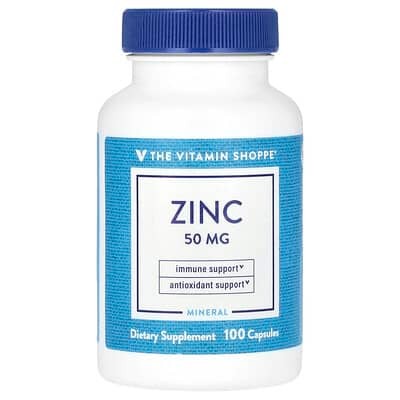
Product Image

Zinc 50 mg

4.8
★ ★ ★ ★ ★
(125 ratings)
Zinc 50 mg
Product Image
Score71

A mixed-form label and excessive amount weaken this zinc capsule. The inclusion of oxide adds little while the form proportions remain unknown.

How scoring works
Capsule
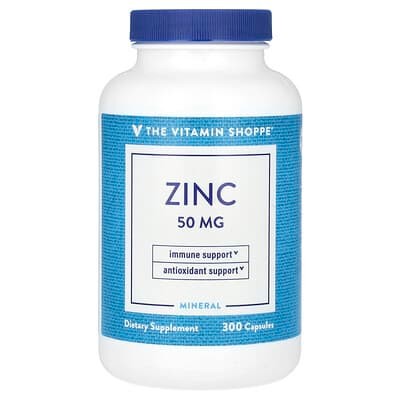
Quantity:300 Capsule(s) • (300 servings)
Goals:

Score 71

A mixed-form label and excessive amount weaken this zinc capsule. The inclusion of oxide adds little while the form proportions remain unknown.

How scoring works

Also available as

1 option
$31.99($0.10 per serving)
iHerb
$ 31.99
Report prices

Analysis

The formula combines zinc aspartate, gluconate, and oxide in a 50 mg total serving. Without each form’s contribution, the label cannot show how much comes from the better organic salts.

Zinc can support several basic health processes when intake is inadequate. Adding multiple salts does not broaden the biological role or make the high amount more useful.

The daily serving exceeds the usual adult upper intake level and contains no copper. Short, professionally directed use is more sensible than continuous supplementation.

Who is it for
  • Adults instructed to use a high zinc amount briefly
  • Buyers comfortable with a mixed-source zinc capsule
Best for
  • Short-term directed supplementation
  • People who value a large supply over precise form disclosure

Pros

  • Total elemental zinc is stated
  • Includes gluconate and aspartate forms
  • Capsule format is practical
  • Serving value is favorable

Cons

  • Does not disclose each form’s share
  • Includes lower-quality zinc oxide
  • Amount exceeds the adult upper intake level
  • No copper is included

Warnings

  • 50 mg exceeds the usual adult upper intake level and is not suited to routine unsupervised use.
  • Repeated use at 50 mg can cause nausea, especially on an empty stomach.
  • Long-term high zinc intake without copper can reduce copper status and affect blood or nerve health.
  • Zinc can reduce absorption of tetracycline or quinolone antibiotics, so dose spacing should follow the medicine instructions.

Nutrient quality

71 High impact

Aspartate and gluconate are useful, while zinc oxide is less favorable and the proportions are unclear. The amount exceeds the adult upper intake level and is too aggressive for routine long-term use.

.
Ingredient transparency

69 High impact

The total amount appears stated, but three repeated zinc entries make the form proportions ambiguous. Directions and inactive ingredients are not supplied, limiting full label transparency.

.

Customer satisfaction

67 High impact

The supplied aggregate rating indicates very strong customer satisfaction. Specific comments are unavailable, so complaint patterns and intended-use fit cannot be verified.

.

Value for money

78 High impact

The serving cost is low, but dose safety and unclear form proportions weaken value. Simpler products provide cleaner comparisons.

.

Report analysis

Goals

Immunity
Impact
Moderate effect
A Goal FitD Strength of SupportF CoverageC- Formula Quality
Zinc · 50 mg

Zinc directly supports immune-cell development, but the 50 mg daily amount exceeds the adult upper intake level. Prolonged use may reduce copper status because no copper is included.

Gluconate and aspartate improve the mixed-form profile, while zinc oxide lowers expected absorption. The capsule is better suited to short-term or clinician-guided use than routine daily maintenance.

Study evidence
Zinc Supportive 73 studies
General Health
Impact
Moderate effect
A Goal FitF Strength of SupportD- CoverageC Formula Quality
Zinc · 50 mg

Zinc has strong relevance to immune function, DNA synthesis, and correcting inadequate intake. The high serving amount is poorly suited to unsupervised daily maintenance despite the established value of zinc itself.

The label identifies several zinc forms but does not show how much each contributes, and oxide is generally less well absorbed. Prolonged use at 50 mg without copper can reduce copper status, so this serving is better reserved for directed short-term use.

Study evidence
Zinc Supportive 60 studies
Testosterone Support
Impact
Moderate effect
B+ Goal FitD+ Strength of SupportF CoverageD+ Formula Quality
Zinc · 50 mg

Zinc is a foundational steroidogenesis nutrient, but the 50 mg amount exceeds the adult upper limit and is not suited to routine unsupervised use. The blend also includes poorly absorbed zinc oxide without showing each form's share.

Correction of zinc deficiency may support testosterone, while excess intake does not provide the same predictable benefit. Long-term daily use without copper may impair copper status and create anemia or neurologic problems.

Study evidence
Zinc Disputed 7 studies
Hair Health
Impact
Moderate effect
B Goal FitD- Strength of SupportF CoverageD Formula Quality
Zinc · 50 mg

Zinc supports follicle cell division and may help hair shedding when deficiency is present. It is unlikely to improve hair when zinc status is already adequate.

The blend includes usable aspartate and gluconate alongside lower-absorption oxide, with no form proportions given. The 50 mg serving exceeds the adult upper limit and lacks copper, so prolonged daily use can impair copper status.
Study evidence
Zinc Supportive 22 studies
Skin Health
Impact
Moderate effect
C Goal FitD- Strength of SupportF CoverageC Formula Quality
Zinc · 50 mg

Zinc supports wound repair, normal skin turnover, and antioxidant enzymes. The amount is too high for routine daily use and does not make the product a complete skin formula.

The blend includes useful organic salts but also zinc oxide, and their individual shares are not disclosed. The zinc amount exceeds the adult upper intake level and may cause nausea or copper deficiency when used regularly without copper.

Study evidence
Zinc Supportive 66 studies

Ingredients

IngredientAmount per serving
Zinc (Zinc Aspartate, Zinc Gluconate, Zinc Oxide)
50 mg
Gluten Free Adults 18–50 Dairy Free Sugar Free
Report overview
D+ Active Ingredient Quality & BioavailabilityD Dose, Safety & Label TransparencyA+ Value

The blend combines zinc gluconate and aspartate with poorly absorbed zinc oxide, while leaving their proportions unclear. The 50 mg dose exceeds the adult upper limit and no copper is included, which is concerning for prolonged daily use. Low serving cost supports value, but it does not resolve the formulation and safety trade-offs.

Loading alternative details
Report alternatives

Sources

Published studies used for the product analysis and the top-ranked studies for each ingredient and goal.

  1. Effectiveness of sodium bicarbonate and zinc chloride mouthwashes in the treatment of oral mucositis and quality of life in patients with cancer under chemotherapy.
    Mohammadi F; Oshvandi K; Kamallan SR; Khazaei S; Ranjbar H; Ahmadi-Motamayel F; Gillespie M; Jenabi E; Vafaei SY · Nursing open · 2022
    Randomized trial144 participantsGeneral Health forZinc
  2. Zinc supplementation in young children with acute diarrhea in India.
    Sazawal S; Black RE; Bhan MK; Bhandari N; Sinha A; Jalla S · The New England journal of medicine · 1995
    Randomized trial937 participantsGeneral Health forZinc
  3. Associations of mortality with ocular disorders and an intervention of high-dose antioxidants and zinc in the Age-Related Eye Disease Study: AREDS Report No. 13.
    Clemons TE; Kurinij N; Sperduto RD; AREDS Research Group · Archives of ophthalmology (Chicago, Ill. : 1960) · 2004
    Randomized trial4,753 participantsGeneral Health forZinc
  4. Effects of zinc and probiotic co-supplementation on inflammation, gastrointestinal symptoms, quality of life, and mood in irritable bowel syndrome patients.
    Rezazadegan M; Soheilipour M; Amani R · Scientific reports · 2026
    Randomized trial84 participantsGeneral Health forZinc
  5. Effect of zinc sulfate supplementation on premenstrual syndrome and health-related quality of life: Clinical randomized controlled trial.
    Siahbazi S; Behboudi-Gandevani S; Moghaddam-Banaem L; Montazeri A · The journal of obstetrics and gynaecology research · 2018
    Randomized trial142 participantsGeneral Health forZinc
  6. The effects of minoxidil, 1% pyrithione zinc and a combination of both on hair density: a randomized controlled trial.
    Berger RS; Fu JL; Smiles KA; Turner CB; Schnell BM; Werchowski KM; Lammers KM · The British journal of dermatology · 2003
    Randomized trial200 participantsHair Health forZinc
  7. Incubatory environment of the scalp impacts pre-emergent hair to affect post-emergent hair cuticle integrity.
    Schwartz JR; Henry JP; Kerr KM; Flagler MJ; Page SH; Redman-Furey N · Journal of cosmetic dermatology · 2018
    Randomized trialHair Health forZinc
  8. A comparison of hair quality and cosmetic acceptance following the use of two anti-dandruff shampoos.
    Draelos ZD; Kenneally DC; Hodges LT; Billhimer W; Copas M; Margraf C · The journal of investigative dermatology. Symposium proceedings · 2006
    Randomized trial40 participantsHair Health forZinc
  9. BMI and levels of zinc, copper in hair, serum and urine of Turkish male patients with androgenetic alopecia.
    Ozturk P; Kurutas E; Ataseven A; Dokur N; Gumusalan Y; Gorur A; Tamer L; Inaloz S · Journal of trace elements in medicine and biology : organ of the Society for Minerals and Trace Elements (GMS) · 2015
    Case-control study216 participantsHair Health forZinc
  10. Analysis of serum zinc and copper concentrations in hair loss.
    Kil MS; Kim CW; Kim SS · Annals of dermatology · 2013
    Case-control study342 participantsHair Health forZinc
  11. Nutrient supplementation for prevention of viral respiratory tract infections in healthy subjects: A systematic review and meta-analysis.
    Vlieg-Boerstra B; de Jong N; Meyer R; Agostoni C; De Cosmi V; Grimshaw K; Milani GP; Muraro A; Oude Elberink H; Pali-Schöll I; Roduit C; Sasaki M; Skypala I; Sokolowska M; van Splunter M; Untersmayr E; Venter C; O'Mahony L; Nwaru BI · Allergy · 2022
    Meta-analysis199,055 participants115 studies pooledImmunity forZinc
  12. Zinc supplementation reduces the incidence of acute lower respiratory infections in infants and preschool children: a double-blind, controlled trial.
    Sazawal S; Black RE; Jalla S; Mazumdar S; Sinha A; Bhan MK · Pediatrics · 1998
    Randomized trial609 participantsImmunity forZinc
  13. A randomized controlled trial of zinc supplementation in the treatment of acute respiratory tract infection in Thai children.
    Rerksuppaphol S; Rerksuppaphol L · Pediatric reports · 2020
    Randomized trial64 participantsImmunity forZinc
  14. The effect of zinc and vitamin A supplementation on immune response in an older population.
    Fortes C; Forastiere F; Agabiti N; Fano V; Pacifici R; Virgili F; Piras G; Guidi L; Bartoloni C; Tricerri A; Zuccaro P; Ebrahim S; Perucci CA · Journal of the American Geriatrics Society · 1998
    Randomized trial136 participantsImmunity forZinc
  15. The role of specific nutrients in preventing immune system and blood cell disorders: an umbrella review.
    Vecchietti A; Strano P; Minutolo G; Grieco V; Cappuccio G; Granvillano G; Confalonieri L; Briganti GL; Raso E; Chimienti M; Pellegrini M; Mercogliano M; Spatari G; Lugli C; Urbano T; Lorenzon A · Journal of preventive medicine and hygiene · 2026
    Systematic review13 studies pooledImmunity forZinc
  16. Sex-related differences in response to zinc pyrithione shampoo vs. non-anti-dandruff shampoo.
    Collins LZ; Baines FL; Matheson JR; Turner GA; Diao Y; Li Y; Pi Y · International journal of cosmetic science · 2019
    Meta-analysis2,088 participants20 studies pooledSkin Health forZinc
  17. Maintenance of an Acidic Skin Surface with a Novel Zinc Lactobionate Emollient Preparation Improves Skin Barrier Function in Patients with Atopic Dermatitis.
    Andrew PV; Pinnock A; Poyner A; Brown K; Chittock J; Kay LJ; Cork MJ; Danby SG · Dermatology and therapy · 2024
    Cohort study23 participantsSkin Health forZinc
  18. Spatial expression of metallothionein, matrix metalloproteinase-1 and Ki-67 in human epidermal wounds treated with zinc and determined by quantitative immunohistochemistry: A randomised double-blind trial.
    Ågren MS; Chafranska L; Eriksen JO; Forman JL; Bjerrum MJ; Schjerling P; Larsen HF; Cottarelli E; Jorgensen LN; Gjerdrum LMR · European journal of cell biology · 2021
    Randomized trial30 participantsSkin Health forZinc
  19. A pilot trial using topical regular crystalline insulin vs. aqueous zinc solution for uncomplicated cutaneous wound healing: Impact on quality of life.
    Attia EA; Belal DM; El Samahy MH; El Hamamsy MH · Wound repair and regeneration : official publication of the Wound Healing Society [and] the European Tissue Repair Society · 2014
    Randomized trial90 participantsSkin Health forZinc
  20. Evidence-Based Nutritional Interventions in Wound Care.
    Saeg F; Orazi R; Bowers GM; Janis JE · Plastic and reconstructive surgery · 2021
    Systematic review2,339 participants36 studies pooledSkin Health forZinc
  21. Environmental exposure to metals and male reproductive hormones: circulating testosterone is inversely associated with blood molybdenum.
    Meeker JD; Rossano MG; Protas B; Padmanahban V; Diamond MP; Puscheck E; Daly D; Paneth N; Wirth JJ · Fertility and sterility · 2010
    Cross-sectional study219 participantsTestosterone Support forZinc
  22. Nonpharmacological Interventions for the Management of Testosterone and Sperm Parameters: A Scoping Review.
    Santos HO; Cadegiani FA; Forbes SC · Clinical therapeutics · 2022
    Scoping reviewTestosterone Support forZinc
  23. Zinc is an Essential Element for Male Fertility: A Review of Zn Roles in Men's Health, Germination, Sperm Quality, and Fertilization.
    Fallah A; Mohammad-Hasani A; Colagar AH · Journal of reproduction & infertility · 2020
    Narrative reviewTestosterone Support forZinc
  24. Clinical, endocrinological and biochemical effects of zinc deficiency.
    Prasad AS · Clinics in endocrinology and metabolism · 1986
    Narrative reviewTestosterone Support forZinc
  25. Clinical, endocrinologic, and biochemical effects of zinc deficiency.
    Prasad AS · Special topics in endocrinology and metabolism · 1986
    Narrative reviewTestosterone Support forZinc