Product Image

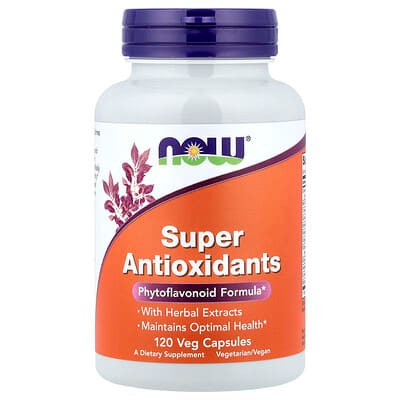
Super Antioxidants

NOW
4.7
★ ★ ★ ★ ★
(3968 ratings)
Rosemary
Hawthorn 30 mg
Bromelain 85 mg
Ginkgo
Ginger
Milk Thistle 100 mg
Turmeric 100 mg
Product Image
Score79
A broad, economical antioxidant blend with useful variety but mostly modest, poorly standardized botanicals. It suits general coverage better than any single targeted goal.
How scoring works
Quantity:120 Capsule(s) • (60 servings)
Goals:
Anti-Aging
Vision Support

Score 79

A broad, economical antioxidant blend with useful variety but mostly modest, poorly standardized botanicals. It suits general coverage better than any single targeted goal.
How scoring works
$21.50($0.35 per serving)
iHerb
$ 24.49
Pure Formulas
$ 24.18
Vitacost
$ 26.55
Daily Vita
$ 23.10
Amazon
$ 21.50
Report prices

Analysis

Green tea, turmeric, quercetin, milk thistle, grape seed, bilberry, and other botanicals provide broad antioxidant coverage. The formula is coherent for general oxidative-stress support but spreads its serving across many ingredients.

EGCG, curcuminoid strength, silymarin percentage, and several other active-marker yields are not disclosed. Ginkgo, ginger, hawthorn, bilberry, and bromelain are also below amounts used in more focused products.

Two capsules and a 60-serving supply make it practical for general use. It is not a strong vision formula because lutein, zeaxanthin, and meaningful bilberry amounts are absent.

Who is it for
  • Adults wanting broad botanical antioxidant coverage
  • People who prefer a multi-ingredient formula
  • Users not seeking a high dose of any one botanical
Best for
  • General antioxidant support
  • Broad botanical variety
  • Users prioritizing convenience over targeted potency

Pros

  • Covers several antioxidant pathways
  • Lists each botanical amount
  • Provides good serving continuity

Cons

  • Many active-marker percentages are missing
  • Several botanicals are lightly dosed
  • Lacks a strong vision-nutrient core

Warnings

  • Ginkgo may increase bleeding risk with anticoagulant or antiplatelet medicines; medication users need product-specific guidance.

Nutrient quality

73 High impact

A broad antioxidant blend uses several standardized botanical extracts. Several amounts are useful but not consistently strong.
Ingredient transparency

83 Highest impact

Active ingredients have stated amounts without a proprietary blend. Important standardization, activity, or form details remain missing.

Customer satisfaction

89 Highest impact

The aggregate rating is favorable and is supported by substantial review volume. No specific comments are supplied, so repeated complaints and purpose alignment cannot be confirmed directly.

Value for money

69 High impact

Value is reasonable for the effective doses and ingredient forms. Lightly dosed additions or premium pricing weaken competitiveness.

Report analysis

Goals

Anti-Aging
Impact
High effect
B- Goal FitC Strength of SupportB CoverageA- Formula Quality
Green Tea · 200 mg

Green tea catechins, turmeric curcuminoids, quercetin, grape seed, and bilberry provide a focused antioxidant and inflammation-related botanical profile. The formula addresses oxidative stress and inflammatory signaling without a long multivitamin base.

EGCG yield, caffeine content, curcuminoid standardization strength, and several extract potencies are incomplete. The doses are moderate and do not provide mitochondrial, structural, omega-3, or NAD-pathway coverage.

Study evidence
Green Tea Supportive 9 studies
Vision Support
Impact
Moderate effect
C Goal FitD- Strength of SupportC- CoverageD Formula Quality

Bilberry and ginkgo provide limited circulation and antioxidant relevance for the eye within a broader antioxidant blend. The product lacks lutein, zeaxanthin, DHA, and a clinically structured ocular nutrient core.

Both bilberry and ginkgo are below stronger targeted amounts, and standardization is incomplete. Ginkgo may increase bleeding risk with anticoagulant or antiplatelet medicines.

Study evidence
Ginkgo Supportive 11 studies

Ingredients

IngredientAmount per serving
Green Tea extract (Catechins)
200 mg
Milk Thistle extract (Silymarin)
100 mg
Turmeric root extract (Curcuminoids)
100 mg
Quercetin (Quercetin Dihydrate)
100 mg
Bromelain (Pineapple Extract)
85 mg
Rosemary
50 mg
Grape seed extract (Polyphenols)
30 mg
Ginkgo biloba extract (Ginkgoflavonglycosides)
30 mg
Ginger
30 mg
Hawthorn extract
30 mg
Cranberry powder
20 mg
Bilberry extract
20 mg
Gluten Free Adults 18–50 Vegan Dairy Free Vegetarian
Report overview
Rosemary · 50 mg OverallScore54
F Active Ingredient Quality & BioavailabilityC Dose, Safety & Label TransparencyB- Value

The whole-herb rosemary lacks extract, marker, and plant-part detail. The 50 mg whole-herb amount is meaningful, though it is not identified as an extract. The near-median serving cost provides reasonable value.

Hawthorn · 30 mg OverallScore39
F Active Ingredient Quality & BioavailabilityC- Dose, Safety & Label TransparencyD- Value
The hawthorn extract lacks an active-marker standard, named plant part, and botanical species. Its small amount is well below the range used for a focused hawthorn supplement. The moderate serving cost cannot offset the weak dose.
F Active Ingredient Quality & BioavailabilityF Dose, Safety & Label TransparencyF Value

85 mg offers only a modest amount within the broader formula. Missing enzyme activity units prevent a reliable judgment of true proteolytic potency. Standard delivery lacks acid protection for the systemic goal, and cost efficiency is poor.

Loading alternative details
Report alternatives

Sources

Published studies used for the product analysis and the top-ranked studies for each ingredient and goal.

  1. Green tea and coffee intake and risk of cognitive decline in older adults: the National Institute for Longevity Sciences, Longitudinal Study of Aging.
    Shirai Y; Kuriki K; Otsuka R; Kato Y; Nishita Y; Tange C; Tomida M; Imai T; Ando F; Shimokata H · Public health nutrition · 2021
    Cohort study1,305 participantsAnti-Aging forGreen Tea
  2. Associations of green tea, coffee, and soft drink consumption with longitudinal changes in leukocyte telomere length.
    Sohn I; Shin C; Baik I · Scientific reports · 2023
    Cohort study1,952 participantsAnti-Aging forGreen Tea
  3. Can teatime increase one's lifetime?
    Nakachi K; Eguchi H; Imai K · Ageing research reviews · 2003
    Cohort studyAnti-Aging forGreen Tea
  4. Influences of tea consumption on self-rated health and life satisfaction among older adults: Evidence from the CLHLS.
    Zou M; Sun C; Yang M; Li C; Wang S; Zheng D; Wang J; Yu L; Sun L; Wang Y; Chen H; Zeng Y · PsyCh journal · 2025
    Cohort study78,345 participantsAnti-Aging forGreen Tea
  5. Double-blinded, placebo-controlled trial of green tea extracts in the clinical and histologic appearance of photoaging skin.
    Chiu AE; Chan JL; Kern DG; Kohler S; Rehmus WE; Kimball AB · Dermatologic surgery : official publication for American Society for Dermatologic Surgery [et al.] · 2005
    Randomized trial40 participantsAnti-Aging forGreen Tea
  6. Effect of Ginkgo biloba extracts in the prevention of posterior capsule opacification after cataract surgery: A randomized clinical trial.
    Amiri AA; Jafari R; Amiri AA; Rad HA; Daneshvar F; Charati JY; Amiri AA · Oman journal of ophthalmology · 2025
    Randomized trial144 participantsVision Support forGinkgo
  7. Effect of Ginkgo biloba extract on preexisting visual field damage in normal tension glaucoma.
    Quaranta L; Bettelli S; Uva MG; Semeraro F; Turano R; Gandolfo E · Ophthalmology · 2003
    Randomized trial27 participantsVision Support forGinkgo
  8. [Ginkgo extract in impaired vision--treatment with special extract EGb 761 of impaired vision due to dry senile macular degeneration].
    Fies P; Dienel A · Wiener medizinische Wochenschrift (1946) · 2002
    Randomized trial99 participantsVision Support forGinkgo
  9. Short-term effects of Ginkgo biloba extract on peripapillary retinal blood flow in normal tension glaucoma.
    Park JW; Kwon HJ; Chung WS; Kim CY; Seong GJ · Korean journal of ophthalmology : KJO · 2012
    Randomized trial30 participantsVision Support forGinkgo
  10. [The course of color vision in early diabetic retinopathy treated with Ginkgo biloba extract. A preliminary double-blind versus placebo study].
    Lanthony P; Cosson JP · Journal francais d'ophtalmologie · 1989
    Randomized trial29 participantsVision Support forGinkgo