
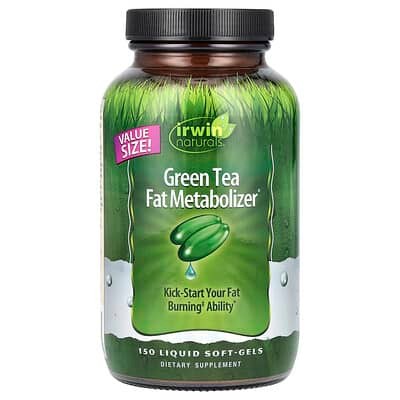

$44.99 $0.59 per serving


Product analysis
Green Tea Fat Metabolizer mainly offers short-term alertness from caffeine. Its weight-management appeal is less convincing because temporary increases in energy use do not establish lasting weight loss.
AI assessment of the formula, label and price. How scoring works
Nutrient Quality21
Most ingredient forms are unspecified, limiting comparisons of absorption and preparation quality. The omega-3 oil type is also unclear.
Ingredient Transparency64
Most amounts are stated, but one combined ingredient entry has no declared amount. Forms are largely unspecified, and part of the composition remains uncertain.
Value For Money40
Value cannot be established confidently for the main contributions. In particular, the omega-3 cost comparison lacks the information needed to relate price to EPA and DHA content.
Customer Satisfaction68
Customer feedback is generally positive across several hundred ratings. That gives a useful view of satisfaction without demonstrating weight loss or other health benefits.
Product Focus55
Short-term alertness is the clearest practical purpose. The many additional claimed uses extend beyond what can be expected reliably from the combination.
- Format
Softgel - Container
- 150 Liquid(s)
- Per serving
- $0.59
- Also available
 Green Tea Fat Metabolizer$24.99
- Customer rating
- 4.3 · 442 ratings
Goals

Impact
Moderate effect
Omega-3 · 255 mgGreen Tea · 400 mgCaffeine · 100 mg
Caffeine may temporarily increase the energy your body uses at rest. The effect is modest and short-lived, so it doesn’t imply lasting fat loss or a sustained rise in metabolic rate.
How this product is rated for Metabolism Support
Ingredient fit50
Caffeine may temporarily increase the energy your body uses at rest.
Goal fit
Caffeine may temporarily increase the energy your body uses at rest.
Dose adequacy
Omega-3 255 mg; Ginger 6 mg. These serving amounts don’t predict a particular change in energy use.
Pathways16
Caffeine’s stimulant action may temporarily raise resting energy use.
Depth
Caffeine’s stimulant action may temporarily raise resting energy use.
Breadth
The direct link is caffeine’s stimulant action; broader calorie-burning effects remain unclear.
Evidence66
Caffeine may temporarily increase the energy your body uses at rest.
Evidence strength
Caffeine may temporarily increase the energy your body uses at rest.
Studied preparation
Ingredient identity and preparation matter; a named form alone doesn’t imply greater calorie burning.
Formulation logic92
No particular conflict or missing ingredient partner is identified. Combining these ingredients doesn’t itself demonstrate extra calorie burning.
Partner coverage
No required ingredient partner is identified as missing.
Conflicts
No particular ingredient conflict is identified.
Effective doses
Amounts remain unresolved for Black pepper / piperine, Green Tea; a parent blend amount cannot supply their individual doses.

Impact
High effect
Green Tea · 400 mgCaffeine · 100 mg
Caffeine can temporarily increase energy expenditure, but this does not establish sustained weight loss and habitual tolerance limits the effect. Green tea retains a separately declared EGCG constituent, but mixed trial results limit expectations for lasting weight change. Chromium has shown only small average weight reductions in low-quality evidence, without reliable added benefit at higher amounts.
How this product is rated for Weight Loss
Ingredient fit59
Several declared amounts provide only partial coverage of the saved comparisons, limiting their attributed contribution.
Goal fit
The relevant ingredients form part of a broader formula with several other purposes, limiting its concentration on weight loss.
Dose adequacy
Several declared amounts provide only partial coverage of the saved comparisons, limiting their attributed contribution.
Pathways47
The strongest identified connection concerns heat production and energy use.
Depth
The strongest identified connection concerns heat production and energy use.
Breadth
The identified connections cover heat production and energy use.
Evidence76
Green Tea leads the saved evidence findings, while the supplied context limits what can be claimed for weight loss.
Evidence strength
Green Tea leads the saved evidence findings, while the supplied context limits what can be claimed for weight loss.
Studied preparation
The evaluated preparations meet the supplied preparation comparison; study population and outcome limitations still apply.
Formulation logic100
The evaluated ingredients have no unmet partner requirement in the supplied findings.
Partner coverage
The evaluated ingredients have no unmet partner requirement in the supplied findings.
Conflicts
No configured ingredient conflict was identified.
Effective doses
The evaluated ingredients meet the saved minimum amount comparison; this is not a proven threshold for weight-loss benefit.

Impact
High effect
Fish Oil · 851 mgCaffeine · 100 mg
Caffeine can increase alertness and reduce sleepiness. This is an acute stimulant effect, rather than more cellular fuel or treatment of persistent fatigue. The explicit 100 mg caffeine amount can be assessed independently of the botanical mass. Fish oil's amount does not establish its EPA+DHA content or routine fatigue relief, despite its inclusion in the saved findings.
How this product is rated for Energy
Ingredient fit50
Caffeine is the main relevant ingredient within a wider formula. The serving provides partial saved amount coverage; fish-oil mass does not establish an EPA+DHA dose.
Goal fit
Caffeine is the main relevant ingredient within a wider formula.
Dose adequacy
The serving provides partial saved amount coverage; fish-oil mass does not establish an EPA+DHA dose.
Pathways47
Central alertness is the strongest saved area, with limited breadth beyond it.
Depth
Central alertness is the strongest saved area; this is distinct from increasing cellular fuel.
Breadth
Only one energy area reaches the saved coverage comparison, limiting breadth.
Evidence100
Caffeine leads with direct acute alertness evidence. The included declarations matched the saved preparation comparison; this does not resolve fish oil's active fatty-acid content.
Evidence strength
Caffeine leads with direct acute alertness evidence.
Studied preparation
The included declarations matched the saved preparation comparison; this does not resolve fish oil's active fatty-acid content.
Formulation logic100
Included ingredients have no missing required partner or configured conflict and meet the saved minimum amount comparison.
Partner coverage
Included ingredients work without an additional required partner, or have their required partner; this does not establish an extra combination benefit.
Conflicts
No configured ingredient conflict was found in the supplied facts.
Effective doses
All included ingredients meet the saved minimum amount comparison; this is not a proven minimum effective dose.

Impact
High effect
Caffeine · 100 mg
Caffeine supports alertness and sustained attention by blocking adenosine signals that promote sleepiness. The contribution is mainly wakeful attention rather than broad cognitive enhancement.
How this product is rated for Mental Focus
Ingredient fit61
Caffeine is the main ingredient relevant to immediate focus. The declared amount reaches the saved amount range; this is not proof of a stronger effect at higher intake.
Goal fit
Caffeine is the main ingredient relevant to immediate focus.
Dose adequacy
The declared amount reaches the saved amount range; this is not proof of a stronger effect at higher intake.
Pathways60
Alertness is the strongest supported route.
Depth
Alertness is the strongest supported route.
Breadth
The contribution is concentrated in alertness rather than several distinct focus mechanisms.
Evidence79
Caffeine has direct acute adult attention evidence.
Evidence strength
Caffeine has direct acute adult attention evidence.
Studied preparation
The saved preparation match is complete for the ingredients that meet its amount criterion; this does not establish consistent focus benefit.
Formulation logic100
The represented ingredients have no missing required partner in the saved finding. No specified ingredient conflict was identified in the saved findings.
Partner coverage
The represented ingredients have no missing required partner in the saved finding.
Conflicts
No specified ingredient conflict was identified in the saved findings.
Effective doses
All ingredients counted by this rule reach its minimum amount criterion; that threshold is not a clinically proven effective dose.

Impact
High effect
Omega-3 · 255 mgGreen Tea · 400 mg
Green tea supplies antioxidant compounds, but dietary tea associations and EGCG mechanisms do not establish an anti-aging benefit from this extract. Its amount is not interchangeable with a measured EGCG dose.
How this product is rated for Longevity
Ingredient fit63
The formula covers broader nutritional or product purposes, so only part of its ingredient mix relates to the assessed aging roles. Amounts meet the saved criteria.
Goal fit
The formula covers broader nutritional or product purposes, so only part of its ingredient mix relates to the assessed aging roles.
Dose adequacy
Included amounts meet the saved amount criteria; a serving does not establish the daily exposure or duration used in research.
Pathways60
The main saved connection is antioxidant defence. Coverage is concentrated in one pathway rather than spread broadly.
Depth
The strongest saved connection is antioxidant defence; this describes an ingredient role rather than a demonstrated slowing of aging.
Breadth
Only one assessed pathway met the saved coverage requirement, so the findings do not indicate broad coverage of aging-related functions.
Evidence82
Green Tea supplies the strongest included evidence in the saved findings; the supplied scientific context limits transfer to routine anti-aging use.
Evidence strength
Green Tea supplies the strongest included evidence in the saved findings; the supplied scientific context limits transfer to routine anti-aging use.
Studied preparation
The saved findings recognize the included preparations as studied; this does not establish benefit for the finished product.
Formulation logic100
No required ingredient partner was missing in the saved findings; this does not establish a combined anti-aging benefit. No configured ingredient conflict was identified in the supplied findings.
Partner coverage
No required ingredient partner was missing in the saved findings; this does not establish a combined anti-aging benefit.
Conflicts
No configured ingredient conflict was identified in the supplied findings.
Effective doses
All counted ingredients meet the saved minimum amount criterion; this is not a proven minimum effective anti-aging dose.

Impact
High effect
Green Tea · 400 mgOmega-3 · 255 mg
Green tea has mixed oral findings for ultraviolet skin responses, and generic extract weight does not establish the catechin exposure studied. Omega-3 research also concerns a specific purified EPA preparation rather than generic fish oil. The saved result gave partial amount recognition and concentrated its findings on antioxidant defence. These findings do not demonstrate protection from sunlight or broad benefits for skin hydration and barrier function.
How this product is rated for Skin Health
Ingredient fit52
Green tea and omega-3 supply the relevant ingredients within a broader formulation.
Goal fit
Green tea and omega-3 supply the relevant ingredients within a broader formulation.
Dose adequacy
The green tea and omega-3 amounts received partial recognition overall.
Pathways52
Only antioxidant defence reached the saved coverage criterion.
Depth
Only antioxidant defence reached the saved coverage criterion.
Breadth
Only antioxidant defence reached the saved coverage criterion.
Evidence89
Green tea drove the saved evidence finding, but oral ultraviolet-response results remain mixed.
Evidence strength
Green tea drove the saved evidence finding, but oral ultraviolet-response results remain mixed.
Studied preparation
The saved result recognized the qualifying preparations; this does not establish exact clinical equivalence or a form-specific skin advantage.
Formulation logic100
No required partner was missing and no listed conflict was matched. The contributing ingredients met the saved minimum amount criterion.
Partner coverage
No contributing ingredient lacked a required partner; this does not establish extra benefit from combining ingredients.
Conflicts
No listed ingredient conflict was matched in the saved result.
Effective doses
The contributing ingredients met the saved minimum amount criterion; this is not proof of a clinically effective skin dose.
Ingredients
| Ingredient | Amount per serving | Score |
|---|---|---|
Calories | 15 Calorie(s) | |
Total Fat | 1 Gram(s) | |
Cholesterol | 5 mg | |
Total Carbohydrates | 1 Gram(s) | |
Protein | 1 Gram(s) | |
Chromium (Chromium Picolinate) | 125 mcg | |
Fish Oil | 851 mg | |
Omega-3 Fatty Acids | 255 mg | |
Green Tea leaf extract | 400 mg | |
EGCG | 200 mg | |
Caffeine (Green Coffee) | 100 mg | |
BioPerine Complex | 6 mg | |
BioPerine (Black Pepper Fruit Extract) | 0 NP | |
Ginger Rhizome Extract (Gingerols) | 6 mg |
Green Tea · 400 mg OverallScore66
Each serving provides 400 mg of green tea extract with 50% EGCG. The saved facts record 100 mg caffeine but do not establish the whole product’s total caffeine.
How this ingredient is rated
Composition and Label Disclosure100
The 400 mg of green tea extract is listed with 50% EGCG.
Declared Green Tea Marker Concentration
The green tea extract is listed with 50% EGCG; the saved calculation gives 200 mg EGCG per serving.
Composition and Label Disclosure40
The saved facts record 100 mg caffeine; they do not establish the whole product’s total caffeine.
Whole-Product Caffeine Disclosure
The saved facts record 100 mg caffeine; they do not establish the whole product’s total caffeine.
Commercial Price and Usability50
The whole-product price works out to about $0.60 per 200 mg EGCG.
Cost per 200 mg Declared EGCG
Based on the recorded EGCG amount, the whole-product price is about $0.60 per 200 mg EGCG.
Caffeine (Green Coffee) · 100 mg OverallScore68
A serving provides 100 mg of caffeine, a moderate amount. The whole-product price is about $0.60 per serving.
How this ingredient is rated
Active Ingredient Quality & Bioavailability40
The stored caffeine form is unresolved, so the specific source form cannot be assessed.
Advanced Bioavailability and Release Profiles
The evaluation identifies caffeine, but the specific form is unresolved in the stored form data.
Dose, Safety & Label Transparency100
The recorded caffeine amount is 100 mg per serving; no listed secondary stimulants were found in the evaluated panel.
Caffeine Dose Transparency
The recorded caffeine amount is 100 mg per serving.
Dosage Efficacy and Safety Margin
The serving provides 100 mg of caffeine, a moderate amount.
Secondary Stimulant Disclosure and Risk
No listed secondary stimulants were identified in the evaluated ingredient panel.
Value60
The whole-product price is about $0.60 per serving, midrange in the comparison.
Price Per Serving vs. Collection Median
At about $0.60 per whole-product serving, the price is midrange in the comparison.
Chromium (Chromium Picolinate) · 125 mcg OverallScore47
Each serving provides 125 mcg of chromium as chromium picolinate. A whole-product serving costs about $0.60.
How this ingredient is rated
Active Ingredient Quality & Bioavailability70
Chromium comes from chromium picolinate, an organic form favored in the evaluation. The saved facts do not identify a branded chromium source.
Chromium Chemical Form
Chromium picolinate is an organic chromium form favored in the evaluation.
Branded & Trademarked Sources
The saved facts do not identify a branded chromium source.
Dose, Safety & Label Transparency43
A serving provides 125 mcg of chromium; the saved facts do not include a separate weight for the chromium compound.
Elemental Chromium Dosage
Each serving provides 125 mcg of chromium.
Label Transparency & Disclosure
The chromium amount is known, but the saved facts do not give a separate weight for its compound.
Value10
The whole-product serving costs about $0.60 and supplies 125 mcg of chromium.
Price per 200 mcg Chromium
At the whole-product serving price, 200 mcg of chromium works out to about $0.96.
Alternative products
Report alternatives
Sources
Published studies used for the product analysis and the top-ranked studies for each ingredient and goal.
- Safety and efficacy of cognitive training plus epigallocatechin-3-gallate in young adults with Down's syndrome (TESDAD): a double-blind, randomised, placebo-controlled, phase 2 trial.
- Association between tea consumption and risk of cognitive disorders: A dose-response meta-analysis of observational studies.
- Investigating the Impact of Tea Consumption on Cognitive Function and Exploring Tea-Genetic Interactions in Older Adults Aged 65-105 Years: Findings from the 2002-2018 CLHLS Data.
- Consumption of green tea, but not black tea or coffee, is associated with reduced risk of cognitive decline.
- Green Tea Consumption and the Risk of Incident Dementia in Elderly Japanese: The Ohsaki Cohort 2006 Study.
- Cognitive and mood improvements of caffeine in habitual consumers and habitual non-consumers of caffeine.
- Caffeine-containing energy drink improves physical performance of elite rugby players during a simulated match.
- Differential cognitive effects of energy drink ingredients: caffeine, taurine, and glucose.
- Does Single or Combined Caffeine and Taurine Supplementation Improve Athletic and Cognitive Performance without Affecting Fatigue Level in Elite Boxers? A Double-Blind, Placebo-Controlled Study.
- Trait Energy and Fatigue Modify the Effects of Caffeine on Mood, Cognitive and Fine-Motor Task Performance: A Post-Hoc Study.
- Omega-3 Fatty Acid Supplementation for 12 Weeks Increases Resting and Exercise Metabolic Rate in Healthy Community-Dwelling Older Females.
- Effects of fish oil during hemodialysis on nutritional status and quality of life: a randomized double-blinded trial.
- Supplementation of fish oil and olive oil in patients with rheumatoid arthritis.
- DHA-rich Fish Oil Increases the Omega-3 Index and Lowers the Oxygen Cost of Physiologically Stressful Cycling in Trained Individuals.
- Fish oil reduces heart rate and oxygen consumption during exercise.
- Effect of caffeine ingestion on cycling performance: a systematic review and meta-analysis.
- Effects of Caffeine Intake on Endurance Running Performance and Time to Exhaustion: A Systematic Review and Meta-Analysis.
- Acute Effects of Caffeine Supplementation on Movement Velocity in Resistance Exercise: A Systematic Review and Meta-analysis.
- Sex Differences in the Ergogenic Response of Acute Caffeine Intake on Muscular Strength, Power and Endurance Performance in Resistance-Trained Individuals: A Randomized Controlled Trial.
- Can I Have My Coffee and Drink It? A Systematic Review and Meta-analysis to Determine Whether Habitual Caffeine Consumption Affects the Ergogenic Effect of Caffeine.