
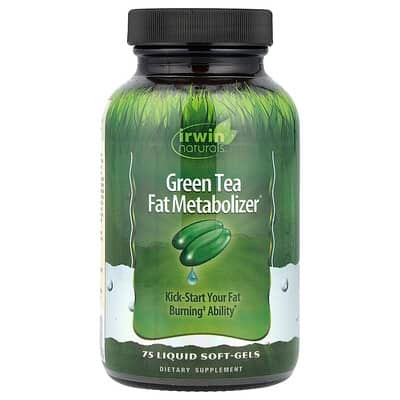

$24.99 $0.67 per serving


Product analysis
Green Tea Fat Metabolizer may briefly increase alertness and calorie use, while sustained weight-loss results are mixed. Combining caffeine with bitter orange adds effects on heart rate and blood pressure.
AI assessment of the formula, label and price. How scoring works
Nutrient Quality21
The caffeine form is unspecified, while another ingredient cannot be clearly identified. How readily the body can use the complete preparation therefore remains uncertain.
Ingredient Transparency61
The caffeine amount is stated, but most individual forms are unspecified. One further amount and part of the mixture breakdown cannot be established, limiting a complete comparison of the preparation.
Value For Money51
Caffeine offers moderate value for the serving cost. Value for the remaining ingredients cannot be judged confidently.
Customer Satisfaction68
Customers are generally satisfied with their purchases. Several hundred ratings offer a useful view of satisfaction, without showing whether the supplement works.
Product Focus59
Caffeine provides the clearest short-term alertness and energy-use effects, with sustained weight-loss benefits uncertain. Bitter-orange synephrine adds effects on heart rate and blood pressure, making the combination a meaningful suitability concern.
- Format
Softgel - Container
- 75 Softgel(s)
- Per serving
- $0.67
- Also available
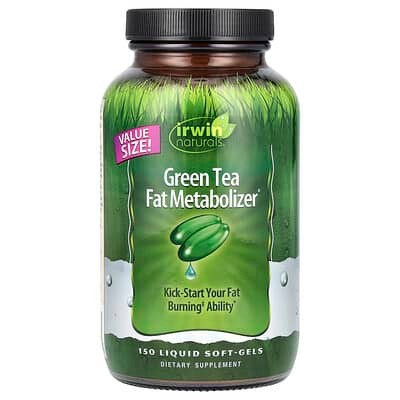 Green Tea Fat Metabolizer$44.99
- Customer rating
- 4.3 · 443 ratings
Goals

Impact
High effect
Green Tea · 400 mgCaffeine · 100 mg


Impact
High effect
Green Tea · 400 mg

Impact
Moderate effect
Caffeine · 100 mg


Ingredients
| Ingredient | Amount per serving | Score |
|---|---|---|
Calories | 15 Calorie(s) | |
Total Fat | 1 Gram(s) | |
Cholesterol | 5 mg | |
Total Carbohydrates | 1 Gram(s) | |
Protein | 1 Gram(s) | |
Chromium (Chromium Picolinate) | 125 mcg | |
Fish Oil (Omega-3 Fatty Acids) | 851 mg | |
Green Tea extract (EGCG) | 400 mg | |
Fat Metabolizer Blend | 300 mg | |
Advantra Z Bitter Orange extract (Synephrine) | 0 NP | |
natural Caffeine | 0 NP | |
Caffeine | 100 mg | |
Bioperine Complex (Herb/Botanical) | 6 mg | |
Bioperine Black Pepper extract (Piperine) | 0 NP | |
Ginger extract (Gingerols) | 0 NP |
Caffeine · 0 NP OverallScore64
Each serving provides 100 mg of caffeine per serving at a moderate cost per serving. Other stimulants are also present, with amounts unclear. The caffeine source is unclear.
How this ingredient is rated
Active Ingredient Quality & Bioavailability40
The caffeine source and release details are unclear in the available information.
Advanced Bioavailability and Release Profiles
The caffeine source and release details are unclear in the available information.
Dose, Safety & Label Transparency90
The serving declares 100 mg of caffeine. Other stimulants are present; their amounts are unclear.
Caffeine Dose Transparency
The total caffeine amount is stated as 100 mg per serving.
Dosage Efficacy and Safety Margin
Each serving provides 100 mg of caffeine.
Secondary Stimulant Disclosure and Risk
Other stimulants are present; their amounts are unclear.
Value60
The cost per serving is moderate.
Price Per Serving vs. Collection Median
The cost per serving is moderate.
Green Tea (EGCG) · 400 mg OverallScore61
The selected serving provides 400 mg of green tea extract. The green tea extract declares 50% EGCG. The estimated whole-product cost per 200 mg of calculated EGCG is high. A caffeine amount of 100 mg is recorded, but the whole-product total is not established.
How this ingredient is rated
Composition and Label Disclosure100
The green tea extract declares 50% EGCG.
Declared Green Tea Marker Concentration
The green tea extract declares 50% EGCG.
Composition and Label Disclosure40
A caffeine amount of 100 mg is recorded, but the whole-product total is not established.
Whole-Product Caffeine Disclosure
A caffeine amount of 100 mg is recorded, but the whole-product total is not established.
Commercial Price and Usability25
The estimated whole-product cost per 200 mg of calculated EGCG is high.
Cost per 200 mg Declared EGCG
The estimated whole-product cost per 200 mg of calculated EGCG is high.
Chromium (Chromium Picolinate) · 125 mcg OverallScore47
The serving provides 125 mcg chromium. The estimated cost for a given amount of chromium is high. It uses Chromium Picolinate. The chromium amount is given, but the source compound weight is not separately stated.
How this ingredient is rated
Active Ingredient Quality & Bioavailability70
It uses Chromium Picolinate. No recognized branded chromium source is specified.
Chromium Chemical Form
It uses Chromium Picolinate.
Branded & Trademarked Sources
No recognized branded chromium source is specified.
Dose, Safety & Label Transparency43
The serving provides 125 mcg chromium. The chromium amount is given, but the source compound weight is not separately stated.
Elemental Chromium Dosage
The serving provides 125 mcg chromium.
Label Transparency & Disclosure
The chromium amount is given, but the source compound weight is not separately stated.
Value10
The estimated cost for a given amount of chromium is high.
Price per 200 mcg Chromium
The estimated cost for a given amount of chromium is high.
Alternative products
Report alternatives
Sources
Published studies used for the product analysis and the top-ranked studies for each ingredient and goal.
- Marine Omega-3 Supplementation and Cardiovascular Disease: An Updated Meta-Analysis of 13 Randomized Controlled Trials Involving 127 477 Participants.
- Impact of omega-3 fatty acids on hypertriglyceridemia, lipidomics, and gut microbiome in patients with type 2 diabetes.
- A systematic review of fish-oil supplements for the prevention and treatment of hypertension.
- Effects of fish oil-derived fatty acids on suboptimal cardiovascular health: A multicenter, randomized, double-blind, placebo-controlled trial.
- Effect of High-Dose Marine Omega-3 Fatty Acids on Atherosclerosis: A Systematic Review and Meta-Analysis of Randomized Clinical Trials.
- A green tea extract high in catechins reduces body fat and cardiovascular risks in humans.
- The effects of green tea supplementation on cardiovascular risk factors: A systematic review and meta-analysis.
- Effect of Green Tea on Blood Pressure in Healthy Individuals: A Meta-Analysis.
- Effects of green tea on lipid profile in overweight and obese women.
- Green tea consumption and risk of cardiovascular and ischemic related diseases: A meta-analysis.
- Safety and efficacy of cognitive training plus epigallocatechin-3-gallate in young adults with Down's syndrome (TESDAD): a double-blind, randomised, placebo-controlled, phase 2 trial.
- Association between tea consumption and risk of cognitive disorders: A dose-response meta-analysis of observational studies.
- Investigating the Impact of Tea Consumption on Cognitive Function and Exploring Tea-Genetic Interactions in Older Adults Aged 65-105 Years: Findings from the 2002-2018 CLHLS Data.
- Consumption of green tea, but not black tea or coffee, is associated with reduced risk of cognitive decline.
- Green Tea Consumption and the Risk of Incident Dementia in Elderly Japanese: The Ohsaki Cohort 2006 Study.
- Cognitive and mood improvements of caffeine in habitual consumers and habitual non-consumers of caffeine.
- Caffeine-containing energy drink improves physical performance of elite rugby players during a simulated match.
- Differential cognitive effects of energy drink ingredients: caffeine, taurine, and glucose.
- Does Single or Combined Caffeine and Taurine Supplementation Improve Athletic and Cognitive Performance without Affecting Fatigue Level in Elite Boxers? A Double-Blind, Placebo-Controlled Study.
- Trait Energy and Fatigue Modify the Effects of Caffeine on Mood, Cognitive and Fine-Motor Task Performance: A Post-Hoc Study.