
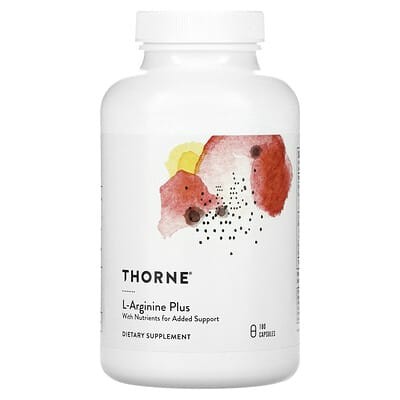

$75.00 $1.25 per serving


Product analysis
L-Arginine Plus combines several nutrients and plant ingredients, but their possible benefits do not establish a longer lifespan. Missing forms for some ingredients make meaningful comparisons harder, and the resveratrol content is costly relative to the amount provided.
AI assessment of the formula, label and price. How scoring works
Nutrient Quality30
Ingredient-form quality remains uncertain across much of the blend. Several preparations are named, but folate, arginine and resveratrol forms are omitted.
Ingredient Transparency81
All ingredient amounts are disclosed, allowing serving comparisons. Only half the ingredient forms are named, leaving several preparations harder to compare.
Value For Money35
Resveratrol is expensive relative to the amount included. Value for the other ingredients cannot be established confidently, so the blend is hard to compare as a whole.
Customer Satisfaction80
Buyer feedback is strongly positive across several hundred ratings. Those ratings describe satisfaction rather than evidence for longevity benefits.
Product Focus76
The formula combines several ingredients around a longevity purpose. Their nutritional and antioxidant roles do not establish longer life or a clear added benefit from the combination.
- Format
Capsule - Container
- 180 Capsule(s)
- Per serving
- $1.25
- Customer rating
- 4.8 · 571 ratings
Goals

Impact
High effect
Folate · 920 mcg DFEGreen Tea · 200 mg
Trans-resveratrol has mixed human evidence for cognitive performance and cerebral blood-flow measures in older adults, including a positive trial in postmenopausal women. The 50 mg per serving is below that trial’s 150 mg daily exposure. Vitamin C supports collagen formation when intake is insufficient, while green-tea extract’s antioxidant connections and folate’s nutritional roles do not establish routine longevity benefits. The saved findings use one serving despite repeated-use directions.
How this product is rated for Longevity
Ingredient fit81
The formula’s relevant ingredients and their declared amounts provide a mixed fit to the bounded aging-related outcomes. Amounts are compared per serving, without assuming daily use.
Goal fit
Relevant ingredients share the formula with other actives, so its focus extends beyond the aging-related outcomes considered here.
Dose adequacy
The declared amounts provide partial coverage of the saved amount comparison; this does not establish a proven effective daily regimen.
Pathways40
Antioxidant-related contributions are strongest here, though biochemical antioxidant roles do not themselves establish slower aging. The finding is concentrated in a single functional area.
Depth
Antioxidant-related contributions are strongest here, though biochemical antioxidant roles do not themselves establish slower aging.
Breadth
The saved finding is concentrated in one area rather than spanning several distinct aging-related functions.
Evidence82
Green Tea leads this finding, but antioxidant mechanisms do not establish routine human longevity benefits.
Evidence strength
Green Tea leads this finding, but antioxidant mechanisms do not establish routine human longevity benefits.
Studied preparation
The qualifying declarations meet the saved preparation check; this does not expand their benefits beyond the supplied human findings.
Formulation logic100
The included ingredients have no missing required partners or configured conflicts. Their amounts pass the saved threshold, without establishing synergy or a clinical benefit.
Partner coverage
No required ingredient partner is missing among the ingredients considered; this does not establish an extra benefit from combining them.
Conflicts
No configured ingredient conflict was identified in the supplied findings; this is not a general product-safety determination.
Effective doses
All included ingredients meet the saved amount threshold, which is a comparison convention rather than proof of clinical effectiveness.
Ingredients
| Ingredient | Amount per serving | Score |
|---|---|---|
Vitamin C (Ascorbic Acid) | 300 mg | |
Folate | 920 mcg DFE | |
L-Arginine | 1 Gram(s) | |
Greenselect (Green Tea Phytosome) | 200 mg | |
R-Lipoic Acid (Sodium R-Lipoic Acid) | 50 mg | |
Trans-Resveratrol | 50 mg |
Resveratrol · 50 mg OverallScore73
A serving lists 50 mg of trans-resveratrol. At the whole-product serving price, the cost is about $6.25 per 250 mg of trans-resveratrol.
How this ingredient is rated
Composition and Label Disclosure77
Trans-resveratrol is identified. The saved information does not give a trans-resveratrol concentration.
Explicit Label Detail
Trans-resveratrol is explicitly identified in the saved information.
Trans-Resveratrol Concentration Disclosure
The saved information does not give a trans-resveratrol concentration.
Composition and Label Disclosure100
A serving lists 50 mg of trans-resveratrol.
Resveratrol Amount Disclosure
A serving lists 50 mg of trans-resveratrol.
Commercial Price and Usability10
At the whole-product serving price, the cost is about $6.25 per 250 mg of trans-resveratrol.
Cost per 250 mg Declared Trans-Resveratrol
At the whole-product serving price, the cost is about $6.25 per 250 mg of trans-resveratrol.
Green Tea (Green Tea Phytosome) · 200 mg OverallScore8
A serving contains 200 mg of green tea phytosome, but its EGCG content is not available in the saved facts. That prevents a cost comparison based on EGCG.
How this ingredient is rated
Composition and Label Disclosure20
A green tea preparation is identified, but its marker concentration is unavailable.
Declared Green Tea Marker Concentration
The serving contains 200 mg of green tea phytosome; no marker concentration is recorded.
Composition and Label Disclosure0
Whole-product caffeine information is not available in the saved facts.
Whole-Product Caffeine Disclosure
The saved facts do not disclose a whole-product caffeine amount or a caffeine-free claim.
Commercial Price and Usability0
An EGCG-based price comparison is unavailable because the EGCG amount is unknown.
Cost per 200 mg Declared EGCG
The EGCG amount is unavailable, so its cost cannot be compared. That does not mean the product contains no EGCG.
Alternative products
Report alternatives
Sources
Published studies used for the product analysis and the top-ranked studies for each ingredient and goal.
- One-carbon metabolism-related compounds are associated with epigenetic aging biomarkers: results from the cross-sectional National Health and Nutrition Examination Survey 1999-2002.
- Longitudinal associations of one-carbon metabolism biomarkers with biological and epigenetic aging in older adults in India.
- Associations between leukocyte telomere length and three measures of folate status: a cross-sectional analysis of NHANES 1999-2002.
- Homocysteine versus the vitamins folate, B6, and B12 as predictors of cognitive function and decline in older high-functioning adults: MacArthur Studies of Successful Aging.
- Blood folate is associated with asymptomatic or partially symptomatic Alzheimer's disease in the Nun study.
- Green tea and coffee intake and risk of cognitive decline in older adults: the National Institute for Longevity Sciences, Longitudinal Study of Aging.
- Associations of green tea, coffee, and soft drink consumption with longitudinal changes in leukocyte telomere length.
- Can teatime increase one's lifetime?
- Influences of tea consumption on self-rated health and life satisfaction among older adults: Evidence from the CLHLS.
- Double-blinded, placebo-controlled trial of green tea extracts in the clinical and histologic appearance of photoaging skin.
- Effects of resveratrol on memory performance, hippocampal functional connectivity, and glucose metabolism in healthy older adults.
- Effects of resveratrol on memory performance, hippocampus connectivity and microstructure in older adults - A randomized controlled trial.
- Resveratrol levels and all-cause mortality in older community-dwelling adults.
- Impact of Resveratrol Supplementation on Human Sirtuin 1: A Grading of Recommendations Assessment, Development and Evaluation-Assessed Systematic Review and Dose-Response Meta-Analysis of Randomized Controlled Trials.
- Trans-resveratrol reduces visible signs of skin ageing in healthy adult females over 40: an 8-week randomized placebo-controlled trial.
- Study on the Multiple Efficacies of Vitamin C Serum in Anti-Glycation, Anti-Carbonylation, Antioxidation, and Anti-Inflammation of Human Skin Based on In Vivo Tests.
- Evaluation of the anti-wrinkle effect of a lipophilic pro-vitamin C derivative, tetra-isopalmitoyl ascorbic acid.
- The role of vitamin C in pushing back the boundaries of skin aging: an ultrasonographic approach.
- In vivo evaluation of topical ascorbic acid application on skin aging by 50 MHz ultrasound.
- Clinical Applications of Vitamin C in Dermatology: A Systematic Review.