
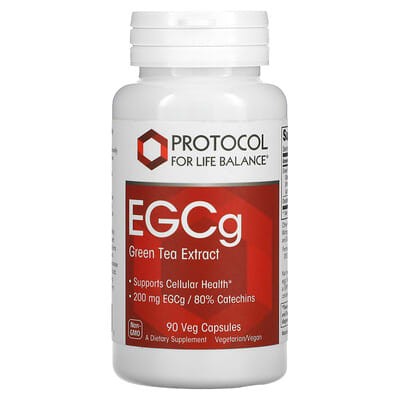
EGCg Green Tea Extract

Goals
$17.00 $0.18 per serving


Product analysis
EGCg Green Tea Extract supplies green tea compounds involved in antioxidant processes, with clear composition details that help you compare extracts.
AI assessment of the formula, label and price. How scoring works
Nutrient Quality40
The named tea compounds make the preparation identifiable, but there is too little information to compare quality confidently. Clear composition does not by itself establish a quality advantage.
Ingredient Transparency100
Amounts, forms and composition are disclosed. That makes checking the extract’s individual components straightforward.
Value For Money40
There is not enough information to judge value confidently. An unresolved cost comparison should not be interpreted as evidence of a high or low price.
Customer Satisfaction82
Customer feedback is very positive across a substantial number of ratings. Those ratings describe satisfaction without establishing skin or cognitive benefits.
Product Focus55
A single tea extract underlies several antioxidant-related aims. Mixed findings and uncertain transfer from particular preparations limit expectations for everyday skin, aging or cognitive benefits.
- Format
Capsule - Container
- 90 Capsule(s)
- Per serving
- $0.18
- Customer rating
- 4.7 · 1,089 ratings
Goals

Impact
Highest effect
Green Tea · 50 mg
Green tea compounds relate to antioxidant processes, but tea-drinking associations and EGCG mechanisms do not establish slower aging from this material; powder, extract and active EGCG amounts are not interchangeable.
How this product is rated for Longevity
Ingredient fit94
The ingredient focus and declared amounts provide a close match to the saved references. The relevant roles remain limited to the specific outcomes described above.
Goal fit
The relevant ingredients are concentrated on this goal; their links to other uses also affect the saved focus finding.
Dose adequacy
The recognized amounts closely match the saved references, without establishing greater benefit above nutritional adequacy.
Pathways60
The strongest saved finding concerns antioxidant defence. The recognized breadth is limited across the other aging-related processes.
Depth
The strongest saved contribution concerns antioxidant defence, describing ingredient roles rather than proven slowing of aging.
Breadth
Only one pathway reaches the saved coverage threshold, leaving the recognized reach narrow.
Evidence82
Green Tea leads the saved evidence finding. The population, outcome and preparation limits described above still apply.
Evidence strength
Green Tea supplies the leading saved evidence finding, subject to its specific population and outcome limitations.
Studied preparation
The saved findings recognize preparation matches for qualifying ingredients, without extending the evidence to broader aging outcomes.
Formulation logic100
The recognized ingredients have their required partners or work independently, and no matched conflict was recorded. Amount limitations remain relevant.
Partner coverage
The recognized ingredients work independently or have their required partner; no extra combination benefit is established.
Conflicts
No matched ingredient conflict was recorded in the supplied calculation.
Effective doses
All recognized ingredients meet the saved amount threshold, a calculation reference rather than proof of anti-aging benefit.

Impact
Situational effect
Green Tea · 50 mg

Impact
Highest effect
Green Tea · 50 mg
Green tea is connected to research on skin responses to UV exposure, but oral findings are mixed. This product retains extract amounts separately from its declared constituents, so constituent rows are not added as extra extract. The saved findings recognize antioxidant coverage, without establishing equivalence to a tested regimen or broad improvements in hydration and structure.
How this product is rated for Skin Health
Ingredient fit90
Green tea provides a focused connection to the evaluated skin roles. Green tea receives substantial amount consideration, with constituent declarations kept separate from extract mass.
Goal fit
Green tea provides a focused connection to the evaluated skin roles.
Dose adequacy
Green tea receives substantial amount consideration, with constituent declarations kept separate from extract mass.
Pathways56
UV antioxidant defence is the only covered area; hydration, barrier and structure are not covered.
Depth
UV antioxidant defence is the only covered area; hydration, barrier and structure are not covered.
Breadth
Only UV antioxidant defence reaches the breadth threshold.
Evidence89
Green tea leads the evidence finding; mixed oral results limit expectations.
Evidence strength
Green tea leads the evidence finding; mixed oral results limit expectations.
Studied preparation
The saved finding accepts green tea preparation, without establishing a matched catechin regimen.
Formulation logic100
No unmet partner requirement or matched conflict is recorded. All credited ingredients pass the saved minimum amount threshold; this does not prove clinical effectiveness.
Partner coverage
Each credited ingredient can stand alone or has its required partner; no extra combined benefit is established.
Conflicts
No matched formulation conflict is recorded in the supplied findings.
Effective doses
All credited ingredients pass the saved minimum amount threshold; this does not prove clinical effectiveness.

Impact
Limited evidence
Green Tea · 50 mg

Impact
Highest effect
Green Tea · 50 mg
Green tea supplies plant compounds associated with antioxidant activity, but that alone does not show better cognitive performance. Its extract amount cannot establish the amount of L-theanine or caffeine. Caffeine presence remains unresolved because the supplied source declarations and imported inventory do not agree, so an alertness contribution cannot be established. The saved green-tea finding should therefore not be read as proof of improved memory or attention.
How this product is rated for Cognitive Support
Ingredient fit90
Green tea is the sole counted ingredient; caffeine remains unresolved. Green tea receives substantial exposure recognition; no caffeine amount can be established.
Goal fit
Green tea is the sole counted ingredient; caffeine remains unresolved.
Dose adequacy
Green tea receives substantial exposure recognition; no caffeine amount can be established.
Pathways55
Oxidative and inflammatory protection is represented; alertness is unresolved.
Depth
Oxidative and inflammatory protection is represented; alertness is unresolved.
Breadth
One pathway reaches the saved coverage threshold, leaving other cognitive routes unrepresented.
Evidence81
Green tea receives a saved preparation match, but extract mass does not establish cognitive benefit.
Evidence strength
Green tea receives a saved preparation match, but extract mass does not establish cognitive benefit.
Studied preparation
The counted ingredients receive a saved preparation match; this alone does not demonstrate improved cognition.
Formulation logic100
The counted ingredients meet the saved minimum exposure threshold, with no missing required partner or configured conflict.
Partner coverage
The counted ingredients have no missing required partner; this does not establish an added benefit from combining them.
Conflicts
No configured ingredient conflict was identified; this is not a general safety assessment.
Effective doses
All counted ingredients meet the saved minimum exposure threshold; this does not establish clinically effective cognitive doses.
Ingredients
| Ingredient | Amount per serving | Score |
|---|---|---|
Green Tea Leaf Extract (Camellia sinensis, Catechins, Epigallocatechin Gallate) | 400 mg | |
Green Tea, Decaffeinated | 50 mg |
A serving records 400 mg of green tea with 50% EGCG, plus 50 mg in an unspecified green tea form. The saved facts also record 4 mg caffeine but do not establish the whole product’s total caffeine.
How this ingredient is rated
Composition and Label Disclosure89
The 400 mg green tea component is listed with 50% EGCG; another 50 mg is in an unspecified form.
Declared Green Tea Marker Concentration
The 400 mg component lists 50% EGCG, while the separate 50 mg component has no specified preparation or marker in the saved facts.
Composition and Label Disclosure40
The saved facts record 4 mg caffeine and describe the tea as decaffeinated; they do not establish the whole product’s total caffeine.
Whole-Product Caffeine Disclosure
The saved facts record 4 mg caffeine and describe the tea as decaffeinated; they do not establish the whole product’s total caffeine.
Commercial Price and Usability75
The whole-product price works out to about $0.19 per 200 mg EGCG.
Cost per 200 mg Declared EGCG
Based on the recorded EGCG amount, the whole-product price is about $0.19 per 200 mg EGCG.
Alternative products
Report alternatives
Sources
Published studies used for the product analysis and the top-ranked studies for each ingredient and goal.
- Safety and efficacy of cognitive training plus epigallocatechin-3-gallate in young adults with Down's syndrome (TESDAD): a double-blind, randomised, placebo-controlled, phase 2 trial.
- Association between tea consumption and risk of cognitive disorders: A dose-response meta-analysis of observational studies.
- Investigating the Impact of Tea Consumption on Cognitive Function and Exploring Tea-Genetic Interactions in Older Adults Aged 65-105 Years: Findings from the 2002-2018 CLHLS Data.
- Consumption of green tea, but not black tea or coffee, is associated with reduced risk of cognitive decline.
- Green Tea Consumption and the Risk of Incident Dementia in Elderly Japanese: The Ohsaki Cohort 2006 Study.
- The effects of green tea on acne vulgaris: A systematic review and meta-analysis of randomized clinical trials.
- Green Tea Catechin Association with Ultraviolet Radiation-Induced Erythema: A Systematic Review and Meta-Analysis.
- Efficacy of (-)-epigallocatechin gallate delivered by a new-type scaler tip during scaling and root planing on chronic periodontitis: a split-mouth, randomized clinical trial.
- Camellia Sinensis Mouthwashes in Oral Care: a Systematic Review.
- Skin photoprotection by green tea: antioxidant and immunomodulatory effects.
- Green tea and coffee intake and risk of cognitive decline in older adults: the National Institute for Longevity Sciences, Longitudinal Study of Aging.
- Associations of green tea, coffee, and soft drink consumption with longitudinal changes in leukocyte telomere length.
- Can teatime increase one's lifetime?
- Influences of tea consumption on self-rated health and life satisfaction among older adults: Evidence from the CLHLS.
- Double-blinded, placebo-controlled trial of green tea extracts in the clinical and histologic appearance of photoaging skin.
- Effect of green tea on glucose control and insulin sensitivity: a meta-analysis of 17 randomized controlled trials.
- Green tea extract ingestion, fat oxidation, and glucose tolerance in healthy humans.
- Efficacy of a green tea extract rich in catechin polyphenols and caffeine in increasing 24-h energy expenditure and fat oxidation in humans.
- A 60-Day Green Tea Extract Supplementation Counteracts the Dysfunction of Adipose Tissue in Overweight Post-Menopausal and Class I Obese Women.
- Epigallocatechin gallate alleviates non-alcoholic fatty liver disease through the inhibition of the expression and activity of Dipeptide kinase 4.