
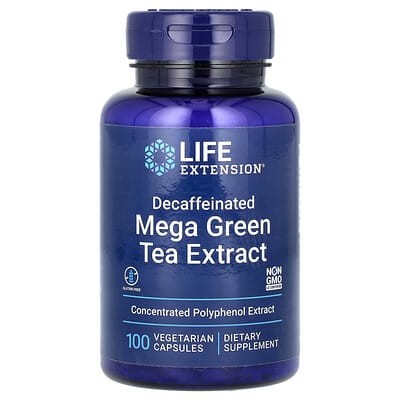
Decaffeinated Mega Green Tea Extract

Goals
$22.50 $0.22 per serving


Product analysis
Decaffeinated Mega Green Tea Extract offers tea compounds in a decaffeinated preparation, with limited support for some cholesterol-related changes. Unclear exposure to the key compounds makes it harder to judge whether the same effects apply to this serving.
AI assessment of the formula, label and price. How scoring works
Nutrient Quality40
Tea compounds are named, but the extract’s form quality remains uncertain. Unknown proportions prevent a clear view of the balance within the preparation.
Ingredient Transparency80
The extract amount and named tea compounds are disclosed. Their individual proportions are missing, so total extract weight cannot establish the exact active-compound exposure.
Value For Money100
The selected serving offers favorable value for green-tea extract. Comparing its declared EGCG content separately from total extract weight helps keep that value judgment meaningful.
Customer Satisfaction87
Customer feedback is very positive. Thousands of ratings provide a broad picture of buyer satisfaction, without establishing the claimed health effects.
Product Focus81
A single extract keeps the formula simple to follow. Several benefits are proposed, but preparation-specific and mixed findings call for cautious expectations.
- Format
Capsule - Container
- 100 Capsule(s)
- Per serving
- $0.22
- Customer rating
- 4.6 · 5,497 ratings
Goals

Impact
Highest effect
Green Tea · 725 mg


Impact
High effect
Green Tea · 725 mg

Impact
High effect
Green Tea · 725 mg

Impact
Highest effect
Green Tea · 725 mg

Impact
Highest effect
Green Tea · 725 mg
Ingredients
| Ingredient | Amount per serving | Score |
|---|---|---|
Green Tea decaffeinated extract (EGCG, Polyphenols) | 725 mg |
Green Tea (EGCG, Polyphenols) · 725 mg OverallScore76
The serving provides 725 mg of green tea leaf extract. The cost per amount of EGCG is low, based on the full serving price. The extract is decaffeinated, but its remaining caffeine amount is unknown.
How this ingredient is rated
Composition and Label Disclosure100
The stated composition includes 45% EGCG, 98% polyphenols.
Declared Green Tea Marker Concentration
The stated composition includes 45% EGCG, 98% polyphenols.
Composition and Label Disclosure40
The extract is decaffeinated, but its remaining caffeine amount is unknown.
Whole-Product Caffeine Disclosure
The extract is decaffeinated, but its remaining caffeine amount is unknown.
Commercial Price and Usability100
The cost per amount of EGCG is low, based on the full serving price.
Cost per 200 mg Declared EGCG
The cost per amount of EGCG is low, based on the full serving price.
Alternative products
Report alternatives
Sources
Published studies used for the product analysis and the top-ranked studies for each ingredient and goal.
- Safety and efficacy of cognitive training plus epigallocatechin-3-gallate in young adults with Down's syndrome (TESDAD): a double-blind, randomised, placebo-controlled, phase 2 trial.
- Association between tea consumption and risk of cognitive disorders: A dose-response meta-analysis of observational studies.
- Investigating the Impact of Tea Consumption on Cognitive Function and Exploring Tea-Genetic Interactions in Older Adults Aged 65-105 Years: Findings from the 2002-2018 CLHLS Data.
- Consumption of green tea, but not black tea or coffee, is associated with reduced risk of cognitive decline.
- Green Tea Consumption and the Risk of Incident Dementia in Elderly Japanese: The Ohsaki Cohort 2006 Study.
- Green tea catechins and blood pressure: a systematic review and meta-analysis of randomised controlled trials.
- Effect of Green Tea on Blood Pressure in Healthy Individuals: A Meta-Analysis.
- Green tea extract reduces blood pressure, inflammatory biomarkers, and oxidative stress and improves parameters associated with insulin resistance in obese, hypertensive patients.
- Green tea intake lowers fasting serum total and LDL cholesterol in adults: a meta-analysis of 14 randomized controlled trials.
- Effects of green tea on lipid profile in overweight and obese women.
- The effects of green tea on acne vulgaris: A systematic review and meta-analysis of randomized clinical trials.
- Green Tea Catechin Association with Ultraviolet Radiation-Induced Erythema: A Systematic Review and Meta-Analysis.
- Efficacy of (-)-epigallocatechin gallate delivered by a new-type scaler tip during scaling and root planing on chronic periodontitis: a split-mouth, randomized clinical trial.
- Camellia Sinensis Mouthwashes in Oral Care: a Systematic Review.
- Skin photoprotection by green tea: antioxidant and immunomodulatory effects.
- Green tea and coffee intake and risk of cognitive decline in older adults: the National Institute for Longevity Sciences, Longitudinal Study of Aging.
- Associations of green tea, coffee, and soft drink consumption with longitudinal changes in leukocyte telomere length.
- Can teatime increase one's lifetime?
- Influences of tea consumption on self-rated health and life satisfaction among older adults: Evidence from the CLHLS.
- Double-blinded, placebo-controlled trial of green tea extracts in the clinical and histologic appearance of photoaging skin.