
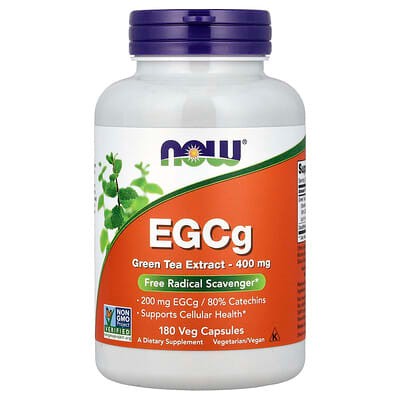

$19.60 $0.10 per serving


Product analysis
EGCg Green Tea Extract 400 mg offers green-tea compounds with antioxidant activity, while its practical benefits for skin and healthy aging remain uncertain.
AI assessment of the formula, label and price. How scoring works
Nutrient Quality40
The green-tea compounds are identified, but preparation quality cannot be judged confidently. Differing quantity declarations also prevent a reliable combined amount.
Ingredient Transparency100
The amount, named compounds and mixture breakdown are disclosed. Those details make the contents easier to compare, though the different quantity declarations should not simply be added together.
Value For Money40
Value for the active green-tea compounds remains uncertain. Differing quantity declarations prevent a reliable combined cost comparison.
Customer Satisfaction90
Customer feedback is favorable across a very large review pool. That gives a broad picture of satisfaction without establishing skin or longevity benefits.
Product Focus45
The single green-tea ingredient keeps the formula simple. Antioxidant activity does not establish longer life or routine skin protection.
- Format
Capsule - Container
- 180 Capsule(s)
- Per serving
- $0.10
- Also available
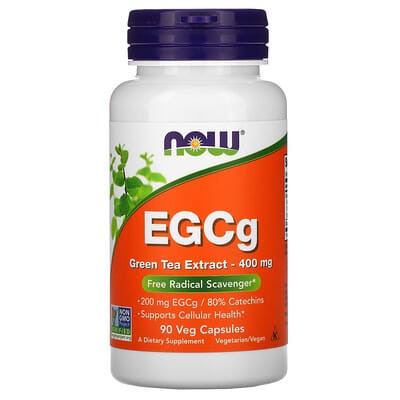 EGCg Green Tea Extract 400 mg$11.00
- Customer rating
- 4.7 · 28,150 ratings
Goals

Impact
Limited evidence
Green Tea · 50 mg

Impact
Situational effect
Green Tea · 50 mg

Impact
Highest effect
Green Tea · 50 mg
Green tea provides compounds with antioxidant activity, but dietary tea findings and laboratory mechanisms do not establish a longevity benefit from this extract. Tea powder, total extract and active EGCG amounts are not interchangeable.
How this product is rated for Longevity
Ingredient fit94
Green Tea provide the main connection. The saved amount comparison should not be interpreted as proof of anti-aging effectiveness.
Goal fit
Green Tea provide the relevant ingredient focus; the product is also linked to other goals.
Dose adequacy
The relevant amounts meet the saved comparison amounts; this does not establish a proven anti-aging dose.
Pathways60
The main connection is antioxidant defence; broader aging outcomes do not follow from that mechanism.
Depth
The main supplied connection is antioxidant defence, through Green Tea. This mechanism does not establish a clinical anti-aging effect.
Breadth
Only one mechanism reaches the saved coverage threshold; the connection remains narrow rather than covering multiple aspects of aging.
Evidence82
The saved finding recognizes ingredient evidence and preparation matches, while the human outcomes remain bounded by the qualifications described above.
Evidence strength
Green Tea anchors the saved evidence finding, but the supported outcome remains limited by the ingredient-specific human findings.
Studied preparation
The ingredients used for this finding match preparations recognized in the saved comparison; this does not remove the limits of their clinical evidence.
Formulation logic100
The supplied checks identify no missing required partner or matched conflict. Amount thresholds describe the saved comparison and do not establish clinical effectiveness.
Partner coverage
The relevant ingredients can act independently or have their required partner; this does not demonstrate an added benefit from combining them.
Conflicts
No conflict was identified by the supplied checks; this is a limited formulation finding, not a general safety conclusion.
Effective doses
The included ingredients meet the saved amount threshold, which is a comparison convention rather than a proven minimum effective dose.

Impact
Situational effect
Green Tea · 50 mg

Impact
Highest effect
Green Tea · 50 mg
Oral green-tea catechins have been investigated for UV-related skin responses, with mixed results and a trial that did not support UV inflammatory protection. The supplied serving declares 450 mg green tea and receives partial amount recognition. Total extract mass does not identify the tested catechin exposure, so it cannot establish matched preparation effects or routine skin protection.
How this product is rated for Skin Health
Ingredient fit90
Green Tea supplies the leading saved contribution. The amount comparison remains partial across the counted ingredients.
Goal fit
Green Tea provides the focused skin-related connection, though the product is also linked to other goals.
Dose adequacy
The counted amounts receive partial overall recognition in the saved comparison, without establishing the same effects as a study regimen.
Pathways56
The saved findings are strongest in uv antioxidant defence. Only this category reaches the breadth threshold.
Depth
The strongest saved contribution is assigned to uv antioxidant defence; this category does not itself demonstrate a clinical skin improvement.
Breadth
Only uv antioxidant defence reaches the saved breadth threshold, leaving the findings concentrated in one category.
Evidence89
Green tea leads the saved evidence comparison, while mixed oral catechin findings and unresolved preparation equivalence limit the benefit claim.
Evidence strength
Green tea leads the saved evidence comparison, while mixed oral catechin findings and unresolved preparation equivalence limit the benefit claim.
Studied preparation
The saved finding recognizes the preparation, but generic green-tea mass does not establish the tested catechin exposure.
Formulation logic100
Partner requirements are met, no configured conflict is matched and the counted amounts meet the saved minimum comparison.
Partner coverage
No unmet partner requirement is recorded for the counted ingredients; this does not establish extra benefit from combining them.
Conflicts
No configured ingredient conflict is matched in the supplied facts.
Effective doses
All counted ingredients meet the saved minimum amount comparison; this does not establish a clinically effective skin dose.
Ingredients
| Ingredient | Amount per serving | Score |
|---|---|---|
Green Tea extract (EGCg, Total Catechins) | 400 mg | |
decaffeinated Green Tea | 50 mg |
Green Tea (EGCg, Total Catechins) · 400 mg OverallScore72
Each serving combines 400 mg of green tea extract at 50% EGCG with 50 mg of green tea. A 4 mg caffeine figure is recorded, but it is not established as the whole-product total.
How this ingredient is rated
Composition and Label Disclosure89
Two green tea preparations are listed, with EGCG concentration established for the extract only.
Declared Green Tea Marker Concentration
The 400 mg extract is identified as 50% EGCG; a separate 50 mg green tea ingredient has no recorded EGCG concentration.
Composition and Label Disclosure40
Some caffeine information is recorded, but the whole-product total is unknown.
Whole-Product Caffeine Disclosure
A decaffeinated tea claim and 4 mg caffeine figure are recorded, but the whole-product caffeine total is not established.
Commercial Price and Usability100
The whole-product serving costs about $0.11.
Cost per 200 mg Declared EGCG
The whole-product price corresponds to about $0.11 per 200 mg of declared EGCG.
Alternative products
Report alternatives
Sources
Published studies used for the product analysis and the top-ranked studies for each ingredient and goal.
- Safety and efficacy of cognitive training plus epigallocatechin-3-gallate in young adults with Down's syndrome (TESDAD): a double-blind, randomised, placebo-controlled, phase 2 trial.
- Association between tea consumption and risk of cognitive disorders: A dose-response meta-analysis of observational studies.
- Investigating the Impact of Tea Consumption on Cognitive Function and Exploring Tea-Genetic Interactions in Older Adults Aged 65-105 Years: Findings from the 2002-2018 CLHLS Data.
- Consumption of green tea, but not black tea or coffee, is associated with reduced risk of cognitive decline.
- Green Tea Consumption and the Risk of Incident Dementia in Elderly Japanese: The Ohsaki Cohort 2006 Study.
- The effects of green tea on acne vulgaris: A systematic review and meta-analysis of randomized clinical trials.
- Green Tea Catechin Association with Ultraviolet Radiation-Induced Erythema: A Systematic Review and Meta-Analysis.
- Efficacy of (-)-epigallocatechin gallate delivered by a new-type scaler tip during scaling and root planing on chronic periodontitis: a split-mouth, randomized clinical trial.
- Camellia Sinensis Mouthwashes in Oral Care: a Systematic Review.
- Skin photoprotection by green tea: antioxidant and immunomodulatory effects.
- Green tea and coffee intake and risk of cognitive decline in older adults: the National Institute for Longevity Sciences, Longitudinal Study of Aging.
- Associations of green tea, coffee, and soft drink consumption with longitudinal changes in leukocyte telomere length.
- Can teatime increase one's lifetime?
- Influences of tea consumption on self-rated health and life satisfaction among older adults: Evidence from the CLHLS.
- Double-blinded, placebo-controlled trial of green tea extracts in the clinical and histologic appearance of photoaging skin.
- Effect of green tea on glucose control and insulin sensitivity: a meta-analysis of 17 randomized controlled trials.
- Green tea extract ingestion, fat oxidation, and glucose tolerance in healthy humans.
- Efficacy of a green tea extract rich in catechin polyphenols and caffeine in increasing 24-h energy expenditure and fat oxidation in humans.
- A 60-Day Green Tea Extract Supplementation Counteracts the Dysfunction of Adipose Tissue in Overweight Post-Menopausal and Class I Obese Women.
- Epigallocatechin gallate alleviates non-alcoholic fatty liver disease through the inhibition of the expression and activity of Dipeptide kinase 4.