
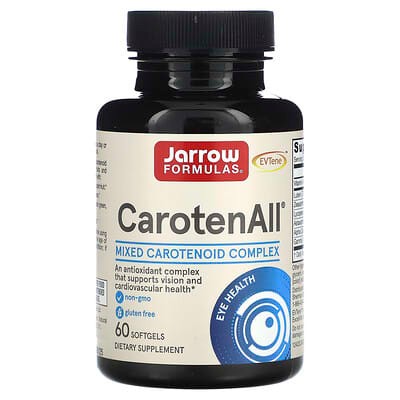

$18.10 $0.30 per serving


Product analysis
CarotenAll offers a carotenoid blend with tentative support for some skin-related outcomes. The findings are modest and inconsistent, so meaningful changes in skin appearance should not be assumed.
AI assessment of the formula, label and price. How scoring works
Nutrient Quality39
Most ingredient sources are identified, but their form quality cannot be judged confidently. Vitamin E is less clearly specified, so the list does not establish a quality advantage.
Ingredient Transparency95
All amounts and most sources are stated, making the blend easier to compare. Vitamin E lacks form detail.
Value For Money45
Lycopene offers moderate value for its declared amount. Value for the rest of the carotenoid blend remains uncertain.
Customer Satisfaction86
Customer feedback is very positive across thousands of ratings. The large number of ratings gives a broad picture of satisfaction without establishing skin or cardiovascular benefits.
Product Focus71
Skin-related effects provide the main connection, with more limited cardiovascular support. The modest and mixed findings do not establish added benefit from combining the carotenoids.
- Format
Softgel - Container
- 60 Softgel(s)
- Per serving
- $0.30
- Customer rating
- 4.7 · 2,864 ratings
Goals

Impact
Moderate effect
Astaxanthin · 500 mcgVitamin E · 10 mgLycopene · 10 mg
CarotenAll declares 10 mg of lycopene from tomato and 500 mcg of astaxanthin, with coverage centered on LDL and vessel-wall oxidative protection. Gamma-tocopherol appears in the facts, but its usable vitamin E amount is unclear. Only one target pathway reaches the breadth threshold, and lycopene supplies most of the relevant support.
How this product is rated for Cardiovascular Support
Ingredient fit55
Lycopene and astaxanthin fit the goal, while alpha-carotene, lutein, vitamin A and zeaxanthin dilute focus; gamma-tocopherol’s usable amount is unclear.
Goal fit
Four off-goal carotenoid actives dilute the focus of the relevant lycopene and astaxanthin.
Dose adequacy
The lycopene amount is clear, but astaxanthin is low and the usable vitamin E amount is unresolved.
Pathways50
Lycopene supplies most of the LDL and vessel-wall oxidative coverage, with little reach elsewhere.
Depth
LDL and vessel-wall oxidative protection is the best-covered pathway.
Breadth
Only one target pathway reaches the coverage threshold.
Evidence83
Lycopene provides the strongest relevant evidence in the formula, while the usable vitamin E amount remains unclear.
Evidence strength
Lycopene’s evidence is below the strongest ingredient evidence for this goal.
Studied preparation
Lycopene is the only ingredient established at an effective amount in a studied preparation.
Formulation logic88
No partner gap or listed conflict appears, though the vitamin E amount is unresolved and does not meet its dose threshold.
Partner coverage
The relevant ingredients work alone or have their listed partners.
Conflicts
No listed conflict was matched.
Effective doses
Only part of the relevant ingredients reach their dose thresholds; vitamin E’s usable amount is unclear.

Impact
Highest effect
Astaxanthin · 500 mcgLycopene · 10 mgVitamin E · 10 mg
Lycopene has modest, conflicting evidence for reducing some UV-related skin changes. Lutein has small combination-trial findings on skin tone, hydration and UV-related measures, but a mixed-carotenoid total does not establish the separately declared lutein exposure. Astaxanthin has limited human evidence, while the small amount here limits its contribution. These findings do not establish sunscreen-equivalent protection or added benefit from combining carotenoids.
How this product is rated for Skin Health
Ingredient fit83
The recognized ingredients give the formula a focused connection to skin, without proving a clinical benefit. Lycopene and the recognized carotenoid amounts contribute, while the unresolved vitamin E amount limits support.
Goal fit
The recognized ingredients give the formula a focused connection to skin, without proving a clinical benefit.
Dose adequacy
Lycopene and the recognized carotenoid amounts contribute, while the unresolved vitamin E amount limits support.
Pathways60
Support is concentrated in skin water binding and hydration through oral hyaluronic acid.
Depth
Support is concentrated in skin water binding and hydration through oral hyaluronic acid.
Breadth
Only the leading area meets the saved coverage criterion.
Evidence87
Lycopene leads the saved evidence finding, with modest, conflicting findings on UV-related skin changes.
Evidence strength
Lycopene leads the saved evidence finding, with modest, conflicting findings on UV-related skin changes.
Studied preparation
The saved result recognizes the retained preparations; this does not expand the benefits established by the supplied scientific context.
Formulation logic94
No required partner is missing and no configured conflict was matched. The unresolved vitamin E amount falls short of the amount check; the other retained ingredients meet it.
Partner coverage
No required partner is missing for the recognized ingredients; normal nutrient relationships do not establish extra benefit.
Conflicts
No configured conflict was matched in the supplied facts; this does not establish general safety.
Effective doses
The unresolved vitamin E amount falls short of the amount check; the other retained ingredients meet it.
Ingredients
| Ingredient | Amount per serving | Score |
|---|---|---|
Vitamin A (Beta-Carotene) | 600 mcg RAE | |
Lutein (Marigold) | 10 mg | |
Zeaxanthin (Marigold) | 2 mg | |
Lycopene (Tomato) | 10 mg | |
Astaxanthin (Haematococcus pluvialis) | 500 mcg | |
Alpha-Carotene (Palm) | 500 mcg | |
Gamma-Tocopherol | 10 mg |
Lycopene (Tomato) · 10 mg OverallScore87
A serving lists 10 mg of lycopene. At the whole-product serving price, the cost works out to about $0.30 per 10 mg of lycopene.
How this ingredient is rated
Composition and Label Disclosure
No additional composition or form criteria were evaluated.
Composition and Label Disclosure100
The serving lists 10 mg of lycopene.
Declared Active Lycopene Amount
The lycopene amount is listed as 10 mg per serving.
Commercial Price and Usability60
At the whole-product serving price, the cost works out to about $0.30 per 10 mg of lycopene.
Whole-Product Cost per 10 mg Declared Active Lycopene
At the whole-product serving price, the cost works out to about $0.30 per 10 mg of lycopene.
Alternative products
Report alternatives
Sources
Published studies used for the product analysis and the top-ranked studies for each ingredient and goal.
- Astaxanthin, a natural antioxidant, lowers cholesterol and markers of cardiovascular risk in individuals with prediabetes and dyslipidaemia.
- Antioxidant Lipid Supplement on Cardiovascular Risk Factors: A Systematic Review and Meta-Analysis.
- Administration of natural astaxanthin increases serum HDL-cholesterol and adiponectin in subjects with mild hyperlipidemia.
- Effects of Astaxanthin Supplementation on Glycemic Control and Lipid Profile in Patients With Prediabetes and Type 2 Diabetes: A Meta-Analysis of Randomized Controlled Trials.
- Astaxanthin Supplemented with High-Intensity Functional Training Decreases Adipokines Levels and Cardiovascular Risk Factors in Men with Obesity.
- Effects of lycopene intake on HDL-cholesterol and triglyceride levels: A systematic review with meta-analysis.
- Improvement of vascular endothelial function by intake of lycopene-rich tomato juice in healthy adults: a randomized, placebo-controlled, double-blind, parallel-group comparative study.
- Tomato and lycopene supplementation and cardiovascular risk factors: A systematic review and meta-analysis.
- Lycopene and tomato and risk of cardiovascular diseases: A systematic review and meta-analysis of epidemiological evidence.
- Lycopene and risk of cardiovascular diseases: A meta-analysis of observational studies.
- Supplementation with vitamin E alone is associated with reduced myocardial infarction: a meta-analysis.
- Vitamin E ameliorates blood cholesterol level and alters gut microbiota composition: A randomized controlled trial.
- Effects of long-term vitamin E supplementation on cardiovascular events and cancer: a randomized controlled trial.
- Independent and combined associations of dietary antioxidant exposure with all-cause and cause-specific mortality in the general population.
- Tocotrienol rich fraction supplementation improved lipid profile and oxidative status in healthy older adults: A randomized controlled study.
- The Protective Role of Astaxanthin for UV-Induced Skin Deterioration in Healthy People-A Randomized, Double-Blind, Placebo-Controlled Trial.
- Supplementating with dietary astaxanthin combined with collagen hydrolysate improves facial elasticity and decreases matrix metalloproteinase-1 and -12 expression: a comparative study with placebo.
- Continuous astaxanthin intake reduces oxidative stress and reverses age-related morphological changes of residual skin surface components in middle-aged volunteers.
- The effectiveness of a standardized rose hip powder, containing seeds and shells of Rosa canina, on cell longevity, skin wrinkles, moisture, and elasticity.
- Cosmetic benefits of astaxanthin on humans subjects.