
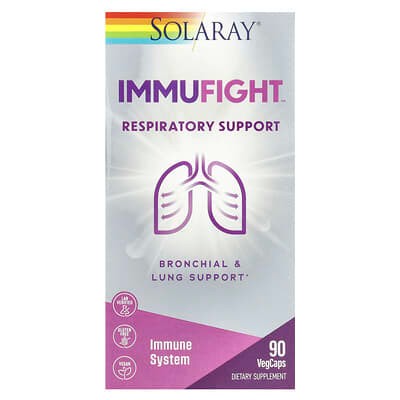

$25.69 $0.85 per serving


Product analysis
Immufight Respiratory Support provides vitamin C, zinc and other nutrients for normal immune function, especially when intake is low. Many added ingredients and unspecified preparations make it less straightforward than a targeted nutrient supplement.
AI assessment of the formula, label and price. How scoring works
Nutrient Quality34
The main nutrient forms are identified, but their quality remains uncertain. Many added ingredients have no specified form, leaving the wider combination harder to judge.
Ingredient Transparency79
Amounts are disclosed for the listed ingredients. Many forms are unspecified, so quantities are clearer than the exact preparations used.
Value For Money32
The serving cost is high for the vitamin C and several added ingredient contributions. Uncertain value for the remaining nutrients makes the whole combination difficult to compare.
Customer Satisfaction79
Customer feedback is very positive across several hundred ratings. The review base offers useful context for satisfaction without establishing respiratory benefits.
Product Focus50
Normal immune nutrition is the clearest purpose, especially when nutrient intake is low. The long list of additions does not establish wider or stronger respiratory benefits.
- Format
Capsule - Container
- 90 VegCap(s)
- Per serving
- $0.85
- Customer rating
- 4.8 · 510 ratings
Goals

Impact
High effect
Vitamin C · 500 mgZinc · 8.3 mgVitamin D · 42 mcgMonolaurin · 100 mgSelenium · 37 mcg
Vitamin C supports normal immune function and may modestly shorten colds with regular use. Zinc and vitamin D contribute to immune-cell function, while selenium supports normal immune function when intake is low; these nutrient roles do not establish infection prevention. The supplied botanical and monolaurin information does not establish a reliable routine adult respiratory benefit, even where the saved calculation retained a contribution.
How this product is rated for Immunity
Ingredient fit56
The formula includes nutrients relevant to normal immune function, alongside ingredients serving other purposes. Vitamin C, zinc, vitamin D and selenium contribute at differing levels.
Goal fit
The formula includes nutrients relevant to normal immune function, alongside ingredients serving other purposes.
Dose adequacy
Vitamin C, zinc, vitamin D and selenium contribute at differing levels.
Pathways80
The saved findings place the strongest contribution in lymphocyte function and immune regulation. Coverage is concentrated in innate immune activity and immune regulation.
Depth
The strongest saved contribution concerns lymphocyte function and immune regulation; this describes ingredient roles rather than proven resistance to infection.
Breadth
The saved findings cover innate immune activity and immune regulation, with less support across the remaining areas.
Evidence100
Vitamin C supplies the leading supported contribution. Nutrient-function evidence does not establish additional infection prevention.
Evidence strength
Vitamin C supplies the leading supported contribution; normal nutrient functions do not establish added protection when intake is adequate.
Studied preparation
The retained ingredients met the saved preparation check; this does not establish clinical superiority for the declared forms.
Formulation logic100
The retained ingredients need no missing partner under the supplied checks. Their counted amounts do not imply extra benefit from combining them.
Partner coverage
The retained ingredients can contribute without an additional partner under the supplied checks; no added benefit from combining them is established.
Conflicts
The supplied combination checks found no matching zinc conflict; this does not assess every possible interaction.
Effective doses
All retained contributors meet the saved minimum amount condition. That condition is a comparison rule, not proof of an effective clinical regimen.
Ginger Not classified
No linked studies yet.

Impact
High effect
Vitamin D · 42 mcgVitamin C · 500 mg
Zinc can help address inflammation associated with low zinc intake; extra anti-inflammatory benefit is not established when intake is adequate. Vitamin C supports antioxidant defenses. The supplied trial was null overall, with lower CRP confined to people starting with elevated CRP, so routine anti-inflammatory benefit is uncertain. Vitamin D has a limited connection to inflammatory markers: a reduction in CRP appeared at two years in older adults but did not persist at four years, and other cytokines were unchanged. The relevant nutrients receive only partial amount recognition in the saved result.
How this product is rated for Inflammation
Ingredient fit54
Vitamin D, vitamin C, zinc and selenium provide the counted connection to this goal. Other active ingredients broaden the formula beyond this goal.
Goal fit
Relevant ingredients share the formula with several actives directed at other goals, reducing its focus.
Dose adequacy
The four counted nutrients receive partial amount recognition overall.
Pathways71
Inflammatory gene signalling is the strongest represented route in the saved findings. Two routes are substantially represented: inflammatory signalling and oxidative stress.
Depth
Inflammatory gene signalling is the strongest represented route in the saved findings.
Breadth
Two routes are substantially represented: inflammatory signalling and oxidative stress.
Evidence93
Vitamin D leads the saved evidence finding, although supplied clinical findings are transient and inconsistent.
Evidence strength
Vitamin D leads the saved evidence finding, although supplied clinical findings are transient and inconsistent.
Studied preparation
The ingredients counted at recognized amounts match preparations accepted by the saved calculation; this does not expand their clinical benefits.
Formulation logic100
The counted ingredients have no missing partner or matched conflict and meet the saved amount threshold.
Partner coverage
The counted ingredients work independently or have their required partner.
Conflicts
No ingredient conflict was identified in the supplied calculation.
Effective doses
All counted ingredients reach the saved amount threshold; this threshold does not prove a clinical benefit.

Impact
High effect
Vitamin D · 42 mcgSelenium · 37 mcgZinc · 8.3 mgVitamin C · 500 mg
Vitamin D contributes to bone and mineral functions, while vitamin C, zinc and selenium support normal immune or antioxidant functions when intake is low. Their amounts provide varying nutritional contributions within the selected serving. The smaller ginger and bromelain amounts add little to the saved findings. These roles do not establish infection prevention or additional benefit when nutrient intake is adequate.
How this product is rated for Everyday Health
Ingredient fit49
The selected serving provides a partial contribution against the saved amount references, with the recognized ingredients contributing to different degrees.
Goal fit
Relevant ingredients share the formula with additional actives whose general-health contributions are not established here.
Dose adequacy
The selected serving provides a partial contribution against the saved amount references, with the recognized ingredients contributing to different degrees.
Pathways75
The strongest represented area is antioxidant and immune defence, reflecting the recognized ingredients and their amounts.
Depth
The strongest represented area is antioxidant and immune defence, reflecting the recognized ingredients and their amounts.
Breadth
The more substantially represented areas are bone and mineral metabolism, antioxidant and immune defence.
Evidence82
Vitamin D provides the strongest recognized basis here; the supplied context still limits expectations for routine benefits in adequately nourished adults.
Evidence strength
Vitamin D provides the strongest recognized basis here; the supplied context still limits expectations for routine benefits in adequately nourished adults.
Studied preparation
The recognized preparations meet the saved check; this does not establish superiority of the named forms or broad clinical benefits.
Formulation logic100
None of the defined ingredient-conflict conditions was triggered by the supplied facts.
Partner coverage
The recognized ingredients can contribute independently or have their required partners present; no added combined benefit is established.
Conflicts
None of the defined ingredient-conflict conditions was triggered by the supplied facts.
Effective doses
All recognized ingredients meet the saved minimum amount threshold; this is not a proven clinical treatment threshold.

Impact
Moderate effect
Zinc · 8.3 mgVitamin C · 500 mgSelenium · 37 mcg
Vitamin C supports normal collagen formation, and zinc contributes to skin repair. Selenium supports antioxidant enzymes; these nutritional roles are most meaningful when intake is inadequate, rather than as demonstrated skin appearance improvements in well-nourished adults.
How this product is rated for Skin Health
Ingredient fit51
The blend serves broader goals, with only part of its ingredients directly contributing to the saved skin findings. The counted amounts provide partial support against the saved targets.
Goal fit
The blend serves broader goals, with only part of its ingredients directly contributing to the saved skin findings.
Dose adequacy
The counted amounts provide partial support against the saved targets.
Pathways8
The strongest saved coverage concerns antioxidant defence.
Depth
The strongest saved coverage concerns antioxidant defence.
Breadth
No area reaches the saved threshold for broad coverage.
Evidence100
Vitamin C provides the strongest evidence contribution among the counted ingredients. Nutritional necessity should be distinguished from an extra cosmetic benefit.
Evidence strength
Vitamin C provides the strongest evidence contribution among the counted ingredients. Nutritional necessity should be distinguished from an extra cosmetic benefit.
Studied preparation
The saved findings recognize the counted effective preparations as matching the evidence.
Formulation logic100
The counted ingredients meet the saved minimum amounts and have no listed conflict.
Partner coverage
The counted ingredients can contribute independently or have the required partner.
Conflicts
The saved check identified no listed ingredient conflict; this is not a general safety assessment.
Effective doses
3 of 3 counted ingredients meet the saved minimum amount threshold.

Impact
Moderate effect
Zinc · 8.3 mgVitamin C · 500 mg
Zinc's vision-related benefit concerns a defined combination used for selected people with age-related macular degeneration, a condition affecting central vision. Taking zinc by itself doesn't show that your vision will improve or that it will prevent the condition. The amount in a serving doesn't tell you whether that complete regimen is appropriate for you.
How this product is rated for Eye Health
Ingredient fit54
Zinc's vision-related benefit concerns a defined combination for selected people with age-related macular degeneration.
Goal fit
Zinc's vision-related benefit concerns a defined combination for selected people with age-related macular degeneration.
Dose adequacy
The serving supplies 8.3 mg of zinc; that amount alone doesn't predict improved vision.
Pathways52
The ingredient connection with eye function does not mean standalone supplementation improves everyday vision.
Depth
The ingredient connection with eye function does not mean standalone supplementation improves everyday vision.
Breadth
The mixture does not demonstrate broad improvements across several aspects of everyday vision.
Evidence70
Zinc's vision-related benefit concerns a defined combination for selected people with age-related macular degeneration. The result depends on the ingredient and the circumstances of use.
Evidence strength
Zinc's vision-related benefit concerns a defined combination for selected people with age-related macular degeneration.
Studied preparation
The declared nutrient form identifies the ingredient, without guaranteeing the benefits of a complete disease-specific combination.
Formulation logic100
The individual ingredients have no identified missing partner or particular conflict.
Partner coverage
No required ingredient partner is missing for the individual contribution described here.
Conflicts
No particular ingredient conflict is identified here.
Effective doses
The serving supplies 8.3 mg of zinc; that amount alone doesn't predict improved vision.
Ingredients
| Ingredient | Amount per serving | Score |
|---|---|---|
Total Carbohydrates | 1 Gram(s) | |
Vitamin C (Calcium Strontium Ascorbate) | 500 mg | |
Vitamin D (Cholecalciferol) | 42 mcg | |
Zinc (Zinc Citrate) | 8.3 mg | |
Selenium (Selenomethionine) | 37 mcg | |
Monolaurin (Glyceryl Monolaurate) | 100 mg | |
Quercetin | 100 mg | |
Berberine HCl (Indian Barberry extract) | 100 mg | |
Cayenne Pepper | 67 mg | |
Ginger root extract | 67 mg | |
Acacia Gum | 67 mg | |
Aloe Vera concentrate | 33 mg | |
Bioflavonoids Concentrate (Citrus) | 10 mg | |
Acerola Cherry powder | 3 mg | |
Rose Hips | 3 mg | |
Bacillus coagulans | 75 mg | |
Grapefruit extract | 100 mg | |
Bromelain (Pineapple) | 100 mg |
Vitamin C (Calcium Strontium Ascorbate) · 500 mg OverallScore70
Each serving provides 500 mg of vitamin C as calcium strontium ascorbate, a buffered mineral form. The whole-product price works out to about $1.71 per gram of vitamin C.
How this ingredient is rated
Active Ingredient Quality & Bioavailability83
The vitamin C is calcium strontium ascorbate, a buffered mineral form.
Vitamin C Chemical Form & Delivery System
The vitamin C is supplied as calcium strontium ascorbate.
Gastric Comfort & pH Balance
The vitamin C uses buffered mineral ascorbate.
Dose, Safety & Label Transparency83
500 mg of vitamin C per serving is listed. The evaluation does not establish complete qualifying mineral disclosure.
Optimal Dosage Targeting
A serving provides 500 mg of vitamin C.
Purity & Excipient Quality
No evaluated sweeteners or artificial colors were flagged in the available ingredient information.
Mineral & Source Transparency
The vitamin C amount and source form are stated, but the evaluation does not establish complete qualifying mineral disclosure for the source.
Value20
The whole-product price works out to about $1.71 per gram of vitamin C.
Price per Gram of Vitamin C
The whole-product price works out to about $1.71 per gram of vitamin C.
Aloe · 33 mg OverallScore57
A serving lists 33 mg of aloe extract. The saved facts do not establish the plant-part and processing combination used in the comparison.
How this ingredient is rated
Composition and Label Disclosure22
An aloe extract is recorded, but the available plant-part and processing details do not establish a match with the comparison preparation.
Aloe Part and Processing Disclosure
The saved facts do not establish the plant-part and processing combination used in the comparison.
Marker and Preparation Disclosure
An extract or concentrate is recorded; an exact marker concentration is not available in the saved facts.
Composition and Label Disclosure100
The aloe amount is disclosed as 33 mg per serving.
Individual Preparation Amount Disclosure
The individual aloe amount is listed as 33 mg per serving.
Commercial Price and Usability40
The whole-product serving costs about $0.86, in the higher-middle range of the price comparison.
Commercial Price per Labeled Serving
The whole-product serving costs about $0.86, in the higher-middle range of the price comparison.
Monolaurin (Glyceryl Monolaurate) · 100 mg OverallScore54
Each serving provides 100 mg of monolaurin. The whole-product price works out to about $8.56 per gram of monolaurin, a relatively high cost for that amount.
How this ingredient is rated
Active Ingredient Quality & Bioavailability80
The monolaurin is identified as a specific monoester form; its source is not specified in the available information.
Chemical Form Specificity
The available information identifies a specific monolaurin monoester form.
Source Material Quality
The source is not specified in the available information.
Dose, Safety & Label Transparency50
Each serving discloses 100 mg of monolaurin, so its individual amount is clear.
Monolaurin Potency per Serving
A serving supplies 100 mg of monolaurin.
Label Transparency & Blend Disclosure
The individual monolaurin amount is disclosed as 100 mg per serving.
Value10
The whole-product price works out to about $8.56 per gram of monolaurin.
Price per Gram of Monolaurin
The whole-product price works out to about $8.56 per gram of monolaurin.
Alternative products
Report alternatives
Sources
Published studies used for the product analysis and the top-ranked studies for each ingredient and goal.
- Perioperative bromelain reduces pain and swelling and improves quality of life measures after mandibular third molar surgery: a randomized, double-blind, placebo-controlled clinical trial.
- Efficacy of proteolytic enzyme bromelain on health outcomes after third molar surgery. Systematic review and meta-analysis of randomized clinical trials.
- Bromelain-based enzymatic burn debridement: A systematic review of clinical studies on patient safety, efficacy and long-term outcomes.
- Placebo-controlled randomized clinical trial on the immunomodulating activities of low- and high-dose bromelain after oral administration - new evidence on the antiinflammatory mode of action of bromelain.
- Bromelain reduces mild acute knee pain and improves well-being in a dose-dependent fashion in an open study of otherwise healthy adults.
- Effect of a Standardized Ginger Root Powder Regimen on Chemotherapy-Induced Nausea and Vomiting: A Multicenter, Double-Blind, Placebo-Controlled Randomized Trial.
- Efficacy and safety of steamed ginger extract for gastric health: a randomized, double-blind, placebo-controlled multi-center clinical trial.
- Ginger extract versus Loratadine in the treatment of allergic rhinitis: a randomized controlled trial.
- The effect of frankincense (Boswellia serrata, oleoresin) and ginger (Zingiber officinale, rhizoma) on heavy menstrual bleeding: A randomized, placebo-controlled, clinical trial.
- The effect of ginger (Zingiber officinale) supplementation on clinical, biochemical, and anthropometric parameters in patients with multiple sclerosis: a double-blind randomized controlled trial.
- Associations of selenium status with all-cause and cause-specific mortality: a systematic review and meta-analysis of cohort studies.
- Dietary Antioxidants, Circulating Antioxidant Concentrations, Total Antioxidant Capacity, and Risk of All-Cause Mortality: A Systematic Review and Dose-Response Meta-Analysis of Prospective Observational Studies.
- The efficacy and safety of selenium supplementation versus placebo in the treatment of Graves' orbitopathy: A systematic review and meta-analysis of randomised controlled trials.
- Associations of plasma metal concentrations with the risks of all-cause and cardiovascular disease mortality in Chinese adults.
- Updates on clinical studies of selenium supplementation in radiotherapy.
- Dietary intake and blood concentrations of antioxidants and the risk of cardiovascular disease, total cancer, and all-cause mortality: a systematic review and dose-response meta-analysis of prospective studies.
- Scientific Opinion on the substantiation of a health claim related to vitamin C and increasing non haem iron absorption pursuant to Article 14 of Regulation (EC) No 1924/2006.
- Vitamin C Depletion and All-Cause Mortality in Renal Transplant Recipients.
- Associations of Serum Biomarkers of Fruit and Vegetable Intake With the Risk of Cause-Specific Mortality and All-Cause Mortality: A National Prospective Cohort Study.
- Relation between plasma ascorbic acid and mortality in men and women in EPIC-Norfolk prospective study: a prospective population study. European Prospective Investigation into Cancer and Nutrition.