


Vitamin D Supportive
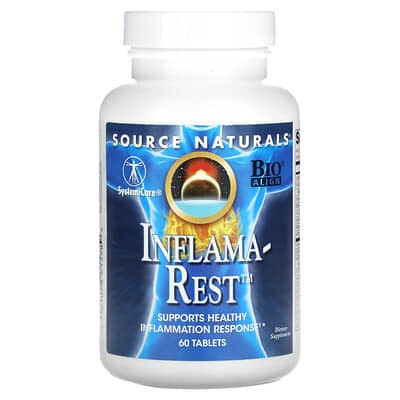
$19.50 $1.30 per serving
Product analysis
Source Naturals Inflama-Rest is designed to support a healthy inflammatory response and comfort during physical activity. Four tablets contain 1,050 mg of turmeric extract standardized to 95% curcuminoids and 125 mg of boswellia, although the potential benefits depend on the specific extracts used.
AI assessment of the formula, label and price. How scoring works
Nutrient Quality33
Vitamin D3 and zinc methionine are clearly identified forms, while the magnesium and selenium mixtures have uncertain proportions. Turmeric has a stated curcuminoid concentration, but many other botanicals are less fully characterized.
Ingredient Transparency61
The individual ingredient and blend weights are stated, while many specific forms are not. Some mixtures lack component proportions, limiting comparisons of the actual amounts of those forms.
Value For Money29
Turmeric and ginger provide good value for the quantities supplied. Boswellia and many of the smaller supporting ingredients are relatively expensive when compared with the full formula price.
Customer Satisfaction66
The formula has a positive average rating of 4.2 out of 5. Its 381 ratings provide some customer feedback, though the sample is not especially large.
Product Focus29
The substantial turmeric and ginger amounts fit the intended support for a healthy inflammatory response, while other preparations are less clearly matched to the supporting evidence. The formula is broad rather than tightly focused, covering numerous nutritional and botanical roles.
- Format
Tablet - Container
- 60 Tablet(s)
- Per serving
- $1.30
- Customer rating
- 4.3 · 389 ratings
Goals

Impact
High effect
Vitamin D · 25 mcgVitamin E · 15 mgVitamin C · 4 mgGreen Tea · 80 mgBoswellia · 125 mg
Inflama-Rest has a plausible but preparation-limited fit for inflammation-related comfort. Its 1,050 mg turmeric extract and 125 mg Boswellia declaration lead the botanical contribution, but neither is identified as the specific preparation linked to the supplied benefits. Ginger at 1,020 mg adds a narrower connection to repeated-use exercise-related muscle discomfort. Magnesium at 350 mg may help when a dietary shortfall contributes to inflammation, rather than providing an assumed benefit for everyone.
Zinc Supportive
Vitamin C Supportive
Magnesium Supportive
Resveratrol Supportive
Selenium Supportive
Ginger Supportive
Vitamin E Supportive
Boswellia Supportive
Green Tea Mixed
Bromelain Supportive
Stinging Nettle Supportive
Rosemary No studies yet


Impact
High effect
Magnesium · 5 mgGreen Tea · 80 mgVitamin D · 25 mcg
Inflama-Rest has a limited heart-health fit driven mainly by magnesium. Its 350 mg magnesium serving supports electrolyte balance and vascular tone, although the supplied blood-pressure effects are inconsistent.
Vitamin D Mixed
Magnesium Supportive
Selenium Mixed
Green Tea Supportive
Resveratrol Supportive

Impact
Moderate effect
Vitamin D · 25 mcgAshwagandha · 175 mgMagnesium · 5 mgVitamin C · 4 mg
Inflama-Rest offers conditional stress support within a broad formula. Magnesium at 350 mg supplies calming support, particularly when intake is low. Ashwagandha at 175 mg adds a perceived-stress contribution with limited preparation matching. Holy basil leaf extract at 150 mg adds qualified support because the declaration does not identify the extract used for the stronger stress findings.
Ashwagandha Supportive
Vitamin D Supportive
Magnesium Supportive
Rosemary Supportive
Vitamin C Supportive
Zinc Supportive

Impact
High effect
Magnesium · 5 mgVitamin C · 4 mgZinc · 5 mgVitamin D · 25 mcgSelenium · 100 mcg
Inflama-Rest has a narrower nutritional immunity role within a broad botanical formula. Vitamin D3 at 25 mcg and selenium at 100 mcg support normal immune function. The 4 mg of vitamin C and 5 mg of zinc contribute little to the supplied goal assessment at these amounts.
Vitamin D Supportive
Zinc Supportive
Vitamin C Supportive
Selenium Mixed
Vitamin E Supportive
Magnesium Supportive
Resveratrol Mixed
Green Tea Not rated yet
The outcomes of these studies are not classified yet.
Bromelain Not rated yet
The outcomes of these studies are not classified yet.
Ginger No studies yet

Impact
High effect
Zinc · 5 mgVitamin D · 25 mcgBromelain · 200 mgMagnesium · 5 mgBoswellia · 125 mg
Inflama-Rest has a limited and situational gut-health fit rather than a clear routine digestive benefit. Ginger at 1.02 g has a narrower connection to nausea support, but its unidentified preparation weakens transfer to the better-characterized ginger material. Bromelain at 200 mg adds a protein-digesting enzyme role. The 355 mg magnesium serving has an unspecified form, making its constipation-related contribution less clear than a named oxide preparation.
Zinc Supportive
Magnesium Supportive
Vitamin D Supportive
Ginger Supportive
Boswellia Supportive
Bromelain Supportive
Ingredients
| Ingredient | Amount per serving | Score |
|---|---|---|
Calories | 10 Calorie(s) | |
Total Carbohydrates | 2 Gram(s) | |
Vitamin C | 4 mg | |
Vitamin D3 (Cholecalciferol) | 25 mcg | |
Calcium | 26 mg | |
Magnesium (Magnesium Amino Acid Complex, Magnesium Oxide) | 350 mg | |
Zinc (OptiZinc) | 5 mg | |
Selenium (L-Selenomethionine, Sodium Selenite) | 100 mcg | |
Magnesium Succinic Acid complex | 5 mg | |
Sodium | 20 mg | |
Turmeric Root Extract (Curcuminoids) | 1.05 Gram(s) | |
Ginger | 1.02 Gram(s) | |
Perluxan (Hops cone extract) | 300 mg | |
Chinese Skullcap root extract | 250 mg | |
Bromelain | 200 mg | |
Ashwagandha root extract | 175 mg | |
Quercetin | 150 mg | |
Holy Basil leaf extract | 150 mg | |
Boswellia gum resin extract (Boswellic Acid, organic Acids) | 125 mg | |
Oregon grape | 120 mg | |
Silymarin (Milk Thistle seed extract) | 100 mg | |
Trans-Resveratrol (Polygonum cuspidatum extract) | 100 mg | |
Green Tea leaf extract | 80 mg | |
Feverfew Aerial Parts Extract | 75 mg | |
Stinging Nettle Leaf | 60 mg | |
Willow bark extract | 50 mg | |
Rosemary leaf extract | 50 mg | |
EVNolMax (Tocotrienol Complex) | 15 mg | |
Bioperine (Black Pepper Fruit Extract) | 15 mg | |
Nattokinase | 12 mg |
Selenium (L-Selenomethionine, Sodium Selenite) · 100 mcg OverallScore55
Source Naturals Inflama-Rest offers costly for its selenium for selenium at $2.60 per 200 mcg, providing 100 mcg per serving as L-selenomethionine and sodium selenite. The full formula costs $1.30 per serving. L-selenomethionine and sodium selenite are named, but their proportions are unknown.
Rosemary · 50 mg OverallScore57
Source Naturals Inflama-Rest provides 50 mg of rosemary leaf extract per serving, but its rosemary quality is limited by the available marker details. No marker amount or extract ratio is specified. The whole formula costs $1.30 per serving, or 50 mg of rosemary leaf extract; that price is high.
Stinging Nettle · 60 mg OverallScore62
Source Naturals Inflama-Rest offers costly for its nettle: each serving has 60 mg of stinging nettle. A root or leaf is indicated, but which plant part is not specified in the available details. The preparation and marker content are not specified in the available details. The price is $3.25 per 150 mg of stinging nettle; the full formula costs $1.30 per labeled serving.
Sources
Published studies used for the product analysis and the top-ranked studies for each ingredient and goal.
- What is the impact of daily oral supplementation of vitamin D3 (cholecalciferol) plus calcium on the incidence of hip fracture in older people? A systematic review and meta-analysis.
- Calcium supplementation prevents seasonal bone loss and changes in biochemical markers of bone turnover in elderly New England women: a randomized placebo-controlled trial.
- The effects of calcium supplementation (milk powder or tablets) and exercise on bone density in postmenopausal women.
- The efficacy of calcium supplementation alone in elderly Thai women over a 2-year period: a randomized controlled trial.
- Calcium-enriched foods and bone mass growth in prepubertal girls: a randomized, double-blind, placebo-controlled trial.
- Association between Serum Magnesium and Fractures: A Systematic Review and Meta-Analysis of Observational Studies.
- Bioabsorbable Magnesium-Based Materials Potential and Safety in Bone Surgery: A Systematic Review.
- Vascularized bone grafting fixed by biodegradable magnesium screw for treating osteonecrosis of the femoral head.
- An update on magnesium and bone health.
- Sex-specific differences in the association of magnesium intake with femoral neck bone mineral density among older adults.
- Can Dietary Intake of Vitamin C-Oriented Foods Reduce the Risk of Osteoporosis, Fracture, and BMD Loss? Systematic Review With Meta-Analyses of Recent Studies.
- Dietary vitamin C intake and the risk of hip fracture: a dose-response meta-analysis.
- Smoking, antioxidant vitamins, and the risk of hip fracture.
- Micronutrients and the risk of hip fracture: Case-control study.
- Favorable effect of dietary vitamin C on bone mineral density in postmenopausal women (KNHANES IV, 2009): discrepancies regarding skeletal sites, age, and vitamin D status.
- Pregnancy vitamin D supplementation and offspring bone mineral density in childhood follow-up of a randomized controlled trial.
- Vitamin D analogs and bone: preclinical and clinical studies with eldecalcitol.
- Efficacy of vitamin D fortified foods on bone mineral density and serum bone biomarkers: A systematic review and meta-analysis of interventional studies.
- Cholecalciferol Supplementation Attenuates Bone Loss in Incident Kidney Transplant Recipients: A Prespecified Secondary Endpoint Analysis of a Randomized Controlled Trial.
- Vitamin D supplementation and bone health in post-menopausal women: a 24-month randomized controlled intervention with enhanced bioavailability formulations.