
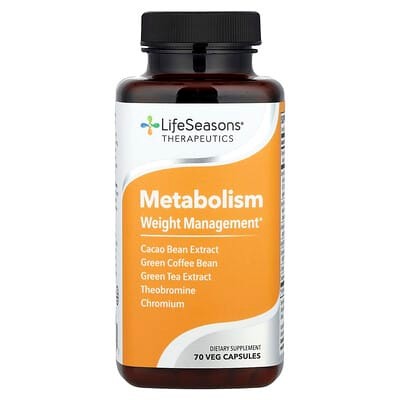

$25.99 $1.13 per serving


Product analysis
Metabolism Weight Management combines green tea and chromium for weight-management support, but any effect on weight is likely to be small and uncertain. Incomplete details about the green tea’s active content make it difficult to compare the formula with the preparations that showed benefits.
AI assessment of the formula, label and price. How scoring works
Nutrient Quality46
Chromium is supplied in a favorable form, while the quality of much of the remaining formula is uncertain. Several preparations are unspecified, and the green tea’s component details are incomplete.
Ingredient Transparency61
All listed ingredient amounts are stated, but several forms are unspecified. The green tea’s incomplete component details make its total extract amount difficult to translate into an active amount.
Value For Money39
Value is uneven across the formula. Chromium compares reasonably well, while the green tea and theanine are costly for what they provide.
Customer Satisfaction68
Customer feedback is generally positive, though less consistently enthusiastic than very highly rated products. A sizeable review history supports the pattern of satisfaction without establishing weight-loss results.
Product Focus66
The ingredients address several related health aims, with small or uncertain benefits for metabolism and weight. Differences between the listed preparations and those examined for benefits limit expectations.
- Format
Capsule - Container
- 70 Capsule(s)
- Per serving
- $1.13
- Customer rating
- 4.2 · 835 ratings
Goals

Impact
High effect
Green Tea · 450 mg
Green tea has mixed weight findings, and its extract mass does not establish active EGCG exposure. Chromium has shown small average weight changes with uncertain practical importance and no reliable dose gradient. The caffeine claim lacks a resolved ingredient amount, so its contribution remains unknown. Generic cayenne cannot inherit findings for defined capsaicinoid preparations.
How this product is rated for Weight Loss
Ingredient fit63
Several declared amounts provide only partial coverage of the saved comparisons, limiting their attributed contribution.
Goal fit
The relevant ingredients form part of a broader formula with several other purposes, limiting its concentration on weight loss.
Dose adequacy
Several declared amounts provide only partial coverage of the saved comparisons, limiting their attributed contribution.
Pathways43
The strongest identified connection concerns heat production and energy use.
Depth
The strongest identified connection concerns heat production and energy use.
Breadth
The identified connections cover heat production and energy use.
Evidence72
Green Tea leads the saved evidence findings, while the supplied context limits what can be claimed for weight loss.
Evidence strength
Green Tea leads the saved evidence findings, while the supplied context limits what can be claimed for weight loss.
Studied preparation
Preparation matching is incomplete for Theanine, limiting transfer of preparation-specific findings.
Formulation logic100
The evaluated ingredients have no unmet partner requirement in the supplied findings.
Partner coverage
The evaluated ingredients have no unmet partner requirement in the supplied findings.
Conflicts
No configured ingredient conflict was identified.
Effective doses
The evaluated ingredients meet the saved minimum amount comparison; this is not a proven threshold for weight-loss benefit.
Theanine Not classified
No linked studies yet.

Impact
High effect
Green Tea · 450 mg
Green tea catechins have a small, uncertain connection to increased energy expenditure, with much of the supplied evidence involving catechin-caffeine mixtures. The declared extract has an EGCG grade, but extract mass does not establish the active amount or the repeated regimen studied. Caffeine remains unresolved in the supplied inventory, so no separate caffeine contribution can be inferred. Its cayenne powder does not match the preparation-specific Capsimax evidence.
How this product is rated for Metabolism Support
Ingredient fit66
The graded green tea extract contributes to the saved ingredient-fit finding. The retained amounts provide only partial reference coverage.
Goal fit
The formula’s recognized ingredients and its other active ingredients and linked uses determine how specifically it relates to this goal.
Dose adequacy
The retained ingredient amounts provide partial coverage of the saved reference levels; this does not identify a clinically effective thermogenic dose.
Pathways50
The strongest recorded connection is adrenergic drive; this mapping does not establish increased calorie expenditure. Coverage remains concentrated in one tracked pathway.
Depth
The strongest recorded connection is adrenergic drive; this mapping does not establish increased calorie expenditure.
Breadth
One tracked pathway reached the saved coverage threshold; coverage did not extend broadly across the other pathways.
Evidence77
Green tea leads the saved evidence finding. Its supplied limitations still restrict claims about a direct, sustained rise in calorie expenditure.
Evidence strength
The graded green tea extract leads the saved evidence finding; supplied thermogenesis evidence is modest and cannot establish lasting weight loss.
Studied preparation
The saved preparation comparison recognizes the retained forms; this does not establish that the complete product was tested for a metabolism boost.
Formulation logic100
No missing required partner or configured conflict was found, and the retained ingredients meet the minimum amount criterion. These findings do not establish synergy.
Partner coverage
No missing required partner was identified for the retained ingredients; this does not establish an added benefit from their combination.
Conflicts
No configured ingredient conflict was identified. This does not assess every interaction or establish individual suitability.
Effective doses
All retained ingredients meet the saved minimum amount criterion; this threshold is not a proven effective thermogenic dose.

Impact
High effect
Green Tea · 450 mg
Green tea provides antioxidant constituents, which are the main proposed connection to aging-related health. Dietary-tea associations and mechanisms do not establish that a concentrated extract preserves function or extends human life. Its declared extract amount cannot be treated as an equivalent amount of EGCG or a beverage intervention.
How this product is rated for Longevity
Ingredient fit60
Green tea provide the main connection. The included amounts meet the reference exposure comparisons; this does not make them proven human anti-aging doses.
Goal fit
Green tea provide the main goal-related connection, within a formula also aimed at other health goals.
Dose adequacy
The included amounts meet the reference exposure comparisons; this does not make them proven human anti-aging doses.
Pathways60
The main connection concerns antioxidant processes; antioxidant activity alone does not establish slower aging. The main coverage is concentrated in one area rather than broad preservation of aging-related function.
Depth
The main connection concerns antioxidant processes; antioxidant activity alone does not establish slower aging.
Breadth
The main coverage is concentrated in one area rather than broad preservation of aging-related function.
Evidence82
Green-tea mechanisms and dietary associations do not establish aging benefits from arbitrary concentrated extracts.
Evidence strength
Green-tea mechanisms and dietary associations do not establish aging benefits from arbitrary concentrated extracts.
Studied preparation
The included preparations match the saved comparison, which does not establish equivalent aging-related outcomes or remove population limitations.
Formulation logic100
No missing required partner or configured conflict was identified. The included amounts meet the minimum exposure comparison.
Partner coverage
No missing required partner was identified; the combination does not establish an added anti-aging effect.
Conflicts
No configured ingredient conflict was identified in the supplied facts.
Effective doses
The included ingredients meet the minimum exposure comparison, which does not establish a proven anti-aging dose.

Impact
Moderate effect
Green Tea · 450 mg
Whether green tea extract reduces everyday inflammation remains unclear. Its total extract weight and the amount of EGCG, one of its compounds, describe different things and can't be treated as equivalent. Changes in a particular inflammation marker don't provide a reliable expectation of broad anti-inflammatory symptom relief.
How this product is rated for Inflammation
Ingredient fit56
Green Tea is relevant to this goal, with benefits limited by ingredient-specific context. Declared amounts describe one label serving.
Goal fit
Green Tea is relevant to this goal, with benefits limited by ingredient-specific context.
Dose adequacy
The selected serving declares Green Tea 450 mg.
Pathways44
The ingredients relate most closely to oxidative stress, which is connected with inflammation. These roles do not guarantee symptom relief.
Depth
The ingredients relate most closely to oxidative stress, which is connected with inflammation.
Breadth
These connections describe possible biological roles, rather than confirming a broad reduction in inflammation.
Evidence73
Green tea has an uncertain broad anti-inflammatory effect; extract weight and EGCG content are not interchangeable. The identified ingredient forms provide relevant context, though form alone cannot guarantee a benefit.
Evidence strength
Green tea has an uncertain broad anti-inflammatory effect; extract weight and EGCG content are not interchangeable.
Studied preparation
The identified ingredient forms provide relevant context, though form alone cannot guarantee a benefit.
Formulation logic100
No additional partner is identified as necessary for the relevant ingredients. No particular ingredient conflict is identified.
Partner coverage
No additional partner is identified as necessary for the relevant ingredients.
Conflicts
No particular ingredient conflict is identified.
Effective doses
The declared amounts provide a basis for comparison, without showing that the serving will produce an anti-inflammatory benefit.

Impact
High effect
Green Tea · 450 mgTheanine · 75 mg
Theanine has limited findings for selected verbal-fluency and executive-function tasks, but its 75 mg serving is below the 200 mg exposure used in the small four-week trial. Green tea also receives a saved contribution, though extract and antioxidant content do not establish cognitive performance benefits. A caffeine claim conflicts with the unresolved ingredient inventory, so neither its presence nor amount supports a counted alertness contribution.
How this product is rated for Cognitive Support
Ingredient fit61
Theanine and green tea receive partial amount credit. Caffeine remains unresolved and is not counted.
Goal fit
The saved contribution centers on theanine and green tea, with other actives reducing cognitive focus.
Dose adequacy
Both counted ingredients receive partial amount coverage; theanine is below its cited trial exposure and caffeine has no confirmed amount.
Pathways55
The saved protection category dominates, with a smaller stress and arousal contribution from theanine.
Depth
The protection category has the strongest saved coverage, through green tea.
Breadth
Only the protection category meets the saved coverage threshold; caffeine contributes no counted alertness coverage.
Evidence81
Theanine and green tea lead the saved evidence finding, but green-tea mass cannot establish caffeine or theanine exposure.
Evidence strength
The saved evidence finding is led by theanine and green tea, with limited direct cognitive support for these exposures.
Studied preparation
The counted theanine and green tea receive preparation recognition in the saved result.
Formulation logic100
The counted ingredients need no partner; no configured conflict was matched, while the caffeine amount remains unresolved.
Partner coverage
The counted contributions do not require a partner or assumed caffeine-theanine synergy.
Conflicts
No configured conflict was matched; the unresolved caffeine declaration does not establish absence or a known caffeine amount.
Effective doses
Both counted ingredients pass the saved minimum amount threshold; unresolved caffeine is excluded.

Impact
High effect
Green Tea · 450 mg
Green tea catechins have been studied for skin responses to UV exposure, but the oral findings are mixed. This product supplies 450 mg green tea leaf extract per serving, which receives substantial recognition in the saved findings. Extract weight does not establish the tested catechin exposure, so the result does not demonstrate routine UV protection or a preparation-equivalent skin benefit.
How this product is rated for Skin Health
Ingredient fit56
The formula contains ingredients relevant to skin nutrition. Their amounts and the presence of other actives determine how focused this finding is.
Goal fit
Relevant skin nutrients sit within a broader formula containing ingredients without an established role for this goal.
Dose adequacy
The disclosed amounts provide partial support; smaller or unresolved quantities limit the amount finding.
Pathways56
The strongest recorded coverage concerns uv antioxidant defence; this describes the saved finding, not a demonstrated clinical effect.
Depth
The strongest recorded coverage concerns uv antioxidant defence; this describes the saved finding, not a demonstrated clinical effect.
Breadth
One skin mechanism reaches the coverage threshold; support across other mechanisms remains limited.
Evidence89
Green Tea provides the strongest recognized evidence contribution, subject to the ingredient-specific population and preparation limits.
Evidence strength
Green Tea provides the strongest recognized evidence contribution, subject to the ingredient-specific population and preparation limits.
Studied preparation
The saved result accepts the relevant preparations, although this does not establish that the finished product matches a skin trial.
Formulation logic100
The included ingredients have no recorded missing partners or configured conflicts. Amount limitations are retained separately.
Partner coverage
No missing required ingredient partner limits the saved finding; this does not establish an added combination benefit.
Conflicts
No configured ingredient conflict was identified in the supplied evaluation.
Effective doses
All ingredients included in this finding meet the saved minimum amount threshold, without proving a clinical response.
Ingredients
| Ingredient | Amount per serving | Score |
|---|---|---|
Chromium (Chromium Niacinate) | 500 mcg | |
Green Tea leaf extract (EGCG, total Polyphenols) | 450 mg | |
Green Coffee bean extract (Chlorogenic Acid) | 250 mg | |
Andean Cocoa seed extract | 200 mg | |
Apple Cider Vinegar | 200 mg | |
Cayenne Pepper | 100 mg | |
L-Theanine | 75 mg | |
Theobromine | 50 mg |
Theobromine · 50 mg OverallScore81
Theobromine is listed at a relatively modest 50 mg per serving. A whole-product serving costs about $1.11.
How this ingredient is rated
Active Ingredient Quality & Bioavailability91
Theobromine has a separate listed amount, though its purity is not established by that amount alone. The evaluation recognizes ordinary excipients or capsule material, which does not establish a minimal ingredient list.
Theobromine Purity and Standardization
Theobromine has its own listed amount of 50 mg per serving; that alone does not establish purity.
Excipient Profile and Clean Label
The evaluation recognizes ordinary excipients or capsule material, which does not establish a minimal ingredient list.
Dose, Safety & Label Transparency82
The label specifies 50 mg of theobromine per serving across 3 capsules.
Theobromine Dosage Efficacy and Safety
50 mg per serving is a modest amount that may contribute alongside other ingredients.
Labeling Transparency and Disclosure
The exact theobromine amount is listed as 50 mg per serving.
Value60
A whole-product serving costs about $1.11.
Price Per Serving Efficiency
A whole-product serving costs about $1.11.
Chromium (Chromium Niacinate) · 500 mcg OverallScore77
The 3-capsule serving provides 500 mcg of chromium as nicotinate. At the labeled rate, the equivalent of 200 mcg of chromium costs about $0.45 in whole-product servings.
How this ingredient is rated
Active Ingredient Quality & Bioavailability70
Chromium nicotinate is an organic form regarded favorably for absorption in the evaluation. The saved facts do not identify a recognized branded chromium source.
Chromium Chemical Form
Chromium nicotinate is an organic form regarded favorably for absorption in the evaluation.
Branded & Trademarked Sources
The saved facts do not identify a recognized branded chromium source.
Dose, Safety & Label Transparency85
The 3-capsule serving supplies 500 mcg of chromium. The saved facts do not separately specify the source-compound weight.
Elemental Chromium Dosage
The serving provides 500 mcg of chromium for metabolic support, according to the evaluation.
Label Transparency & Disclosure
The saved facts give a chromium amount of 500 mcg per serving but do not separately specify the source-compound weight.
Value75
At the labeled rate, the equivalent of 200 mcg of chromium costs about $0.45 in whole-product servings.
Price per 200 mcg Chromium
At the labeled rate, the equivalent of 200 mcg of chromium costs about $0.45 in whole-product servings.
Theanine · 75 mg OverallScore70
Each serving provides 75 mg of L-theanine, a modest amount that may offer mild support for relaxation or focus. The whole-product price works out to about $1.49 per 100 mg of theanine.
How this ingredient is rated
Active Ingredient Quality & Bioavailability80
The form is identified as L-theanine; the available facts do not record a branded source or purity claim.
Isomer Specificity (L-Theanine)
The form is identified as L-theanine.
Branded Forms & Purity Standards
The available facts do not record a branded source or purity claim.
Dose, Safety & Label Transparency86
The 75 mg of L-theanine per serving is separately disclosed and may offer mild support for relaxation or focus.
Theanine Dosage Efficacy
The 75 mg per serving may offer mild support for relaxation or focus.
Label Transparency & Blends
The 75 mg of L-theanine per serving is separately disclosed.
Value20
The whole-product price is about $1.49 per 100 mg of theanine, a relatively high cost on this basis.
Price per 100mg L-Theanine
The whole-product price is about $1.49 per 100 mg of theanine, a relatively high cost on this basis.
Alternative products
Report alternatives
Sources
Published studies used for the product analysis and the top-ranked studies for each ingredient and goal.
- Safety and efficacy of cognitive training plus epigallocatechin-3-gallate in young adults with Down's syndrome (TESDAD): a double-blind, randomised, placebo-controlled, phase 2 trial.
- Association between tea consumption and risk of cognitive disorders: A dose-response meta-analysis of observational studies.
- Investigating the Impact of Tea Consumption on Cognitive Function and Exploring Tea-Genetic Interactions in Older Adults Aged 65-105 Years: Findings from the 2002-2018 CLHLS Data.
- Consumption of green tea, but not black tea or coffee, is associated with reduced risk of cognitive decline.
- Green Tea Consumption and the Risk of Incident Dementia in Elderly Japanese: The Ohsaki Cohort 2006 Study.
- Assessing the effects of caffeine and theanine on the maintenance of vigilance during a sustained attention task.
- Effects of Tea (Camellia sinensis) or its Bioactive Compounds l-Theanine or l-Theanine plus Caffeine on Cognition, Sleep, and Mood in Healthy Participants: A Systematic Review and Meta-Analysis of Randomized Controlled Trials.
- Effects of L-Theanine Administration on Stress-Related Symptoms and Cognitive Functions in Healthy Adults: A Randomized Controlled Trial.
- Dose-response effect of L-theanine on psychomotor speed, sustained attention, and inhibitory control: a double-blind, placebo-controlled, crossover study.
- Acute effects of theanine, caffeine and theanine-caffeine combination on attention.
- The effects of green tea on acne vulgaris: A systematic review and meta-analysis of randomized clinical trials.
- Green Tea Catechin Association with Ultraviolet Radiation-Induced Erythema: A Systematic Review and Meta-Analysis.
- Efficacy of (-)-epigallocatechin gallate delivered by a new-type scaler tip during scaling and root planing on chronic periodontitis: a split-mouth, randomized clinical trial.
- Camellia Sinensis Mouthwashes in Oral Care: a Systematic Review.
- Skin photoprotection by green tea: antioxidant and immunomodulatory effects.
- Green tea and coffee intake and risk of cognitive decline in older adults: the National Institute for Longevity Sciences, Longitudinal Study of Aging.
- Associations of green tea, coffee, and soft drink consumption with longitudinal changes in leukocyte telomere length.
- Can teatime increase one's lifetime?
- Influences of tea consumption on self-rated health and life satisfaction among older adults: Evidence from the CLHLS.
- Double-blinded, placebo-controlled trial of green tea extracts in the clinical and histologic appearance of photoaging skin.