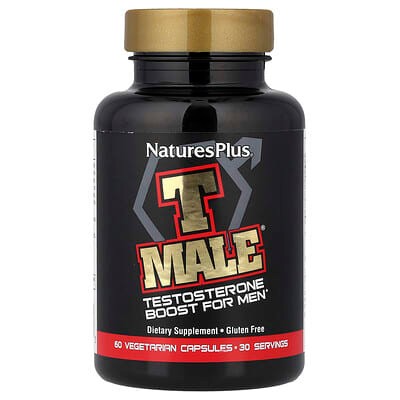
T Male

T Male

NaturesPlus4.4 (981 ratings)
Format:Capsule Quantity: 60 Capsule(s) · 30 servings
Goals

About this product

The testosterone rationale is strongest when low zinc intake is limiting normal hormone function. Zinc at 30 mg uses a clearly identified aspartate source, but more zinc does not establish a hormone increase in adequately nourished adults. FuranoMax fenugreek is not established as equivalent to the specific preparation associated with hormone findings.

The fenugreek serving is 300 mg across several descriptive entries, rather than an established sum of those repeated rows. Marker amounts and extract yield are not established, limiting comparison with other preparations. A separate proprietary nutrient blend leaves its individual components unclear, and the repeated ViNitrox descriptions likewise do not establish additive servings.

Boron is clearly supplied at 5.5 mg as citrate, but its amount does not establish improved bone density or a testosterone effect. The small calcium contribution and limited magnesium coverage make the formula a poor match for filling a substantial mineral gap. Additional strength, hair and everyday vision benefits are not established by these normal nutrient roles.

The full serving cost is relatively high for zinc and boron. Copper content is not established, so mineral balance remains uncertain with ongoing zinc use. The 30 mg zinc serving also needs to be counted alongside food and other supplements when considering the adult 40 mg daily upper limit.

Who is it for
  • Adults seeking a mixed men's nutrient formula who understand that hormone relevance depends mainly on zinc need.
Best for
  • Zinc-focused nutritional support when dietary intake is low and a mixed formula is specifically desired.

Pros

  • The zinc amount and aspartate source are clearly stated.
  • Elemental boron amount and citrate source are identified.
  • The fenugreek extract amount is separately disclosed.

Cons

  • Fenugreek is not established as equivalent to the preparation associated with hormone benefits.
  • Fenugreek marker content and extract yield are not established.
  • The proprietary nutrient blend leaves individual components unclear.
  • Limited calcium and magnesium coverage for substantial mineral gaps.
  • Relatively high serving cost for zinc and boron.

Warnings

  • The 30 mg zinc serving can bring total intake above the adult 40 mg daily upper limit when combined with food or other zinc supplements; account for all sources before stacking products.


Product analysis

54 out of 100

T Male supplies nutrients that support normal immune and metabolic functions, particularly when intake is low. The undisclosed blend contents make its broader men’s-health contribution harder to judge.

AI assessment of the formula, label and price. How scoring works

Nutrient Quality50

Zinc aspartate and boron citrate are favorable, clearly identified forms. The quality of the remaining mixture is less certain, especially where blend contents are not fully specified.

Ingredient Transparency77

Nutrient amounts, blend totals and most forms are stated. Fenugreek form proportions and the full contents of the proprietary blends are not disclosed.

Value For Money37

The full serving cost is relatively high when considered for zinc or boron alone, while fenugreek offers moderate value. The value of the other nutrients remains uncertain.

Customer Satisfaction74

Customer ratings are generally positive across nearly a thousand ratings. The feedback describes satisfaction without establishing effectiveness or safety.

Product Focus34

The clearest role is filling nutrient gaps, with testosterone-related zinc benefits mainly relevant when zinc is low. The fenugreek preparation does not establish the same effects as a different, specifically studied extract.

Format
Capsule
Container
60 Capsule(s)
Per serving
$0.94
Customer rating
4.4 · 981 ratings
Report analysis

Goals

Impact
High effect
B- Ingredient FitC- PathwaysA EvidenceA+ Formulation Logic
Magnesium · 80 mgZinc · 30 mgBoron · 5.5 mg

Zinc can help restore testosterone when zinc deficiency is limiting hormone production; extra zinc does not establish an increase in zinc-replete men. FuranoMax fenugreek is not established as equivalent to the studied Testofen preparation, so its extract amount cannot support the same hormone expectations.

How this product is rated for Testosterone Support

Ingredient fit74

The saved findings recognize the declared nutrients, with broader ingredients and amount differences limiting the formula’s focus.
Goal fit
The formula includes ingredients serving other purposes, reducing its focus on testosterone support.
Dose adequacy
The recognized amounts partly meet the saved comparison; smaller quantities limit the finding without proving ineffectiveness.

Pathways57

The saved route findings describe composition rather than demonstrated changes in circulating testosterone.
Depth
Free-testosterone availability is the strongest saved route; this does not establish SHBG inhibition or a higher free-testosterone level.
Breadth
Only one hormone route reached the coverage criterion, leaving the overall coverage narrow.

Evidence93

The strongest saved ingredient finding remains subject to the population and preparation limits of the supplied human research.
Evidence strength
Zinc leads the saved finding, with practical benefit limited to correcting inadequate zinc status.
Studied preparation
The saved finding recognizes the preparation, without proving a hormone response for routine use.

Formulation logic100

No required partner is missing, and no specified conflict was triggered.
Partner coverage
No required partner is missing for the ingredients recognized in this comparison.
Conflicts
None of the specified conflicts was triggered in the supplied findings.
Effective doses
Every recognized ingredient reaches the minimum amount criterion; that criterion does not establish an effective testosterone-raising dose.
Study evidence
Boron Disputed 3 studies
Fenugreek Supportive 12 studies
Magnesium Disputed 5 studies
Selenium No effect 16 studies
Vitamin E Disputed 3 studies
Zinc Disputed 7 studies
Everyday Health
Impact
Highest effect
B Ingredient FitA+ PathwaysB+ EvidenceA+ Formulation Logic
Magnesium · 80 mgBoron · 5.5 mgSelenium · 35 mcgZinc · 30 mgVitamin C · 60 mg

The B vitamins provide nutrients used in normal metabolism. Zinc and Selenium add further nutritional contributions. These contributions matter when dietary intake is inadequate; additional benefits above adequate intake are not established.

How this product is rated for Everyday Health

Ingredient fit78

The included nutritional ingredients share the formula with ingredients serving other purposes, reducing its general-health focus. Declared amounts provide partial coverage of the saved comparisons; this concerns nutrient availability rather than a proven clinical response.
Goal fit
The included nutritional ingredients share the formula with ingredients serving other purposes, reducing its general-health focus.
Dose adequacy
Declared amounts provide partial coverage of the saved comparisons; this concerns nutrient availability rather than a proven clinical response.

Pathways99

The strongest connection is antioxidant and immune defence. This describes the main supplied functional connection. The findings span several functional areas, indicating broader coverage without establishing added benefit from combining ingredients.
Depth
The strongest connection is antioxidant and immune defence. This describes the main supplied functional connection.
Breadth
The findings span several functional areas, indicating broader coverage without establishing added benefit from combining ingredients.

Evidence82

The saved findings recognize evidence and preparation matches for the included ingredients. Nutritional availability and narrower outcomes do not establish routine broad health improvement.
Evidence strength
Selenium leads the saved evidence comparison; its nutritional or indication-specific evidence does not establish broad benefits above adequate status.
Studied preparation
Included preparations matched the saved comparison, without establishing superiority of delivery or chemical form.

Formulation logic100

Included ingredients had no missing required partners or configured conflicts and reached the saved minimum amount threshold.
Partner coverage
No required partner was missing among the included ingredients; this does not establish synergy.
Conflicts
No configured ingredient conflict was identified in the supplied facts.
Effective doses
All included ingredients reached the saved minimum amount threshold; excluded low amounts are not necessarily nutritionally worthless.
Study evidence
Boron Supportive 6 studies
Magnesium Supportive 114 studies
Selenium Supportive 70 studies
Vitamin C Supportive 56 studies
Zinc Supportive 60 studies
Skin Health
Impact
Moderate effect
C+ Ingredient FitF PathwaysB+ EvidenceA+ Formulation Logic
Zinc · 30 mgVitamin C · 60 mgSelenium · 35 mcgVitamin E · 20 mg

Zinc supports normal skin repair, while vitamin B6 helps meet a nutrient need relevant to healthy skin. Selenium and vitamin E participate in antioxidant defenses, and vitamin C is needed for collagen formation. These normal roles do not guarantee visible improvements when nutrient intake is adequate.

How this product is rated for Skin Health

Ingredient fit66

Skin-related nutrients form part of a broader formula with several other purposes. The assessed amounts largely meet the saved benchmarks.
Goal fit
Skin-related nutrients form part of a broader formula with several other purposes.
Dose adequacy
The assessed amounts largely meet the saved benchmarks.

Pathways8

The strongest assigned contribution is to antioxidant defenses related to UV exposure, with limited coverage in the saved findings. None of the assessed skin processes reaches the saved coverage benchmark.
Depth
The strongest assigned contribution is to antioxidant defenses related to UV exposure, with limited coverage in the saved findings.
Breadth
None of the assessed skin processes reaches the saved coverage benchmark.

Evidence83

The saved findings classify the assessed ingredients at qualifying amounts as studied preparations; that does not guarantee a visible benefit. Confidence also depends on how closely the supplied skin evidence applies to the ingredient and intended user.
Evidence strength
Zinc provides the strongest evidence contribution at an assessed amount in the saved findings. The ingredient’s normal function and the limits of the supplied human evidence still matter when judging practical skin benefits.
Studied preparation
The saved findings classify the assessed ingredients at qualifying amounts as studied preparations; that does not guarantee a visible benefit.

Formulation logic100

The assessed ingredients have no missing required partners or identified conflicts. All ingredients retained in this part of the assessment meet its saved minimum amount benchmark.
Partner coverage
The assessed ingredients can contribute without a missing required partner in the saved findings.
Conflicts
No ingredient conflicts were identified in the supplied assessment.
Effective doses
All ingredients retained in this part of the assessment meet its saved minimum amount benchmark.
Study evidence
Selenium Supportive 22 studies
Vitamin C Supportive 53 studies
Vitamin E Supportive 38 studies
Zinc Supportive 66 studies
Immunity
Impact
Highest effect
C+ Ingredient FitB+ PathwaysA+ EvidenceA+ Formulation Logic
Magnesium · 80 mgVitamin C · 60 mgZinc · 30 mgSelenium · 35 mcg

Zinc, Selenium, Vitamin B6 supply nutrients needed for normal immune-cell function, with usefulness mainly when intake is low. Cold-treatment findings from early, repeated zinc lozenges cannot be transferred to a generic single serving.

How this product is rated for Immunity

Ingredient fit67

Zinc, Selenium, Vitamin B6 provide the main immune-related focus, alongside other actives with less direct relevance. The included amounts make a partial contribution to the saved comparison; smaller or unresolved quantities limit the overall contribution.
Goal fit
Zinc, Selenium, Vitamin B6 provide the main immune-related focus, alongside other actives with less direct relevance.
Dose adequacy
The included amounts make a partial contribution to the saved comparison; smaller or unresolved quantities limit the overall contribution.

Pathways80

The strongest area is lymphocyte function and immune regulation, with substantial coverage from the relevant ingredients.
Depth
The strongest area is lymphocyte function and immune regulation, with substantial coverage from the relevant ingredients.
Breadth
The areas reaching the saved coverage threshold are innate immune cell activity, lymphocyte function and immune regulation.

Evidence100

Zinc leads the saved evidence comparison; its nutritional role does not establish extra infection prevention.
Evidence strength
Zinc leads the saved evidence comparison; its nutritional role does not establish extra infection prevention.
Studied preparation
The eligible preparations match those accepted in the saved findings, without implying superior forms or broader clinical benefits.

Formulation logic100

None of the evaluated ingredient conflicts was triggered. The relevant ingredients can contribute independently or have their required partner present; no extra combined effect is established.
Partner coverage
The relevant ingredients can contribute independently or have their required partner present; no extra combined effect is established.
Conflicts
None of the evaluated ingredient conflicts was triggered.
Effective doses
All included ingredients meet the saved minimum amount comparison; this is not itself a clinically proven effectiveness threshold.
Study evidence
Magnesium Supportive 8 studies
Selenium Mixed 37 studies
Vitamin C Supportive 53 studies
Vitamin E Supportive 21 studies
Zinc Supportive 73 studies
Eye Health
Impact
Moderate effect
D Ingredient FitD PathwaysB+ EvidenceA+ Formulation Logic
Zinc · 30 mgVitamin E · 20 mgVitamin C · 60 mg

Zinc's eye-health use concerns a defined nutrient combination for people with certain stages of age-related macular degeneration, which affects central vision. That doesn't translate into an expectation of better everyday vision from zinc alone. Selenium is also present, but its role in enzymes hasn't translated into a clear cataract-prevention benefit.

How this product is rated for Eye Health

Ingredient fit50

Vitamin C belongs to a targeted nutrient combination for selected macular degeneration patients, rather than a standalone way to improve everyday vision.
Goal fit
Vitamin C belongs to a targeted nutrient combination for selected macular degeneration patients, rather than a standalone way to improve everyday vision.
Dose adequacy
Zinc: 30 mg; Selenium: 35 mcg; Vitamin C: 60 mg. Amounts alone do not predict visual improvement.

Pathways47

The ingredients relate to selected eye functions, with uncertainty about what that means for everyday vision.
Depth
Vitamin C belongs to a targeted nutrient combination for selected macular degeneration patients, rather than a standalone way to improve everyday vision.
Breadth
The ingredient roles address particular aspects of eye function; they do not imply broad improvements in vision.

Evidence84

Vitamin C belongs to a targeted nutrient combination for selected macular degeneration patients, rather than a standalone way to improve everyday vision.
Evidence strength
Vitamin C belongs to a targeted nutrient combination for selected macular degeneration patients, rather than a standalone way to improve everyday vision.
Studied preparation
Ingredient identity alone does not make this serving equivalent to a complete, targeted eye-health nutrient combination.

Formulation logic100

No particular ingredient conflict is identified for this serving.
Partner coverage
No missing required ingredient partner is identified; this does not imply an added benefit from combining ingredients.
Conflicts
No particular ingredient conflict is identified for this serving.
Effective doses
Zinc: 30 mg; Selenium: 35 mcg; Vitamin C: 60 mg. Amounts alone do not predict visual improvement.
Study evidence
Selenium Supportive 15 studies
Vitamin C Disputed 24 studies
Vitamin E Disputed 35 studies
Zinc Supportive 39 studies
Hair Health
Impact
Moderate effect
C Ingredient FitF PathwaysA+ EvidenceA+ Formulation Logic
Zinc · 30 mgVitamin C · 60 mg

Zinc may help diffuse shedding when low zinc is responsible. That expectation doesn't extend to routine regrowth when zinc intake is adequate. Selenium contributes to antioxidant functions, and vitamin C helps normal collagen formation and iron absorption. These are distinct nutrient roles, but they don't show that the combination will reverse thinning from another cause.

How this product is rated for Hair Health

Ingredient fit61

Selenium, Vitamin C, Zinc connects the serving to hair-related nutrition.
Goal fit
Selenium, Vitamin C, Zinc provides a connection to hair biology or nutrient sufficiency.
Dose adequacy
Selenium 35 mcg, Vitamin C 60 mg, Zinc 30 mg per selected serving.

Pathways11

Selenium or vitamin C provides the main connection to antioxidant functions around hair follicles; that role is different from guaranteed regrowth.
Depth
Selenium or vitamin C provides the main connection to antioxidant functions around hair follicles; that role is different from guaranteed regrowth.
Breadth
The connection is concentrated in follicle antioxidant functions.

Evidence98

Zinc's hair relevance has practical limits; an ingredient's normal biological role is not a promise of regrowth.
Evidence strength
Zinc has a relevant hair connection, but the expected benefit depends on the ingredient's limits and the cause of the hair problem.
Studied preparation
The ingredient forms provide relevant context, but matching a form does not guarantee a hair-growth benefit.

Formulation logic100

No missing required partner or particular ingredient conflict is identified. Declared amounts do not by themselves establish a hair-growth effect.
Partner coverage
No missing required ingredient partner is identified for the relevant ingredients.
Conflicts
No particular ingredient conflict is identified.
Effective doses
The relevant declared amounts can be compared with ingredient-specific reference amounts; those comparisons do not guarantee hair benefits.
Study evidence
Selenium Disputed 7 studies
Vitamin E No effect 3 studies
Zinc Supportive 22 studies
Fitness
Impact
Moderate effect
C Ingredient FitF PathwaysD+ EvidenceA+ Formulation Logic
Magnesium · 80 mg

Zinc supports normal nutrition relevant to training, but the supplied evidence does not show extra strength gains in zinc-replete adults. Vitamin C and magnesium contribute to normal body functions, while unresolved rhodiola and amino-acid amounts leave their independent performance value uncertain.

How this product is rated for Fitness

Ingredient fit60

Relevant ingredients sit within a broader formula with several other purposes, limiting its focus on fitness. The assessed amount reaches the saved reference level.
Goal fit
Relevant ingredients sit within a broader formula with several other purposes, limiting its focus on fitness.
Dose adequacy
The assessed amount reaches the saved reference level.

Pathways0

No specific fitness pathway has a positive saved coverage finding. No pathway reaches the saved coverage threshold.
Depth
No specific fitness pathway has a positive saved coverage finding.
Breadth
No pathway reaches the saved coverage threshold.

Evidence53

Zinc supplies the strongest saved evidence finding at the assessed amount; the scope of its actual cognitive evidence still matters. The effective entries are classified as studied preparations in the saved findings.
Evidence strength
Zinc supplies the strongest saved evidence finding at the assessed amount; the scope of its actual cognitive evidence still matters.
Studied preparation
The effective entries are classified as studied preparations in the saved findings.

Formulation logic100

The assessed ingredients can work alone or have their required partner. No configured ingredient conflict was found in the supplied assessment. All assessed ingredients reach the saved minimum amount threshold.
Partner coverage
The assessed ingredients can work alone or have their required partner.
Conflicts
No configured ingredient conflict was found in the supplied assessment.
Effective doses
All assessed ingredients reach the saved minimum amount threshold.
Study evidence
Magnesium Disputed 29 studies
Vitamin C No effect 17 studies
Zinc Supportive 7 studies

Ingredients

IngredientAmount per servingScore
Vitamin C (Ascorbic Acid)
60 mg
Vitamin E (D-Alpha-Tocopheryl Acetate)
20 mg
Vitamin B6 (Pyridoxine Hydrochloride)
2 mg
Calcium (Calcium Citrate)
11 mg
Magnesium (Magnesium Aspartate)
80 mg
Zinc (Zinc Aspartate)
30 mg 65
Selenium (Sodium Selenite)
35 mcg
FuranoMax Fenugreek extract (Fenugreek Furans, Furanostanols, Stanols)
300 mg 63
T MALE Proprietary Nutrient Blend
200 mg
ViNitrox (Apple (Malus pumila) extract, Grape (Vitis vinifera) extract, Polyphenols)
150 mg
Boron (Boron Citrate)
5.5 mg 72
Gluten Free Men 18–50
Report overview
B- Composition And Label DisclosureD+ Commercial Price And Usability
Each serving provides 300 mg of fenugreek extract. The whole-product serving costs about $0.95.
How this ingredient is rated

Composition and Label Disclosure

No additional composition rule was evaluated in this group.

Composition and Label Disclosure70

The available facts record 300 mg of fenugreek extract per serving; a saponin amount or percentage is not specified in those facts.
Amount and Label Disclosure
The available facts record 300 mg of fenugreek extract per serving; a saponin amount or percentage is not specified in those facts.

Commercial Price and Usability50

A whole-product serving costs about $0.95; that price is for the entire serving.
Commercial Price per Labeled Serving
The listed whole-product serving costs about $0.95.
B+ Active Ingredient Quality & BioavailabilityC+ Dose, Safety & Label TransparencyF Value
Each serving provides 30 mg of zinc as zinc aspartate, an amount within the evaluation’s target. The copper amount is unknown, so zinc-to-copper balance cannot be assessed.
How this ingredient is rated

Active Ingredient Quality & Bioavailability80

The listed form is zinc aspartate.
Zinc Form Bioavailability
The listed form is zinc aspartate.

Dose, Safety & Label Transparency67

Each serving contains 30 mg of zinc; the amount and source are stated. The copper amount is unknown, so balance cannot be assessed.
Elemental Dose Transparency
The label states 30 mg of zinc per serving and identifies a source.
Zinc Dosage Safety & Effectiveness
30 mg per serving falls within the evaluation’s target.
Zinc-to-Copper Mineral Balance
The copper amount is unknown, so the zinc-to-copper balance cannot be assessed.

Value30

The whole product costs about $0.95 per serving.
Price Per Serving Efficiency
The whole product costs about $0.95 per serving.
C Active Ingredient Quality & BioavailabilityA+ Dose, Safety & Label TransparencyF Value
Each serving provides 5.5 mg of boron, from boron citrate. The equivalent of 3 mg of boron costs about $0.52 in whole-product servings.
How this ingredient is rated

Active Ingredient Quality & Bioavailability64

Boron Citrate is a named organic boron form. No trademarked boron source or specific purity claim is recorded in the saved facts.
Boron Form & Bioavailability
Boron Citrate is a named organic boron form.
Trademarked & High-Purity Sources
No trademarked boron source or specific purity claim is recorded in the saved facts.

Dose, Safety & Label Transparency100

Each serving provides 5.5 mg of elemental boron. The boron amount is separately identified.
Elemental Dose Transparency
The elemental boron amount is recorded as 5.5 mg per serving.
Dosage Efficacy & Safety Margin
Each serving provides 5.5 mg of elemental boron.

Value30

The equivalent of 3 mg of boron costs about $0.52 in whole-product servings.
Price per 3mg Elemental Boron
The equivalent of 3 mg of boron costs about $0.52 in whole-product servings.
Report alternatives

Sources

Published studies used for the product analysis and the top-ranked studies for each ingredient and goal.

  1. Effects of boron supplementation on the severity and duration of pain in primary dysmenorrhea.
    Nikkhah S; Dolatian M; Naghii MR; Zaeri F; Taheri SM · Complementary therapies in clinical practice · 2015
    Randomized trial113 participantsEveryday Health forBoron
  2. Efficacy and safety of tavaborole topical solution, 5%, a novel boron-based antifungal agent, for the treatment of toenail onychomycosis: Results from 2 randomized phase-III studies.
    Elewski BE; Aly R; Baldwin SL; González Soto RF; Rich P; Weisfeld M; Wiltz H; Zane LT; Pollak R · Journal of the American Academy of Dermatology · 2015
    Randomized trialEveryday Health forBoron
  3. The efficacy and safety of tavaborole, a novel, boron-based pharmaceutical agent: phase 2 studies conducted for the topical treatment of toenail onychomycosis.
    Toledo-Bahena ME; Bucko A; Ocampo-Candiani J; Herz-Ruelas ME; Jones TM; Jarratt MT; Pollak RA; Zane LT · Journal of drugs in dermatology : JDD · 2015
    Clinical trial336 participantsEveryday Health forBoron
  4. Boron neutron capture therapy (BNCT) for glioblastoma multiforme: a phase II study evaluating a prolonged high-dose of boronophenylalanine (BPA).
    Henriksson R; Capala J; Michanek A; Lindahl SA; Salford LG; Franzén L; Blomquist E; Westlin JE; Bergenheim AT; Swedish Brain Tumour Study Group · Radiotherapy and oncology : journal of the European Society for Therapeutic Radiology and Oncology · 2009
    Single-arm trial30 participantsEveryday Health forBoron
  5. Effects of Calcium Fructoborate on Levels of C-Reactive Protein, Total Cholesterol, Low-Density Lipoprotein, Triglycerides, IL-1β, IL-6, and MCP-1: a Double-blind, Placebo-controlled Clinical Study
    Otilia-Constantina Rogoveanu, George Dan Mogosanu, Cornelia Bejenaru, Ludovic Everard Bejenaru, Octavian Croitoru, Johny Neamtu, Zbigniew Pietrzkowski, Tania Reyes-Izquierdo, Andrei Bita, Iulia Daria Scorei, Romulus Ion Scorei · Biological Trace Element Research · 2015
    Randomized trial78 participantsEveryday Health forBoron
  6. Perioperative systemic magnesium to minimize postoperative pain: a meta-analysis of randomized controlled trials.
    De Oliveira GS; Castro-Alves LJ; Khan JH; McCarthy RJ · Anesthesiology · 2013
    Meta-analysis1,257 participants20 studies pooledEveryday Health forMagnesium
  7. Long-term outcome after intravenous magnesium sulphate in suspected acute myocardial infarction: the second Leicester Intravenous Magnesium Intervention Trial (LIMIT-2).
    Woods KL; Fletcher S · Lancet (London, England) · 1994
    Randomized trial2,316 participantsEveryday Health forMagnesium
  8. Association of magnesium sulfate use with mortality in critically ill patients with sepsis: a retrospective propensity score-matched cohort study.
    Gu WJ; Duan XJ; Liu XZ; Cen Y; Tao LY; Lyu J; Yin HY · British journal of anaesthesia · 2023
    Cohort study10,999 participantsEveryday Health forMagnesium
  9. Hypomagnesemia and Mortality in Incident Hemodialysis Patients.
    Li L; Streja E; Rhee CM; Mehrotra R; Soohoo M; Brunelli SM; Kovesdy CP; Kalantar-Zadeh K · American journal of kidney diseases : the official journal of the National Kidney Foundation · 2016
    Cohort study9,359 participantsEveryday Health forMagnesium
  10. The effects of magnesium supplementation on abnormal uterine bleeding, alopecia, quality of life, and acne in women with polycystic ovary syndrome: a randomized clinical trial.
    Jaripur M; Ghasemi-Tehrani H; Askari G; Gholizadeh-Moghaddam M; Clark CCT; Rouhani MH · Reproductive biology and endocrinology : RB&E · 2022
    Randomized trial64 participantsEveryday Health forMagnesium
  11. Associations of selenium status with all-cause and cause-specific mortality: a systematic review and meta-analysis of cohort studies.
    Cui Z; Xie R; Lu X; Schomburg L; Brenner H; Schöttker B · Redox biology · 2025
    Meta-analysis95 participants20 studies pooledEveryday Health forSelenium
  12. Dietary Antioxidants, Circulating Antioxidant Concentrations, Total Antioxidant Capacity, and Risk of All-Cause Mortality: A Systematic Review and Dose-Response Meta-Analysis of Prospective Observational Studies.
    Jayedi A; Rashidy-Pour A; Parohan M; Zargar MS; Shab-Bidar S · Advances in nutrition (Bethesda, Md.) · 2019
    Meta-analysis507,251 participants41 studies pooledEveryday Health forSelenium
  13. The efficacy and safety of selenium supplementation versus placebo in the treatment of Graves' orbitopathy: A systematic review and meta-analysis of randomised controlled trials.
    Sharabati I; Qafesha RM; Hindawi MD; Amro S; Ayesh BM · Clinical endocrinology · 2024
    Meta-analysis4 studies pooledEveryday Health Eye Health forSelenium
  14. Associations of plasma metal concentrations with the risks of all-cause and cardiovascular disease mortality in Chinese adults.
    Shi L; Yuan Y; Xiao Y; Long P; Li W; Yu Y; Liu Y; Liu K; Wang H; Zhou L; Yang H; Li X; He M; Wu T · Environment international · 2021
    Cohort study6,155 participantsEveryday Health forSelenium
  15. Updates on clinical studies of selenium supplementation in radiotherapy.
    Puspitasari IM; Abdulah R; Yamazaki C; Kameo S; Nakano T; Koyama H · Radiation oncology (London, England) · 2015
    Systematic review16 studies pooledEveryday Health forSelenium
  16. Dietary intake and blood concentrations of antioxidants and the risk of cardiovascular disease, total cancer, and all-cause mortality: a systematic review and dose-response meta-analysis of prospective studies.
    Aune D; Keum N; Giovannucci E; Fadnes LT; Boffetta P; Greenwood DC; Tonstad S; Vatten LJ; Riboli E; Norat T · The American journal of clinical nutrition · 2019
    Meta-analysis69 studies pooledEveryday Health forVitamin C
  17. Scientific Opinion on the substantiation of a health claim related to vitamin C and increasing non haem iron absorption pursuant to Article 14 of Regulation (EC) No 1924/2006.
    EFSA Panel on Dietetic Products, Nutrition and Allergies (NDA) · EFSA journal. European Food Safety Authority · 2026
    Guideline / consensusEveryday Health forVitamin C
  18. Vitamin C Depletion and All-Cause Mortality in Renal Transplant Recipients.
    Sotomayor CG; Eisenga MF; Gomes Neto AW; Ozyilmaz A; Gans ROB; Jong WHA; Zelle DM; Berger SP; Gaillard CAJM; Navis GJ; Bakker SJ · Nutrients · 2018
    Cohort study598 participantsEveryday Health forVitamin C
  19. Associations of Serum Biomarkers of Fruit and Vegetable Intake With the Risk of Cause-Specific Mortality and All-Cause Mortality: A National Prospective Cohort Study.
    Pu L; Zhang R; Wang X; Zhao T; Sun H; Han L · Frontiers in nutrition · 2022
    Cohort study12,530 participantsEveryday Health forVitamin C
  20. Relation between plasma ascorbic acid and mortality in men and women in EPIC-Norfolk prospective study: a prospective population study. European Prospective Investigation into Cancer and Nutrition.
    Khaw KT; Bingham S; Welch A; Luben R; Wareham N; Oakes S; Day N · Lancet (London, England) · 2001
    Cohort study19,496 participantsEveryday Health forVitamin C